

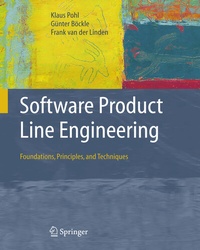
Software Product Line Engineering
Description

More details
Other editions
Additional editions
Persons
Dr. Günter Böckle received a MSc degree in Mathematics from the Technical University Stuttgart in 1973 and a PhD (Dr. rer. nat.) in 1976. He joined Siemens 1977 and has since worked in several departments. His major working areas include modeling, simulation, system assessment and performance validation, processor and bus architecture development, and operating system development. He worked in the USA in a joint product development with a major microprocessor manufacturer. Specializing in parallel systems, he focused on instruction-level parallelism. Since several years he is working in the field of systems engineering, currently with emphasis on requirements engineering. Since 1999 the focus shifted to system family engineering. He published a book on fine-grain parallel systems and had many publications at conferences and workshops, including one in IEEE Computer. The work encompassed also company-internal training courses. He is a member of the German chapter of INCOSE (International Council on Systems Engineering).
Dr. Klaus Pohl is full professor for software systems engineering and director of the Institute for Computer Science and Business Information Systems at the University of Essen, Germany. He holds a degree in computer science (FH Karlsruhe, Germany) and a degree in information systems (Univ. Konstanz, Germany). Klaus Pohl received his PhD and his habilitation in Computer Science from the Technical University of Aachen, Germany. His current research interest include software product lines, requirements management and scenario-based test case derivation.
Current research projects include the European ITEA initiative in software product lines (the CAFÉ project) and various industrial uptake projects with leading Germany companies. Klaus Pohl is (co-)author of over 90 referred publications in the area of requirements and software engineering. He as published a book on Process-Centred Requirments Engineering (RSP/Wiley)and is (co-editor) of more than 15 conference and workshop proceedings. Moreover, he is/was co-editor of several special issues of well-established journals, including "Introduction of Software Product Lines", IEEE Software, 2002.
He is a member of the IFIP working-group 2.9 on software requirements engineering, member of the steering committee of the IEEE Intl. Requirements Engineering Conference (RE), member of the editorial board of the Requirements Engineering Journal and founder and member of the advisory board of the Requirements Engineering: Foundation for Software Quality (REFSQ) workshop series. He is/was program chair of various conferences and workshops including the IEEE Joint Intl. Requirements Engineering Conference (RE '02).
Dr. Frank van der Linden is project leader at Philips Medical Systems, since 1999. Before that time he was researcher at Philips Research Laboratories since 1984. He did his PhD. in Mathematics (Number Theory) at the University of Amsterdam between 1979 and 1984. His main interests are with software engineering and architecture. He was Philips project leader of the ESPRIT project 20.477, ARES (Architectural Reasoning for Embedded Systems) and is project leader of the ITEA projects 99005, ESAPS and ip00004, CAFÉ and the proposed project leader of the succeeding ITEA project ip02009, FAMILIES. He was the programme chair of five International Workshops on Development and Evolution of Software Architectures for System families, respectively in Las Navas in November 1996, Las Palmas in February 1998 and March 2000, Bilbao in October 2001, and Sienna in November 2003. These workshops are organised within ARES, ESAPS and CAFÉ. He is the editor of the proceedings of the second to fourth workshop (Springer LNCS 1429, 1951 and 2290). Moreover he is co-editor of the ARES experience book: Mehdi Jazayeri, Alexander Ran, Frank van der Linden, Software Architecture for System families, Principles andPractice, Addison Wesley, 2000.
