

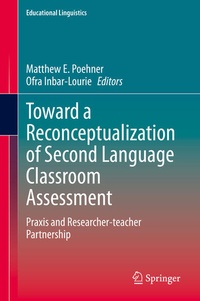
Toward a Reconceptualization of Second Language Classroom Assessment
Description

This book responds to the call for praxis in L2 education by documenting recent and ongoing projects around the world that see partnership with classroom teachers as the essential driver for continuing to develop both classroom assessment practice and conceptual frameworks of assessment in support of teaching and learning. Taken together, these partnerships shape the language assessment literacy, the knowledge and skills required for theorizing and conducting assessment activities, of both practitioners and researchers. While united by their orientation to praxis, the chapters offer considerable diversity with regard to languages taught, learner populations included (varying in age and proficiency level), specific innovations covered, research methods employed, and countries in which the work was conducted. As a whole, the book presents a way of engaging in research with practitioners that is likely to stimulate interest among not only language assessment scholars but also those studying second language education and language teacher education as well as language teaching professionals themselves.
More details
Other editions
Additional editions
Content
An Epistemology of Action for Understanding and Change in L2 Classroom Assessment: The Case for Praxis; Matthew E. Poehner and Ofra Inbar-Lourie.- PART I: REALIZING PRAXIS: EXEMPLARS OF RESEARCHER-TEACHER PARTNERSHIPS.- 'Bringing the Teacher back in': Toward L2 Assessment Praxis in English as an Additional Language Education; Michael Michell and Chris Davison.- Mediation in the Assessment of Language Learning within an Interlingual and Intercultural Orientation: The Role of Reciprocal Interpretation; Angela Scarino.- Trajectories of Language Assessment Literacy in a Teacher-researcher Partnership: Locating Elements of Praxis through Narrative Inquiry; Luke Harding and Tineke Brunfaut.- PART II: RESISTING RESEARCHER-TEACHER HIERARCHIES IN FAVOR OF COOPERATIVE PARTNERSHIPS.- Learning-Oriented Assessment: More than The Chalkface; Constant Leung.- Narrative Inquiry as Praxis: Examining Formative Assessment Practices in a Nature-based Indigenous Language Classroom; Beverly Baker and Joyce Germain.- Learning from Each Other: School-University Collaborative Action Research as Praxis; Cheri Chan and Chris Davison.- PART III: ADDRESSING PROBLEMS OF THEORY AND PRACTICE THROUGH RESEARCHER-TEACHER ENGAGEMENT.- Advancing Written Feedback Practice through a Teacher-Researcher Collaboration in a University Spanish program; Kathryn Hill and Ana Maria Ducasse.- Reconsidering time and process in L2 Dynamic Assessment; Matthew E. Poehner and Rémi A. van Compernolle.- Reconceptualizing Classroom Dynamic Assessment: Lessons from Teacher Practice; Kristin J. Davin and José David Herazo.- PART IV: RESEARCHER-TEACHER ACTION CHALLENGING ASSESSMENT CULTURE.- Addressing the Possibilities and Limitations of Implementing a new Classroom-based Assessment of oral Proficiency; Martin East.- Assessment Literacy as Praxis: Mediating Teacher Knowledge of Assessment-for-learning Practices; Ofra Inbar-Lourie and Tziona Levi.
