

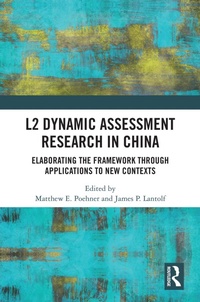
L2 Dynamic Assessment Research in China
Elaborating the Framework through Applications to New Contexts
Published on 24. June 2025
154 pages
978-1-040-39611-7 (ISBN)
Description

Dynamic Assessment is an innovative approach to revealing the full range of learner abilities that has rapidly gained attention from language educators and researchers. While much of the research to date has examined Dynamic Assessment in Western countries, the research in this book further extends the framework by documenting its uses by Chinese scholars in meeting context-specific challenges.
Dynamic Assessment, or DA, originated in the writings of Russian psychologist L. S. Vygotsky concerning the concept of the Zone of Proximal Development. While many assessment approaches call for closer integration with teaching, DA embeds an instructional component, referred to as mediation, as part of the assessment procedure. Following Vygotsky, the picture of a person's abilities is incomplete if focus is restricted to past development as diagnosed by what the person can achieve independently and without considering those abilities that are emerging as revealed through responsiveness to mediation. In this way, DA offers insights into learner abilities not easily obtained through other assessments. Widely employed in special education and general abilities testing, the second language field has witnessed a rapid growth of interest in using DA to better understand the full range of learner language abilities and to determine how instruction can optimally promote the development of all learners. This book brings together a collection of original studies conducted by scholars in China that build upon methods and principles from previous DA research and that leverage them to meet local demands. In so doing, this research collectively illustrates the extension of DA into new cultural contexts while simultaneously yielding findings that are sure to resonate with language educators, assessors, and researchers around the world.
This book was originally published as a special issue of Language Assessment Quarterly.
Dynamic Assessment, or DA, originated in the writings of Russian psychologist L. S. Vygotsky concerning the concept of the Zone of Proximal Development. While many assessment approaches call for closer integration with teaching, DA embeds an instructional component, referred to as mediation, as part of the assessment procedure. Following Vygotsky, the picture of a person's abilities is incomplete if focus is restricted to past development as diagnosed by what the person can achieve independently and without considering those abilities that are emerging as revealed through responsiveness to mediation. In this way, DA offers insights into learner abilities not easily obtained through other assessments. Widely employed in special education and general abilities testing, the second language field has witnessed a rapid growth of interest in using DA to better understand the full range of learner language abilities and to determine how instruction can optimally promote the development of all learners. This book brings together a collection of original studies conducted by scholars in China that build upon methods and principles from previous DA research and that leverage them to meet local demands. In so doing, this research collectively illustrates the extension of DA into new cultural contexts while simultaneously yielding findings that are sure to resonate with language educators, assessors, and researchers around the world.
This book was originally published as a special issue of Language Assessment Quarterly.
More details
Language
English
Place of publication
London
United Kingdom
Publishing group
Taylor & Francis Ltd
Target group
College/higher education
File size
9,27 MB
ISBN-13
978-1-040-39611-7 (9781040396117)
Copyright in bibliographic data and cover images is held by Nielsen Book Services Limited or by the publishers or by their respective licensors: all rights reserved.
Schweitzer Classification
Other editions
Additional editions
Matthew E. Poehner | James P. Lantolf
L2 Dynamic Assessment Research in China
Elaborating the Framework through Applications to New Contexts
Book
06/2025
1st Edition
Routledge
€206.20
Shipment within 15-20 days
Persons
Matthew E. Poehner is Professor of Applied Linguistics and Education at The Pennsylvania State University, USA.
James P. Lantolf is Greer Professor of Language Acquisition and Applied Linguistics, Emeritus at The Pennsylvania State University, USA.
James P. Lantolf is Greer Professor of Language Acquisition and Applied Linguistics, Emeritus at The Pennsylvania State University, USA.
Content
Introduction: Advancing L2 Dynamic Assessment: Innovations in Chinese contexts 1. Enhancing EFL learners' reading proficiency through Dynamic Assessment 2. An interventionist Dynamic Assessment approach to college English writing in China 3. Promoting learning potential among students of L2 Chinese through Dynamic Assessment 4. Fostering self-regulated young writers: Dynamic Assessment of metacognitive competence in a secondary school EFL class 5. A study on peer mediation in Dynamic Assessment of translation revision competence 6. Dynamic Assessment of the learning potential of Chinese as a second language
