

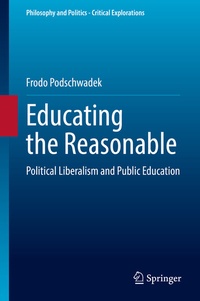
Educating the Reasonable
Description

Offering the first developed account of political liberal education, this book combines a thorough analysis of the theoretical groundwork of political liberal education with application-oriented approaches to contemporary educational challenges. Following in depth engagement with the shortcomings of Rawls' theory and addressing some key objections to neutrality-based restrictions in education, the volume moves on to provide an insightful discussion of topics such as same-sex relations in sex-education, the position of migrant children and the rights of religious parents to determine the education of their children. This book outlines a political liberal account of education which provides a useful contribution to the current debates about liberalism and education in a way unprecedented in the literature on political liberalism so far. It is of interest to anyone working at the intersection of political philosophy and philosophy of education as well as for scholars with abroader interest in how liberalism can respond to the challenges of value pluralism.
More details
Other editions
Additional editions
Person
Frodo Podschwadek studied philosophy at the University of Hamburg and the University of Glasgow. His research focuses on applied political philosophy, with a strong focus on liberalism and democracy and their intersection with areas like education, media ethics, and the normative challenges of new technologies. Further research interests include applied ethics and moral philosophy, as well as the philosophy of artificial intelligence. After having published articles on the moral capacities of artificial agents and the relation between media competence education and political autonomy, he is currently working on questions regarding migration and citizenship.
Content
Chapter 1. Introduction.- Part 1: Central Elements of Political Liberalism: Chapter 2. Rawlsian Education: Preliminary Observations.- Chapter 3. Political Virtues.- Chapter 4. Autonomy.- Chapter 5. Rights.- Part 2: Application Cases: Chapter 6. Religion.- Chapter 7. Same-Sex Relations in Education.- Chapter 8. Immigration and Integration.- Chapter 9. Conclusion.
