

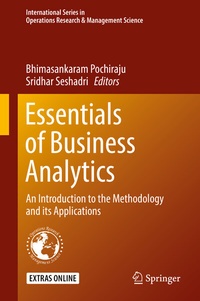
Essentials of Business Analytics
Description

This comprehensive edited volume is the first of its kind, designed to serve as a textbook for long-duration business analytics programs. It can also be used as a guide to the field by practitioners. The book has contributions from experts in top universities and industry. The editors have taken extreme care to ensure continuity across the chapters.
The material is organized into three parts: A) Tools, B) Models and C) Applications. In Part A, the tools used by business analysts are described in detail. In Part B, these tools are applied to construct models used to solve business problems. Part C contains detailed applications in various functional areas of business and several case studies. Supporting material can be found in the appendices that develop the pre-requisites for the main text.
Every chapter has a business orientation. Typically, each chapter begins with the description of business problems that are transformed into data questions; and methodology is developed to solve these questions. Data analysis is conducted using widely used software, the output and results are clearly explained at each stage of development. These are finally transformed into a business solution. The companion website provides examples, data sets and sample code for each chapter.
More details
Other editions
Additional editions
Persons
Bhimasankaram Pochiraju obtained his Ph.D. in Statistics from the Indian Statistical Institute. He was the Clinical Professor of Statistics, Executive Director of Applied Statistics and Computing Lab and Faculty Director, Certificate Programme in Business Analytics at the Indian School of Business. He was formerly Professor of Statistics and Head, SQC & OR Division at the Indian Statistical Institute. He co-authored a text book and a research monograph in Linear Algebra. His areas of research interest include Analytics, Causal Inference and Linear Algebra.
Sridhar Seshadri
obtained his PhD at the University of California, Berkeley after graduating from the Indian Institute of Technology, Madras, India and the Indian Institute of Management, Ahmedabad, India. He is currently Professor and Area Leader of IS, Operations Management and Supply Chain Management areas at the Geis College of Business. He has also been a faculty member at The Indian School of Business, The University of Texas at Austin, New York University and the Administrative Staff College of India. During his teaching career, he was awarded the Stern School of Business Teaching Excellence Award (1998) and recognized as the Stern School of Business Undergraduate Teacher of the Year in 1997. His current research includes Analytics, Pricing and Revenue Optimization and Risk Management in supply chains.
Content
Chapter 1. Introduction.- Chapter 2. Data Collection.- Chapter 3. Data Management - Relational Database Systems (RDBMS).- Chapter 4. Big Data Management.- Chapter 5. Data Visualization.- Chapter 6. Statistical Methods-Basic inferences.- Chapter 7. Statistical Methods-Regression.- Chapter 8. Advanced Regression Analysis.- Chapter 9. Text Analytics.- Chapter 10. Simulation.- Chapter 11. Introduction to Optimization.- Chapter 12. Forecasting Analytics.- Chapter 13. Count Data Regression.- Chapter 14. Survival Analysis.- Chapter 15. Machine Learning (Unsupervised).- Chapter 16. Machine Learning (Supervised).- Chapter 17. Deep Learning.- Chapter 18. Retail Analytics.- Chapter 19. Marketing Analytics.- Chapter 20. Financial Analytics.- Chapter 21. Social Media and Web Analytics.- Chapter 22. Healthcare Analytics.- Chapter 23. Pricing Analytics.- Chapter 24. Supply Chain Analytics.- Chapter 25. Case study: Ideal Insurance.- Chapter 26. Case study: AAA Airline.- Chapter 27. Case study: Informedia Solutions.- Chapter 28. Appendix 1: Introduction to R.- Chapter 29. Appendix 2: Introduction to Python.- Chapter 30. Appendix 3: Probability and Statistics.-
