

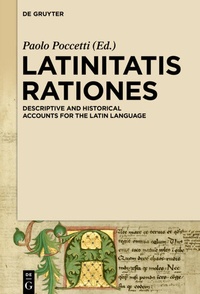
Latinitatis rationes
Descriptive and Historical Accounts for the Latin Language
1st Edition
Published on 5. December 2016
XIV, 941 pages
978-3-11-043189-6 (ISBN)
Description

This volume assembles 50 contributions presented at the XVII International Colloquium on Latin Linguistics. They embrace essential topics of Latin linguistics with different theoretical and methodological approaches: phonetics, syntax, etymology and semantics, pragmatics and textual analysis. It is a useful resource for the study of comparative and general linguistics, not only for linguists but also for scholars of classical philology.
More details
Language
English
French
Italian
Place of publication
Berlin/Boston
Germany
Target group
Professional and scholarly
US School Grade: College Graduate Student
Illustrations
2 farbige Abbildungen, 31 s/w Abbildungen
31 b/w and 2 col. ill.
File size
7,16 MB
ISBN-13
978-3-11-043189-6 (9783110431896)
Schweitzer Classification
Other editions
Additional editions
E-Book
12/2016
1st Edition
De Gruyter
€210.00
Available for download
Book
12/2016
1st Edition
De Gruyter
€229.00
Article exhausted; check different version
Book
12/2016
1st Edition
De Gruyter
€210.00
Shipment within 7-9 days
Person
Paolo Poccetti, Università di Roma 2 'Tor Vergata', Rome, Italy.
Content
- Intro
- Introduction
- Contents
- I. Phonetics and morphology
- 1 The frequency of syncope in the Latin of the empire: a statistical and dialectological study based on the analysis of inscriptions
- 2 Remarks on the type faxo/faxim
- 3 Lat. quin(c)tus, sa n(c)tus e l'allungamento vocalico davanti a -nct-
- 4 On the morpheme - submorpheme continuum in Latin pronoun families
- 5 Metrical words and accent in late Latin prose rhythm
- 6 L'anaptissi in latino: analisi del corpus plautino
- 7 Le nominalizzazioni agentive in -tor
- 8 Il ritmo trocaico come determinante fonologico: legame commune tra latino, gallico e italiano
- 9 A cognitive-functional study of the prefix circum-: some non-prototypical cases
- II Syntax
- 10 Argument structure and satellite-framedness in Latin: evidence from Unselected Object Constructions
- 11 From Hittite to Latin: S. C. de Cn. Pisone patre (III)
- 12 Considerazioni sul fenomeno dell'ellissi verbale
- 13 Infinitif et narration: analyse dans deux romans latins
- 14 Osservazioni sull'ordine degli aggettivi latini
- 15 Le système des déterminants et la place virtuelle de l'article en latin
- 16 The position of weak pronouns in Latin prose
- 17 Auxiliaries within comparative clauses: some remarks concerning their syntax and grammatical description
- III Lexicon and semantics
- 18 Composizione verbale in latino: il caso dei verbi in -facio, -fico
- 19 Il ruolo della prefissazione nel mutamento semantico: il caso dei composti di legere
- 20 Lexical domains in Latin predicative structures: 'agentive', fientive and stative types
- 21 Expresión de la noción de 'sustituir' y 'sustitución' en latín
- 22 Per alta silentia: sinestesie tra i versi
- 23 La spécialisation des verbes préfixés dans le lexique culinaire d'Apicius
- 24 Les quantificateurs latins omnis et omnes: origine et grammaticalisation
- 25 The use of the term 'metaphor' in Latin linguistic discourse before Quintilian
- 26 Nuovi percorsi oltre il ciclo di Jespersen: l'apporto del latino
- 27 Concretezza ed astrattezza nella terminologia giuridica romana: la fiducia
- 28 Le feu de la colère en latin: une métaphore basée sur la température
- 29 El lugar de la autonimia en la gramática del latín
- IV Etymology
- 30 Spigolature etimologiche: arbiter, custos
- 31 Patrimonium e matrimonium: un'ipotesi interpretativa
- 32 Cuniculus, testiculus y mentula. Etimología y razón metafórica
- 33 Sobre la etimología del verbo iuuare
- 34 Per l'etimologia di pratum
- 35 Latin -d-verbal bases (claudo, mando, plaudo .): an etymological analysis
- V Linguistic analysis of corpora
- 36 Formes et fonctions des énoncés autonymiques gréco-latins dans les Nuits attiques d'Aulu-Gelle
- 37 L'ordre des constituants en poesie: verbe initial chez Ovide
- 38 Le notae sententiarum e altre figurae nell'Enchiridion di Byrhtferth: metalinguaggio delle "scritture brevi" tra fonte classica e traduzione anglosassone
- 39 Subjonctif latin et optatif grec chez Priscien
- 40 Remarks on temporal clauses and participial phrases in late historical texts
- 41 Plaut. y Ter. absqve te foret/esset: -qve y modalidad
- 42 A statistical investigation into the corpus of Seneca
- 43 Orosius friend of Augustine: the use of Latin vocabulary in Orosius' work and Augustine's practice
- 44 Sulla nomenclatura grammaticale e retorica della funzione avverbiale negli scolii di Lattanzio Placido
- 45 La place des génitifs chez Vitruve et Pline l'Ancien
- 46 Changements phonétiques et syntaxiques: traces des formes propres au latin vulgaire dans la chronique de Benoît de Saint André
- 47 Common ground in Latin discourse: two case studies of narrative negation in Cicero and Vergil
- 48 Principi descrittivi ed esplicativi nel De lingua latina di Varrone
- VI Typology, pragmatics and text linguistics
- 49 Sic habeto: the functions of -to imperatives in legal Latin and beyond
- 50 Gender in Latin and in language typology
- 51 Argumentation and Latin linguistics
- 52 On the distinction between ego énonciateur and ego énoncé in firstperson texts: iste as a manifestation of the ego énonciateur
- 53 Marcatezza, marcatezza locale e diasistema. Alcune riflessioni in merito ad apparenti eccezioni tipologiche
- 54 Linguistic features of peaks in Latin narrative texts
- 55 Latin causativization in typological perspective
