

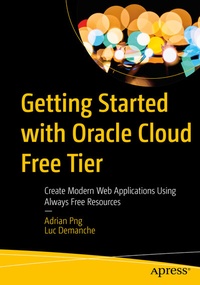
Getting Started with Oracle Cloud Free Tier
Description

Examples in this book introduce the broad suite of Always Free options that are available from Oracle Cloud Infrastructure. You will learn how to provision autonomous databases and autonomous Linux compute nodes. And you will see how to use Terraform to manage infrastructure as code. You also will learn about the virtual cloud network and application deployment, including how to create and deploy public-facing Oracle Application Express solutions and three-tier web applications on a foundation of Oracle REST Data Services. The book also includes a brief introduction to using and managing access to Oracle Machine Learning Notebooks.
Cloud computing is a strong industry trend. Mastering the content in this book leaves you well-positioned to make the transition into providing and supporting cloud-based applications and databases. You will have the knowledge and skills that you need to deploy modest applications along with a growing understanding of Oracle's Cloud platform that will serve you well as you go beyond the limits of the Always Free options and take full advantage of all that Oracle Cloud Infrastructure can offer.
What You Will Learn
- Know which resources are available for free forever from Oracle Cloud Infrastructure
- Provision your virtual cloud network
- Host, manage, and monitor web applications using the freely available components
- Provision and manage Autonomous Databases and Autonomous Linux Compute Nodes
- Use and manage access to Oracle Machine Learning Notebooks
- Automate and manage your infrastructure as code using Terraform
- Monitor and manage costs when you grow beyond the Always Free platform
Who This Book Is For
Database administrators and application developers who want to learn about Oracle's cloud offerings, application developers seeking a robust platform on which to build and deploy modest applications at zero cost, and developers and administrators interested in exploring Oracle Application Express running on a self-managing, self-tuning Oracle Database
More details
Other editions
Additional editions
Persons
Luc Demanche is an Oracle DBA with 20 years of experience. His high-level expertise recently earned him the distinctions of Oracle Cloud Infrastructure 2018 Certified Architect, Oracle Autonomous Database Cloud 2019 Specialist, and Oracle Certified Professional 12c. His passion for the discipline has also led him to share his knowledge through a 2016 IOUG-published book titled Oracle Application Express Administration , which he co-authored with his colleague Francis Mignault, CTO at Insum. Luc specializes in Oracle databases from 7.3 to 19c and is particularly knowledgeable about the numerous Oracle tools used on his projects. He is heavily involved in building the Oracle Cloud team at Insum and has several successfully completed cloud projects to his credit.
Content
Introduction.- Part I. Getting Started.- 1. Create an Account.- 2. Identity and Access Management.- Part II. Infrastructure and Operations.- 3. Basic Networking.- 4. Compute Instances.- 5. Storage.- 6. Oracle Autonomous Linux.- 7. Autonomous Databases.- 8. Load Balancers.- 9. Notifications and Monitoring.- Part III. Applications.- 10. SQL Developer Web.- 11. Oracle Application Express.- 12. Oracle REST Data Services.- 13. Deploy Multitiered Web Applications.- 14. Oracle Machine Learning Notebooks.- Part IV. Next Steps.- 15. Infrastructure as Code.- 16. Account Management.
