

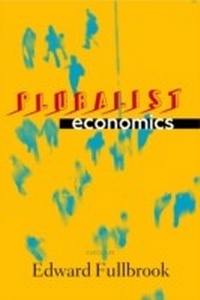
Pluralist Economics
Zed Books Ltd (Publisher)
1st Edition
Published on 15. May 2009
254 pages
978-1-84813-372-3 (ISBN)
Description

This book is an authoritative and accessible guide to the pluralist movement threatening to revolutionise mainstream economics. Leading figures in the field explain why pluralism is a required virtue in economics, how it came to be blocked and what it means for the way we think about, research and teach economics.
The first part of the book looks at how neoclassical economics gained its stranglehold, particularly in the United States, and how the social and intellectual underpinnings of economics have enabled it to maintain this in the face of inconsistent evidence from the real world. This is then contrasted with different approaches to pluralism. Pluralist Economics then goes on to address the array of arguments for establishing pluralism, showing how economics came to function as a concealed ideology and not as a science, and how value-free economics is an illusion. Finally, it addresses the practical problems presented by this different way of doing economics.
The first part of the book looks at how neoclassical economics gained its stranglehold, particularly in the United States, and how the social and intellectual underpinnings of economics have enabled it to maintain this in the face of inconsistent evidence from the real world. This is then contrasted with different approaches to pluralism. Pluralist Economics then goes on to address the array of arguments for establishing pluralism, showing how economics came to function as a concealed ideology and not as a science, and how value-free economics is an illusion. Finally, it addresses the practical problems presented by this different way of doing economics.
Reviews / Votes
Edward Fullbrook's exceptional volume aims to challenge and counter the cavalier way mainstream economists dismiss theories and perspectives other than their own as "nonscience". Pluralism is long overdue in economics, and this is the best single introduction to what it means for the way we think about and use economics in the real world. * David F. Ruccio, University of Notre Dame * Edward Fullbrook and his coauthors present the case for an eclectic, diverse, tolerant and relevant alternative. They show with special clarity how pluralism actually works in other disciplines, notably physics, and the value of metaphor and narrative in making arguments in social science persuasive. * James K. Galbraith, University of Texas at Austin * Edward Fullbrook has done it again, with an excellent and timely collection on an especially pertinent topic. This is an exceptionally insightful and thought-provoking book featuring work from significant contributors to modern heterodox economics. * Tony Lawson, University of Cambridge *More details
Edition
1. Auflage
Language
English
Place of publication
London
United Kingdom
Publishing group
Bloomsbury Publishing PLC
Target group
College/higher education
Professional and scholarly
ISBN-13
978-1-84813-372-3 (9781848133723)
Copyright in bibliographic data and cover images is held by Nielsen Book Services Limited or by the publishers or by their respective licensors: all rights reserved.
Schweitzer Classification
Other editions
Additional editions
Persons
Edward Fullbrook is the founder and editor of The Real World Economics Review (formerly the Post-Autistic Economics Review) and webmaster of www.paecon.net. He is a research fellow in the School of Economics at the University of the West of England. He is the author of Sex and Philosophy: Rethinking de Beauvoir and Sartre (2008).
Content
Notes on Contributors
Introduction - Edward Fullbrook
Part I: What is Pluralism?
1. Neoclassical Economics: Three Identifying Features - Christian Arnsperger and Yanis Varoufakis
2. Pluralism, Formalism and American Economics - Harry Landreth and David Colander
3. The Construction of Economics - Kyle Siler
4. Paradigms and Pluralism - Robert F. Garnett, Jr.
Part II: Arguments for Pluralism
5. Narrative Pluralism - Edward Fullbrook
6. Three Arguments for Pluralism - J. E. King
7. Economics as Ideology - Peter Soederbaum
8. Metaphor and Pluralism - Geoffrey Hodgson
9. Explanatory Pluralism - Jeroen van Bouwel
Part III: Pluralist Practice in Economics
10. Beyond Talking the Talk - Andrew Kliman and Alan Freeman
11. In the Economics Classroom - Peter Earl
12. Some Practical Aspects - Thomas Mayer
13. Islamic Economics: A Case Study - Mohamed Aslam Haneef
Notes
References
Index
Introduction - Edward Fullbrook
Part I: What is Pluralism?
1. Neoclassical Economics: Three Identifying Features - Christian Arnsperger and Yanis Varoufakis
2. Pluralism, Formalism and American Economics - Harry Landreth and David Colander
3. The Construction of Economics - Kyle Siler
4. Paradigms and Pluralism - Robert F. Garnett, Jr.
Part II: Arguments for Pluralism
5. Narrative Pluralism - Edward Fullbrook
6. Three Arguments for Pluralism - J. E. King
7. Economics as Ideology - Peter Soederbaum
8. Metaphor and Pluralism - Geoffrey Hodgson
9. Explanatory Pluralism - Jeroen van Bouwel
Part III: Pluralist Practice in Economics
10. Beyond Talking the Talk - Andrew Kliman and Alan Freeman
11. In the Economics Classroom - Peter Earl
12. Some Practical Aspects - Thomas Mayer
13. Islamic Economics: A Case Study - Mohamed Aslam Haneef
Notes
References
Index
