

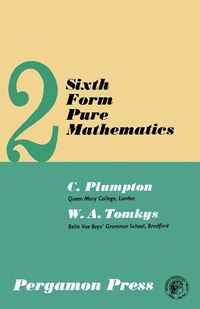
Sixth Form Pure Mathematics
Volume 2
1st Edition
Published on 15. May 2014
416 pages
978-1-4831-4088-9 (ISBN)
Description

Sixth Form Pure Mathematics, Volume 2, provides an introduction to inverse trigonometric functions, hyperbolic and inverse hyperbolic functions, and a range of mathematical methods including the use of determinants, the manipulation of inequalities, the solution of easy differential equations, and the use of approximate numerical methods. Complex numbers are defined and the various ways of representing and manipulating them are considered. Polar coordinates, curvature, an elementary study of lengths of curves and areas of surfaces of revolution, a more mature discussion of two-dimensional coordinate geometry than was possible in Volume 1, and an elementary introduction to the methods of three dimensional coordinate geometry comprise the geometrical content of the book. Throughout, the authors have tried to preserve the concentric style which they used in Volume 1 and the many worked examples and exercises in each chapter are designed or chosen to provide a continuous reminder of the work of the preceding chapters. Except for Pure Geometry, the two volumes cover almost all of the syllabuses for Advanced Pure Mathematics of the nine Examining Boards. This book provides an adequate course for mathematical pupils at Grammar Schools and a useful introductory course for Science and Engineering students in their first year at University or Technical College or engaged in private study.
More details
Other editions
New editions
E-Book
05/2014
2nd Edition
Elsevier
€54.95
Available for download
Additional editions

Charles Plumpton | William Arthur Tomkys
Sixth Form Pure Mathematics: v. 2
Book
12/1963
Pergamon
€11.45
Article exhausted; check different version
Content
Chapter XI Linear Equations and Determinants The Solution of Linear Simultaneous Equations in Two Unknowns Second Order Determinants Rules of Manipulation for Second Order Determinants Third Order Determinants Factorization of Determinants Geometrical Interpretation. The Equation of a Straight Line through Two Given Points The Equation of a Tangent to the Curve The Equation of a Line-Pair The Equation of a Circle through Three Given Points The Area of a Triangle The Solution of Simultaneous Equations Summary The Product of Two Determinants The Derivative of a DeterminantChapter XII Inverse Circular Functions, Hyperbolic Functions and Inverse Hyperbolic Functions Inverse Circular Functions. The Derivatives of the Inverse Circular Functions Standard Integrals The Hyperbolic Functions Inverse Hyperbolic Functions Derivatives of the Inverse Hyperbolic Functions Logarithmic Forms of the Inverse Hyperbolic Functions Methods of Integration The Integrals Summary of Standard Integrals and Methods of Integration So Far ConsideredChapter XIII Definite Integrals. Further Applications of Integration Properties of Definite Integrals Infinite Integrals Reduction Formula Approximate Numerical Integration Mean Values and Root Mean Square Center of Mass The Theorem of Pappus concerning Volumes Moments of InertiaChapter XIV Some Properties of Curves Points of Inflexion The Length of a Curve The Cycloid Areas of Surfaces of Revolution The Theorem of Pappus concerning Surfaces of Revolution Curvature Newton's Formula for Radius of Curvature at the OriginChapter XV Polar Coordinates Definitions Loci in Polar Coordinates Curve Sketching in Polar Coordinates The Lengths of Chords of Polar Curves Which are Drawn through The Pole Transformations from Polar to Cartesian Equations and the Reverse Process Areas in Polar Coordinates The Length of an Arc in Polar Coordinates Volumes of Revolution and Areas of Surfaces of Revolution in Polar Coordinates The Angle between the Tangent and the Radius Vector The Tangential Polar Equation-CurvatureChapter XVI Complex Numbers The Number System Definition of Complex Number The Cube Roots of Unity Conjugate Pairs of Complex Roots The Geometry of Complex Numbers The Polar Coordinate Form of a Complex Number- Modulus and Argument Products and Quotients De Moivre's Theorem The Exponential Form of a Complex Number Exponential Values of Sine and CosineChapter XVII Differential Equations Formation of Differential Equations The Solution of a Differential Equation First Order Differential Equations with Variables Separable Homogeneous Equations The Law of Natural Growth Linear Equations of the First Order Bernoulli's Equation Equations of Higher Orders Linear Equations of the Second Order with Constant Coefficients The Complementary Function.
