

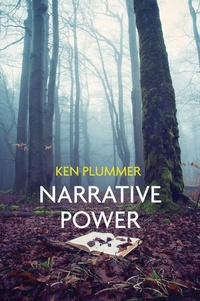
Narrative Power
Description

More details
Other editions
Additional editions
Content
OVERTURE: In the Beginning
1 Narratives of Suffering: Six Stories in Search of a Better World
ACT I Setting Scenes: Narrative Power as a Way of Seeing
2 Narrative Actions of Power
3 Narrative Power as a Struggle for Human Value
ACT 2 Locating Tensions: The Fragility of Narrative
4 Narrative Inequalities
5 Narrative Digitalism
6 Narrative States
7 Narrative Wisdom
8 Narrative Contingencies
ACT 3 Moving On: Acts of Narrative Hope
9 Caring for Narrative Futures: Towards a Politics of Narrative Humanity
Notes
References
Index
Prologue: Going Backstage
Once upon a time, there was the story. Like you, I have lived all my life with stories. It is an almost universally recognized fact that what makes our humanity distinct from other life on Planet Earth is our ability to tell and listen to stories. What is less universally recognized is that we are also thinkers about the power of our stories: we do not just tell and listen, we also reflect upon them and act with them. Stories help us to imagine, animate and value human life. We live our lives between stories of imagination and stories of reality: call this, if you like, the reality puzzle. This book provides some further ways to reflect on these flowing stories: I ask how power shapes stories, how stories shape power and how understanding the way all this works might help move us towards better worlds for all.
From the slow evolution of the face-to-face local oral cultures of antiquity to our currently dazzling moments of global digitalism that convulse us with rapidly fragmenting, fast-speed, niched networked tweets, we have always been the animal living with narrative power. We dwell across the globe in a vast multitude of complex interconnecting reflective storied social worlds. Our narratives are continually born, sparkle, flicker, silence and die; some get remembered. Our everyday lives are influenced, shaped and even coerced, by the storied actions of others. They become saturated in everyday political relations. And this is a basic puzzle: just how do we human beings come to dwell within this story-power dialogue, and what does it do to humane governance and us?
A life in stories
I guess I started being interested in narrative power when I was about 15. As an unread working-class teenage boy and young man born in Wood Green, London, I struggled for a few years with the possibility of being homosexual. This was England in the early 1960s and homosexuality was stigmatized as sin, sickness, crime and tragedy. (It still is today in much of the world.) Everywhere I turned, I heard stories and saw images that suggested my being was a problem and I was doomed for a tragic existence. My life became a dialogue with queer stories. Watching the film Victim in 1961 displayed this only too clearly. Here was the story of a life of queer-bashing, blackmail, therapy, prison, darkness, sorrow and ultimately suicide. If I was to believe this dominant powerful narrative of the day, could this well be my own pathetic life story? Maybe. If I had been born any earlier, this may have been my fate, as it certainly was for a great many. But I was also a child of the countercultural 1960s and challenging counter-narratives were in the making. Among these was the emerging powerful, positive story of Gay Pride and Gay Rights: 'Sing if you're glad to be gay, sing if you are happy that way.' A few lawyers were beginning to tell new stories to change the law; some psychiatrists were reworking their scripts of sickness into health; and a new language and culture of stories was starting to be told that gave us new visions. A new narrative, and imagery, were in the making and I was living them: the 'Coming Out as Gay or Lesbian' story became a growing genre of writing and film and eventually appeared in many countries across the world. Slowly, new possibilities were being sensed. I seized the moment, as we say, and started to refashion my little youthful life and world through these new tales. My life was not to be downtrodden: I was not going to live in the closet; I was going to make sure I could lead a life where I could be an out gay man. And this is more or less what happened, and very quickly. The old story was discarded, the new one shaped and adopted. The counter-stories of social movements changed my life. But I also learnt that stories are never finished - there is a kaleidoscope of sensibilities around them, and they will keep moving on.1
Retrospectively, I can see unfolding in all of this a major genre of storytelling, which has sculptured many little lives and big political moments: a self-fulfilling narrative. Stories become grounded in everyday life, have consequences, shape outcomes, change lives and sometimes become self-amplifying: telling the story helps bring about what it tells. This means we had better be careful what stories we tell. I was lucky to find new stories in the making: the old ones would have made my life very unhappy. I slowly learnt that stories have a history, and their right moment matters a great deal.
And, indeed, since the mid-1970s, I have spent a life academically engaged with stories. Initially examining a wide range of stories about the sexually diverse, I argued for the significance of narrative and story research as a powerful method for the social sciences (in my first publications 'Doing Life Histories' (Faraday and Plummer, 1979) and Documents of Life (Plummer, [1983] 2001)). Over the subsequent years, I have increasingly tried to develop an approach that is less concerned with literary narrative and more with the sociological, ethical and political importance of storytelling and listening: there is an ecology of narratives in which stories are assembled, understood, given value and lived through our actions in the world. This was most clearly set out in my book Telling Sexual Stories (Plummer, 1995), which offered a sociology of stories and then applied it to the field of sexualities.
And so it seems that I have been living with narrative power all my life, even if I did not quite realize it at the time; and it has now become the prime focus of this study. This new book has been simmering within me for many years. My question, simply put, is: How does narrative shape power and how does power shape narrative? My focus is on power-narrative interaction, a dialogue in which each feeds on the other, is emergent and generates change. I ultimately look to a world where narrative acts and narrative power make for better worlds. As they have for me.
Both narrative and power have existed everywhere since the beginning of human time. They are ubiquitous, and at the start of the twenty-first century there is an explosion of new forms. As I was writing this book, there was never a day when issues of narrative power were not prominent: Trump's 'fake media', the Brexit divide, terrorist stories, 'Putin', the clash over the environment, the refugee crisis, Syria, Yemen, the dangers of the digital world of tweets and surveillance, the emergence of the story of 'Trans', the sexual harassment stories of #MeToo and Weinstein, Hollywood and the UK Parliament. As each of them flagged a significant narrative crisis or muddle, I wondered whether there had there been any progress in our narrative understanding and skills since Aristotle's famous discussion of rhetoric and poetics (Aristotle, 1991, 1996). They provided little hope that a civilized, caring modern narrative world was at work here. And yet, at the same time, every day I exchanged good stories with people of all kinds, watched videos, read books, visited art galleries, went to the theatre, listened to music and experienced the omnipresent joy of narratives at their best.
Taking a stance
Folk have written a lot about stories, life stories, narratives, discourse and what is often called 'narratology'. My focus here is selective: on how stories work socially and politically, highlighting the generic features that underpin a great many different stories. I will mention many tales, but I have no space to illustrate any of them in great detail. Readers looking for extended discussions of any specific story will not find them. (I have chosen, for example, largely to bypass Trump and Brexit where there is already a huge industry discussing them.) Nor am I concerned with fiction. My main focus is on tales of suffering in documentary reality: these stories are grounded in real life. There will be leakage all around - indeed, the very distinction of what is reality and what is fiction will become central as we move on. I also write at a time of cataclysmic change: digital stories are reworking classical storytelling. I live myself as a migrant in time. Having lived half my life with the classical modern narrative, I have since lived in a world where digital narratives have rapidly taken over. I now stand at this vital threshold and confront it as best I can.
Within this study, two rather different books jostle to appear. First, I attempt to produce a grounded, intellectually serious account of narrative power, highlighting its many elements but especially the idea of narrative actions. I do this by looking at a range of stories that give us down-to-earth problems to think about, and using them to suggest a few wider patterns.
This is how the book starts and ends; and along the way you will be introduced to a wide array of stories. But second, the book is also a very personal one. It is driven by my own personal, political and normative concerns about human suffering, the struggle for human value, and the precarious narrative muddle we keep making for ourselves.
Each chapter is discrete and problem-focused - drawing out its own questions, examples and ideas. Underpinning all this is a critical humanist stance: a stance that is analytic, theoretical, methodological, ethical and political.2 It simply takes the complex, grounded human life as a key starting point, even as it must also immediately be located in its insignificance in a vast pluriverse of time and space. Ultimately, it links to progressive...
