

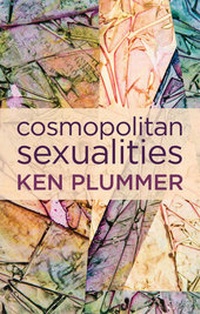
Cosmopolitan Sexualities
Description

Reviews / Votes
"Plummer has given us a new sexology for our age... Warning us not to take our stereotypes for granted, he takes us through sexualities in China, in Africa and in Middle Eastern societies, and organises sexualities into global zones, regional discrepancies and local eruptions." Times Higher Education "Ken Plummer's new work on sexualities is a carefully constructed book designed to captivate students and scholars with an interest in sexuality studies...a thoroughly enjoyable read which leaves the reader with a comprehensive knowledge of sexualities and a hopeful perspective for a humanistic world." James Pickles, Network Review "This is a book of deep knowledge and passionate commitment. It is the culmination of a lifetime's work on the sociology, culture and politics of sexuality, and is suffused with a critical humanism that offers a guide for the perplexed troubled by our contemporary sexual labyrinth. It is a landmark of sexual scholarship." Jeffrey Weeks, London South Bank University "Ken Plummer helped define the field of sexuality studies, and now he pushes well beyond its boundaries, taking on big questions of social theory. Cosmopolitan Sexualities uses the lens of sexuality studies to grapple with debates about belonging and difference in our rapidly globalizing world. Plummer has read absolutely everything, and in this book he offers a comprehensive, often dazzling road map of the myriad changes which are simultaneously remaking intimate life and macro worlds, and what they tell us about what it means to be human." Arlene Stein, Rutgers UniversityMore details
Other editions
Additional editions
Person
Content
Introduction
O wonder!
How many goodly creatures are there here!
How beauteous mankind is!
O brave new world, That has such people in it!
Shakespeare: The Tempest, 1610
Endless forms most beautiful and wonderful
Charles Darwin, On the Origins of the Species, 1859
Planet Earth currently houses well over seven billion human beings in some two hundred nations with thousands of ethnic tribes often in conflict, and more than seven thousand languages, each with histories stretching back across the millennia. Imagine, if you dare, the sheer multiplicity of various gendered, sexual and intimate relationships and practices that these little animals, us, have experienced as they have walked the earth through time and space; and the different religions, states and economies that have been brought into existence that have helped shape them. Here is a truly vast labyrinth of desire, gender and reproduction. Think perhaps of the sheer complexities, or not, of your own life; and those of your parents, grandparents and their communities too. Think of all the films you may have seen, the novels you might have read, the television you might have watched, the music you have heard about human relationships and sex. Spend a few minutes searching some of the millions of sex sites on the web. Then massively multiply all this into the global gendered world of human sexual complexity: the human sexual labyrinth.
Now this is indeed a challenge - and it is what this small study is about. I want you to stand with me in amazement at this oh so 'incorrigibly plural' world (to quote Louis MacNeice's poem 'Snow'), this 'pluriverse of differences', and these 'endless forms most beautiful'. I want you to wonder, along with Shakespeare, how many goodly creatures there are here and, maybe, how beauteous mankind is. Or, just maybe, to ask how many of these creatures are really not so beautiful at all. And with this, to ponder just how it is we can live together with all this difference. In this book, I puzzle about these varieties of embodied, emotional human sexual and gendered experiences, and ask how we humans live, or fail to live, with them. I will not be aiming here to chart a topography of these 'world varieties of sexual experience', to document 'the global history of sex', to review the multiple forms of the 'world gender order', to detail any kind of global scientific truth about diverse and gendered sexualities, or even to provide a manual of titillating sex acts: all this has now been tried in very many places. In this book, my focus lies with the challenge of grasping human vulnerabilities and asking how we can live with the diversities of our genders and sexualities and their tangled, emotional, biographical bodies; how we can build some common cosmopolitan values that will enable us to connect such diversity; how we can appreciate just where boundaries and borders do indeed have to be drawn; and how we can start to build up cosmopolitan institutions that make all these tasks possible.
To help me in this, I draw on the long history of cosmopolitanism, which suggests a form of everyday practical consciousness that recognizes human differences and then struggles to build social structures and cultures that help make diversity a workable feature of the humane, good social life. It is a goal to strive for, it harbours utopian visions and there are a few signs to indicate that we may be a little on our way towards its development. At the same time, the path to its realization is cluttered with major problems and difficulties that need facing head on. My version of cosmopolitanism is a humanist theory; and my stance in this book will be broadly that of critical humanism. This takes seriously the centrality of a contingent human vulnerability, agency and meaning emerging alongside global human values: empathy and dialogue, care and kindness, dignity and rights, actualization and human flourishing, and fairness and justice. Despite a continual attack from many directions on humanism, it provides an imagination of great value.
A troubled world
And yet, everyday, as I have been writing this book, I have been torn with a dark hope. As the daily world news arrives, I am given a repeatedly clear vision of the devaluing of human lives across the world: the damaged and destroyed lives in the wars, violence and terrorist acts in Syria, the Ukraine, Iraq, Palestine, the Congo and elsewhere. We live in a very cruel, nasty world of dehumanization that is destroying lives for generations to come. Money, religion, nation and power (usually linked to gender and masculinity) seem to be the prime motivating forces for much of this misery and conflict. Yet, at the same time, I can also see the flourishing of human lives - in music and art, in education and care, in sport and science, in hundreds of little miracles of everyday human kindness. It is a joyous world of human creativity and caring. And this contrast will be a recurrent theme of this book. The bad news is humanity's inhumanity to humanity. Often with the help of the state and religion, unbelievable violence and cruelty are heaped on large numbers of people. Systems of ranking, honour and status are used to brutally destroy 'the other'. Powerful elites get away with murder, and tragic human suffering among the masses is ubiquitous. But the good news is humanity's evolving compassion, hope and creative activism. People in the world fight back: they do not like the horrors of the world, they create new movements to resist them and they bring dreams of a better world. Cosmopolitan sexualities, and this book, form part of that dream.
Just as embodied human vulnerabilities are displayed everywhere, so too is human resilience. As I write, I hear of Meriam Ibrahim in the Sudan being sentenced to death for marrying a Christian man and committing apostasy from Islam. Following a worldwide response, her sentence was repealed and she was allowed to leave the country. A young student is gang-raped on a bus in Delhi in December 2012 and dies two weeks later; it leads to a public outcry about male violence towards women in India, where a woman is raped every 20 minutes. New social movements are born.1 In Russia, gay men become objects of new regressive discriminatory legislation. A major campaign is organized on the Internet against this move. In the UK, the failure to deal with female genital mutilation (involving thousands of women each year) and child sexual abuse become national scandals, and public concern forces the government to act. And in Chibok, Nigeria, Boko Haram (meaning 'non-Muslim teaching is forbidden' and responsible for at least 10,000 deaths) kidnapped more than 250 female students as part of a widespread Islamic insurgency in northern Nigeria, professing their opposition to the education of girls and the Westernization of Nigeria. Many of the girls become so-called 'sex slaves'. Despite both a world response and a local one (the 'Bring Our Girls Back' movement), as I write, this remains a very bleak story.
Only a few incidents like these get reported. They take place against the backdrop of worldwide silenced human sexual suffering, where women are regulated in multiple ways, children are abused routinely, same-sex relations are outlawed, and much more. For example, in more than 70 countries, there are laws that criminalize homosexual relations. In Iran, Afghanistan, Saudi Arabia and Chechnya, gay sex can lead to the death penalty. From Europe to Africa to the Americas to Asia, case after case of torture, ill-treatment, violence and discrimination against lesbians and gay men is documented. There are also very many cases of transgender rights activists - the ultimate gender outlaws - being abused across the world. And so it goes on.
A tale to tell
In this book I puzzle over some of these problems and suggest a few pathways ahead, giving my account in two major connected parts. The first part examines the transformations of our sexualities in the early decades of the twenty-first century, suggests growing variety, and then charts some of the ways we are developing to try to live with this difference. The second part examines some of the problems encountered in doing this, taking the strong stand that if we are ever to advance we have to be clear about the universal values we all need to strive for and incorporate into our everyday lives now. The 'we' here is a global one, not a narrow Western one, which seeks progressive change for all and not for just a few.
Chapter 1 sets the scene by locating cosmopolitanism in a humanist tradition, describing it and suggesting the many problems it brings in its wake. My critical humanism is far from being a mainstream stance taken by others who research such matters. Indeed, for some it might seem dangerously old-fashioned. So I have to spend a little time saying what it is and why I use it. Above all, I highlight human actions and positive values. Chapter 2 then suggests that in the modern world the range of global possibilities for human sexual diversity is rapidly accelerating. It outlines some of the key conditions that are bringing about these sexual transformations and claims that as most of these changes are unlikely to go away this century, we had better learn to work with them. The next chapter then proceeds to demonstrate...
