

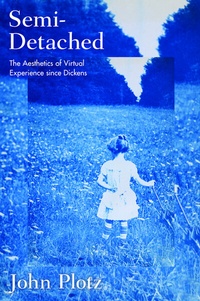
Semi-Detached
The Aesthetics of Virtual Experience since Dickens
1st Edition
Published on 10. September 2018
344 pages
978-1-4008-8788-0 (ISBN)
Description

When you are half lost in a work of art, what happens to the half left behind? Semi-Detached delves into this state of being: what it means to be within and without our social and physical milieu, at once interacting and drifting away, and how it affects our ideas about aesthetics. The allure of many modern aesthetic experiences, this book argues, is that artworks trigger and provide ways to make sense of this oscillating, in-between place. John Plotz focuses on Victorian and early modernist writers and artists who understood their work as tapping into, amplifying, or giving shape to a suspended duality of experience.
The book begins with the decline of the romantic tale, the rise of realism, and John Stuart Mill's ideas about social interaction and subjective perception. Plotz examines Pre-Raphaelite paintings that take semi-detached states of attention as their subject and novels that treat provincial subjects as simultaneously peripheral and central. He discusses how realist writers such as Charles Dickens, George Eliot, and Henry James show how consciousness can be in more than one place at a time; how the work of William Morris demonstrates the shifting forms of semi-detachment in print and visual media; and how Willa Cather created a form of modernism that connected aesthetic dreaming and reality. Plotz concludes with a look at early cinema and the works of Buster Keaton, who found remarkable ways to portray semi-detachment on screen.
In a time of cyberdependency and virtual worlds, when it seems that attention to everyday reality is stretching thin, Semi-Detached takes a historical and critical look at the halfway-thereness that audiences have long comprehended and embraced in their aesthetic encounters.
The book begins with the decline of the romantic tale, the rise of realism, and John Stuart Mill's ideas about social interaction and subjective perception. Plotz examines Pre-Raphaelite paintings that take semi-detached states of attention as their subject and novels that treat provincial subjects as simultaneously peripheral and central. He discusses how realist writers such as Charles Dickens, George Eliot, and Henry James show how consciousness can be in more than one place at a time; how the work of William Morris demonstrates the shifting forms of semi-detachment in print and visual media; and how Willa Cather created a form of modernism that connected aesthetic dreaming and reality. Plotz concludes with a look at early cinema and the works of Buster Keaton, who found remarkable ways to portray semi-detachment on screen.
In a time of cyberdependency and virtual worlds, when it seems that attention to everyday reality is stretching thin, Semi-Detached takes a historical and critical look at the halfway-thereness that audiences have long comprehended and embraced in their aesthetic encounters.
More details
Other editions
Additional editions
Book
02/2024
Princeton University Press
€28.50
Shipment within 10-20 days
Book
11/2017
Princeton University Press
€47.04
Shipment within 10-20 days
Person
John Plotz is professor of Victorian literature at Brandeis University. His books include The Crowd: British Literature and Public Politics, Portable Property: Victorian Culture on the Move (Princeton), and a young-adult novel, Time and the Tapestry: A William Morris Adventure. Plotz is the editor of the B-Sides series at Public Books.
Content
List of Illustrations ix
Acknowledgments xi
Introduction: Through Bright Glass 1
1 Pertinent Fiction: Short Stories into Novels 19
2 Mediated Involvement: John Stuart Mill's Partial Sociability 48
3 Visual Interlude I / Double Visions: Pre-Raphaelite Objectivity and Its Pitfalls 74
4 Virtual Provinces, Actually 102
5 Experiments in Semi-Detachment 122
6 Visual Interlude II / "This New-Old Industry": William Morris's Kelmscott Press 153
7 H. G. Wells, Realist of the Fantastic 175
8 Overtones and Empty Rooms: Willa Cather's Layers 196
9 Visual Interlude III / The Great Stone Face: Buster Keaton, Semi-Detached 215
Conclusion: Apparitional Criticism 238
Notes 245
Bibliography 293
Index 315
