

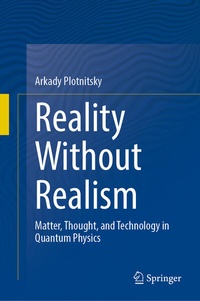
Reality Without Realism
Description

This book presents quantum theory as a theory based on new relationships among matter, thought, and experimental technology, as against those previously found in physics, relationships that also redefine those between mathematics and physics in quantum theory. The argument of the book is based on its title concept, reality without realism (RWR), and in the corresponding view, the RWR view, of quantum theory. The book considers, from this perspective, the thinking of Bohr, Heisenberg, Schrödinger, and Dirac, with the aim of bringing together the philosophy and history of quantum theory. With quantum theory, the book argues, the architecture of thought in theoretical physics was radically changed by the irreducible role of experimental technology in the constitution of physical phenomena, accordingly, no longer defined independently by matter alone, as they were in classical physics or relativity. Or so it appeared. For, quantum theory, the book further argues, made us realize that experimental technology, beginning with that of our bodies, irreducibly shapes all physical phenomena, and thus makes us rethink the relationships among matter, thought, and technology in all of physics.
More details
Other editions
Additional editions
Person
Arkady Plotnitsky is a distinguished professor at Purdue University, where he teaches in the Literature, Theory and Cultural Studies Program and the Philosophy and Literature Program. He received his M.S. in Mathematics from Leningrad (now St. Petersburg) State University, and his PhD in Literary Theory from the University of Pennsylvania. Before coming to Purdue, he taught at the University of Pennsylvania and Duke University. He has been awarded fellowships at Duke, Utah, Vanderbilt and Oregon State Universities, and was twice a short-term visitor at the Perimeter Institute for Theoretical Physics. His extensive publications on the philosophy of physics and Modernism, and on the relationships among literature, philosophy, and science, include eight books, two hundred articles and, as editor/coeditor, eight volumes of essays and journal issues. He has given about one hundred invited plenary lectures and presented over three hundred papers at international conferences. His most recent book is The Principles of Quantum Theory, from Planck's Quantum to the Higgs Boson: The Nature of Quantum Reality and the Spirit of Copenhagen (Springer, 2016).
