

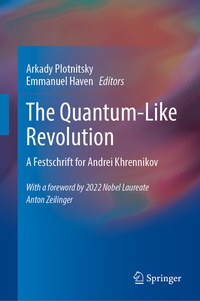
The Quantum-Like Revolution
Description

Over the last ten years, elements of the formalism of quantum mechanics have been successfully applied beyond physics in areas such as psychology (especially cognition), economics and finance (especially in the formalization of so-called 'decision making'), political science, and molecular biology. An important stream of work along these lines, commonly under the heading of quantum-like modeling, has been published in well regarded scientific journals, and major publishers have devoted entire books to the topic. This Festschrift honors a key figure in this field of research: Andrei Khrennikov, who made momentous contributions to it and to quantum foundations themselves. While honoring these contributions, and in order to do so, this Festschrift orients its reader toward the future rather than focusing on the past: it addresses future challenges and establishes the way forward in both domains, quantum-like modeling and quantum foundations. A while ago, in response to the developments of using the quantum formalism outside of quantum mechanics, the eminent quantum physicist Anton Zeilinger said, 'Why should it be precisely the quantum mechanics formalism? Maybe its generalization would be more adequate.' This volume responds to this statement by both showing the reasons for the continuing importance of quantum formalism and yet also considering pathways to such generalizations. Khrennikov's work has been indispensable in establishing the great promise of quantum and quantum-like thinking in shaping the future of scientific research across the disciplines.
More details
Other editions
Additional editions
Persons
Arkady Plotnitsky is a Distinguished Professor of the Literature, Theory, and Cultural Studies program, and the Philosophy and Literature Program Purdue University. He has authored 9 books, and edited or coedited 7 volumes of essays and journal issues, and published near 200 articles on continental philosophy, the philosophy of mathematics and science, and related subjects. His latest book is The Principles of Quantum Theory, from Planck's Quantum to the Higgs Boson: The Nature of Quantum Reality and the Spirit of Copenhagen (Springer 2016)
Emmanuel Haven holds the Alex Faseruk Chair in Financial Management at Memorial University in Canada. He has co-authored and co-edited several books which have been published notably with Cambridge University Press, Palgrave MacMillan and the Springer LNCS series. He published in a diverse set of areas ranging from finance; economic theory; operations research to physicsand applied mathematics.
Content
'Quantum-like' and the quantum revolution outside of physics, Arkady Plotnitsky (Purdue University, USA).- Andrei Khrennikov: a look-back on past research successes, Arkady Plotnitsky (Purdue University, USA); M. A. Man'ko (Lebedev Physical Institute, Russia); Philippe Grangier (CNRS, France); Emmanuel Haven (Memorial University, Canada).- The Vaxjo Conference Series: the longest conference series in the world on the foundations of quantum mechanics,Theo Niewenhuizen (Universiteit van Amsterdam, The Netherlands).- When John Wheeler said: 'all things physical are information-theoretic in origin', Gregg Jaeger (Boston University, USA).- More on information: categorical quantum mechanics, Samson Abramsky (Oxford University, UK).- Improving the applicability of 'quantum-like': first generalization: the informational axioms, Mauro d'Ariano (University of Pavia, Italy); G. Chiribella(University of Hong Kong, China); P. Perinotti (University of Pavia, Italy).- Applying information axioms in social science?, Sandro Sozzo; Polina Khrennikova (University of Leicester, UK); Emmanuel Haven (Memorial University, Canada).- Improving the applicability of 'quantum-like': a second generalization: positive operator valued measures (POVM) and more general operator formalisms, Irina Basieva (City University, UK).- POVM and the advanced modelling of cognition and other areas of decision making?, Jerome Busemeyer (Indiana University, USA); Emmanuel Pothos (City University, UK); Joyce Wang (Ohio State University, USA).- Improving the applicability of 'quantum-like': a third generalization: contextuality, Dzhafarov, E.N. (Purdue University, USA); de Barros A. (San Francisco State University, USA); Adan Cabello (University of Seville, Spain); J.A. Larsson (Linkoping University, Sweden); P. Kurzzinsky (Poznan University, Poland).- A fourth generalization: probability theories beyond quantum probability, R. D. Sorkin (Perimeter Institute, Canada).- Heterodoxy: non-Hermiticity and other issues, Carl Bender (Washington University, USA) and Irina Basieva (City University, UK).- Epilogue.
