

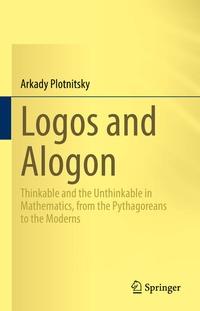
Logos and Alogon
Description

This book is a philosophical study of mathematics, pursued by considering and relating two aspects of mathematical thinking and practice, especially in modern mathematics, which, having emerged around 1800, consolidated around 1900 and extends to our own time, while also tracing both aspects to earlier periods, beginning with the ancient Greek mathematics. The first aspect is conceptual, which characterizes mathematics as the invention of and working with concepts, rather than only by its logical nature. The second, Pythagorean, aspect is grounded, first, in the interplay of geometry and algebra in modern mathematics, and secondly, in the epistemologically most radical form of modern mathematics, designated in this study as radical Pythagorean mathematics. This form of mathematics is defined by the role of that which beyond the limits of thought in mathematical thinking, or in ancient Greek terms, used in the book's title, an alogon in the logos of mathematics. The outcomeof this investigation is a new philosophical and historical understanding of the nature of modern mathematics and mathematics in general. The book is addressed to mathematicians, mathematical physicists, and philosophers and historians of mathematics, and graduate students in these fields.
More details
Other editions
Additional editions
Person
Arkady Plotnitsky is a distinguished professor at Purdue University, where he teaches in the Literature, Theory and Cultural Studies Program, and the Philosophy and Literature Program. He received his M.S. in Mathematics from Leningrad (now St. Petersburg) State University, and his PhD in Literary Theory from the University of Pennsylvania. He previously taught at the University of Pennsylvania and Duke University. His extensive publications on the philosophy of mathematics and physics, continental philosophy, and on the relationships among literature, philosophy, and science, include nine books, two hundred articles and, as editor/coeditor, nine volumes of essays and journal issues. He has given about one hundred invited plenary lectures and presented over three hundred papers at international conferences. His most recent books are The Principles of Quantum Theory, from Planck's Quantum to the Higgs Boson: The Nature of Quantum Reality and the Spirit of Copenhagen (Springer,2016) and Reality Without Realism: Matter, Thought, and Technology in Quantum Physics (Springer, 2021).
