

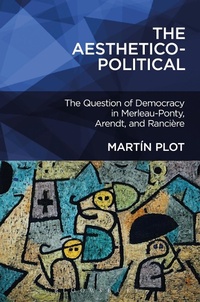
The Aesthetico-Political
The Question of Democracy in Merleau-Ponty, Arendt, and RancieRe
1st Edition
Published on 23. October 2014
176 pages
978-1-4411-9566-1 (ISBN)
Description

This study uses new arguments to reinvestigate the relation between aesthetics and politics in the contemporary debates on democratic theory and radical democracy.
First, Carl Schmitt and Claude Lefort help delineate the contours of an aesthetico-political understanding of democracy, which is developed further by studying Merleau-Ponty, Ranciere, and Arendt.
The ideas of Merleau-Ponty serve to establish a general "ontological" framework that aims to contest the dominant currents in contemporary democratic theory. It is argued that Merleau-Ponty, Arendt, and Ranciere share a general understanding of the political as the contingently contested spaces and times of appearances. However, the articulation of their thought leads to reconsider and explore under-theorized as well as controversial dimensions of their work.
This search for new connections between the political and the aesthetic thought of Arendt and Merleau-Ponty on one hand and the current widespread interest in Ranciere's aesthetic politics on the other make this book a unique study that will appeal to anyone who is interested in political theory and contemporary continental philosophy.
First, Carl Schmitt and Claude Lefort help delineate the contours of an aesthetico-political understanding of democracy, which is developed further by studying Merleau-Ponty, Ranciere, and Arendt.
The ideas of Merleau-Ponty serve to establish a general "ontological" framework that aims to contest the dominant currents in contemporary democratic theory. It is argued that Merleau-Ponty, Arendt, and Ranciere share a general understanding of the political as the contingently contested spaces and times of appearances. However, the articulation of their thought leads to reconsider and explore under-theorized as well as controversial dimensions of their work.
This search for new connections between the political and the aesthetic thought of Arendt and Merleau-Ponty on one hand and the current widespread interest in Ranciere's aesthetic politics on the other make this book a unique study that will appeal to anyone who is interested in political theory and contemporary continental philosophy.
Reviews / Votes
Martin Plot's Latin American background, his experience teaching theory to American art school students, and his firm grasp of debates in contemporary political thought are brought together in this sweeping vision of an 'aesthetico-political' theory. Plot argues that normative political theory needs to learn what he calls 'theorizing from events.' Using theory to go beyond theory, his approach recalls what Richard Armstrong, the director of the Guggenheim museum, recently called for: 'not looking at but engaging with' our times. * Dick Howard, distinguished Professor Emeritus at Stony Brook University and author of The Primacy of the Political and The Specter of Democracy * The political dimension of Merleau-Ponty's aesthetic and its implications for contemporary democratic thought have been little understood. Not only does Plot's improvisation on Merleau-Ponty's radical notion of the flesh, as distinct from body, contribute to remedying that situation, it also explains its importance for radical thought that interrogates the relation between modernity, the political and democracy. Through a 'coherent deformation' Plot's book establishes the basis of the problematic of radical democracy and demonstrates its limits. * Jeremy Valentine, Queen Margaret University, Edinburgh, UK * Just when one begins to think that there is not much new that can be said of the democratic insights at work in the thinking of Merleau-Ponty, Arendt, Lefort, and Ranciere, along comes Plot's original, insightful, and nuanced reading of these thinkers. Critical of democracy, but not dismissive of it, Plot provides a provocative, thoughtful, and extensive argument for democracy's reliance on an aesthetic dimension. This is an indispensable book for anyone working on the question of democracy today. * Peg Birmingham, Professor of Philosophy, DePaul University, US *More details
Edition
1. Auflage
Language
English
Place of publication
New York
United States
Publishing group
Bloomsbury Publishing PLC (Digital)
Target group
Professional and scholarly
ISBN-13
978-1-4411-9566-1 (9781441195661)
Copyright in bibliographic data and cover images is held by Nielsen Book Services Limited or by the publishers or by their respective licensors: all rights reserved.
Schweitzer Classification
Other editions
Additional editions
Martin Plot
The Aesthetico-Political
The Question of Democracy in Merleau-Ponty, Arendt, and Ranciere
Book
06/2016
Bloomsbury Academic USA
€56.30
Shipment within 15-20 days
Martin Plot
The Aesthetico-Political
The Question of Democracy in Merleau-Ponty, Arendt, and Ranciere
Book
12/2014
Bloomsbury Academic
€194.30
Shipment within 15-20 days
Person
Martin Plot is Research Professor of Political Theory at the National Scientific and Technical Research Council (CONICET-IDAES/UNSAM, Argentina) and Research Fellow in Political Thought at the CalArts's Aesthetics and Politics Program. He is also the author of Indivisible (2011) and has edited, most recently, Claude Lefort. Thinker of the Political (2013.)
Content
Preface
Acknowledgements
Introduction - The Advent of the Aesthetico-Political
The Enigma of Democracy
Schmitt, Lefort, and the Theologico-Political
The Epistemological Regime of Politics
Conclusion
Chapter I - Our Element: Flesh and Democracy in Maurice Merleau-Ponty
Deus Mortalis
Flesh and Democracy
An Entire Politics
Conclusion
Chapter II - The Law of the Earth: Hannah Arendt and the Aesthetic Regime of Politics
Disagreement: Arendt and Habermas
Political Phenomenology
Spaces and Times of Appearance
Conclusion: Political Kitsch and Ideology Politics
Chapter III - The (Re)Aestheticization of Politics: Jacques Ranciere and the Question of Democracy
Ranciere, Lefort, and the Political
The Question of Democracy-In America
Recapitulation
Bibliographic References
Acknowledgements
Introduction - The Advent of the Aesthetico-Political
The Enigma of Democracy
Schmitt, Lefort, and the Theologico-Political
The Epistemological Regime of Politics
Conclusion
Chapter I - Our Element: Flesh and Democracy in Maurice Merleau-Ponty
Deus Mortalis
Flesh and Democracy
An Entire Politics
Conclusion
Chapter II - The Law of the Earth: Hannah Arendt and the Aesthetic Regime of Politics
Disagreement: Arendt and Habermas
Political Phenomenology
Spaces and Times of Appearance
Conclusion: Political Kitsch and Ideology Politics
Chapter III - The (Re)Aestheticization of Politics: Jacques Ranciere and the Question of Democracy
Ranciere, Lefort, and the Political
The Question of Democracy-In America
Recapitulation
Bibliographic References
