

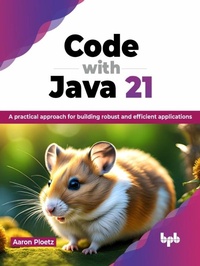
Code with Java 21
A practical approach for building robust and efficient applications (English Edition)
1st Edition
Published on 25. January 2024
434 pages
978-93-5551-925-2 (ISBN)
Description

No detailed description available for "Code with Java 21".
More details
Other editions
Additional editions
Aaron Ploetz
Code with Java 21
A practical approach for building robust and efficient applications (English Edition)
E-Book
01/2024
1st Edition
De Gruyter
€46.00
Available for download
Book
01/2024
BPB Publications
€41.50
Article not available for order
Content
- Intro
- Cover
- Title Page
- Copyright Page
- Dedication Page
- About the Author
- About the Reviewer
- Acknowledgement
- Preface
- Table of Contents
- 1. Getting to Know Java
- Introduction
- Structure
- Objectives
- Why code with Java?
- Configuring your environment
- Operating System
- Java Runtime Environment
- Java Development Kit
- JDK vendors and editions
- Installation
- Windows
- MacOS
- Linux
- Version management
- Integrated Development Environment
- Java dependency management
- Source control
- Git installation
- Object-oriented programming
- Encapsulation
- Inheritance
- Abstraction
- Polymorphism
- Static polymorphism
- Dynamic polymorphism
- Advantages of OOP
- What is new in Java 21?
- Virtual threads
- Sequenced Collections
- String templates
- Conclusion
- Points to remember
- 2. Fundamental Programming Structures
- Introduction
- Structure
- Objectives
- Getting started
- Maven
- HelloWorld
- Anonymous main classes
- Variables and formatting
- Reading input
- Error handling
- If statements
- Switch/case statements
- Loops
- For loops
- While loops
- Do loops
- Files
- Writing to a file
- Reading from a file
- Reading row properties from a file
- Methods and constructors
- Conclusion
- Points to remember
- 3. Strings, Characters, and Regular Expressions
- Introduction
- Structure
- Objectives
- Characters
- ASCII art
- Strings
- substring
- toUpperCase
- toLowerCase
- String equality
- Equality of string suffixes
- Equality of string prefixes
- contains
- Regular expressions
- Conclusion
- Points to remember
- 4. Arrays, Collections, and Records
- Introduction
- Structure
- Objectives
- Arrays
- Multi-dimensional arrays
- Collections and maps
- Sets
- HashSet
- LinkedHashSet
- TreeSet
- ArrayList
- LinkedList
- Maps
- HashMap
- LinkedHashMap
- TreeMap
- Sequenced collections
- Records
- Building a simple example
- RPGSimulation class
- Player class
- Hero class
- RPGSimulation class continued
- Conclusion
- Points to remember
- 5. Arithmetic Operations
- Introduction
- Structure
- Objectives
- Integer arithmetic
- Addition
- Testing add() with JUnit
- Subtraction
- Multiplication
- Division
- Modulo
- Exponent
- Floating point arithmetic
- Addition
- Nuances with floating point arithmetic
- Subtraction
- Multiplication
- Division
- Formatting floating point values
- Exponent
- Square root
- Cube root
- Absolute value
- Conclusion
- Points to remember
- 6. Common Data Structures
- Introduction
- Structure
- Objectives
- Stacks
- Queues
- Linked lists
- Binary trees
- Conclusion
- Points to remember
- 7. Working with Databases
- Introduction
- Structure
- Introduction to databases
- Short history of databases
- CAP theorem
- Consistency
- Availability
- Partition tolerance
- CAP designations
- PostgreSQL
- ElephantSQL
- Schema
- Loading data
- Querying data
- Accessing from Java
- Apache Cassandra
- Astra DB
- Schema
- Loading data
- Querying data
- Accessing from Java
- Choosing the right database
- Conclusion
- Points to remember
- 8. Web Applications
- Introduction
- Structure
- Objectives
- Restful operations
- Restful URIs
- Simple operations
- Web services with Spring Boot
- MVC
- Weather application controller
- Hello world service endpoint
- Weather Application model
- Define a new keyspace
- Define a new table
- Generate a new token
- Set application properties and environment variables
- pom.xml redux
- WeatherPrimaryKey class
- WeatherEntity class
- WeatherReading class
- WeatherAppRepository interface
- Building our response JSON objects
- Measurement class
- CloudLayer class
- Properties class
- Geometry class
- LatestWeather class
- Weather application controller redux
- Building web user interfaces
- pom.xml redux
- Weather application view
- Horizontal build methods
- Running the weather application
- Conclusion
- Points to remember
- 9. Graphics in Java
- Introduction
- Structure
- Objectives
- Simple graphics with AWT and Swing
- SimpleDraw class
- MyPanel class
- Animation
- Planet class
- SolarSystem class
- DrawPlanets class
- Java Breakout
- pom.xml
- Ball class
- Brick class
- Paddle class
- KeyHandler class
- BreakoutPanel class
- BreakoutGame class
- Conclusion
- Points to remember
- 10. Final Java Project
- Introduction
- Structure
- Introducing movie application
- Architecture
- Database
- Database selection
- Create a new vector database
- Table design
- Data loader
- pom.xml
- CassandraConnection class
- AstraConnection class
- Movie class
- MovieDataLoader class
- Querying the data
- Creating the movie application project
- Images directory
- pom.xml
- application.yml
- Model
- Movie class
- MovieRepository interface
- MovieByTitle class
- MovieByTitleRepository interface
- Controller
- MovieAppController class
- Querying the service
- Movies by ID
- Movies by title
- Movie recommendations
- View
- MovieAppMainView class
- Conclusion
- Points to remember
- Appendix A: References
- Appendix B: UTF Conversion Chart
- Appendix C: Database Command Reference
- SELECT
- INSERT
- UPDATE
- DELETE
- CREATE TABLE
- CREATE INDEX
- Appendix D: Common HTTP Response Codes
- Appendix E: Common Color Codes
- Appendix F: Garbage Collection
- Index
