

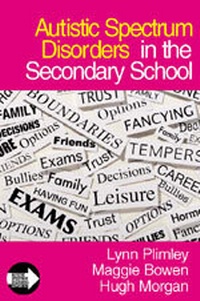
Autistic Spectrum Disorders in the Secondary School
1st Edition
Published on 24. April 2006
96 pages
978-1-84787-850-2 (ISBN)
Description

'I liked the way it dealt with the difficult issues such as mental health, sexuality and future employment in a clear and direct way, providing well thought out, practical responses.' 'Easy to read yet informative.' 'Very accessible in an area of SEN that is now a key area of concern.' ' Captivating, good presentation with the case studies, reflective oasis and points to remember.' 'Very useful for Sencos and teachers.' - Judging Panel for NASEN/TES Book Award
'There can be no doubt that the action suggested by the authors to improve outcomes for pupils with ASD, would benefit the inclusion of all pupils' - Special Needs Information Press
'The book gives a clear insight into some of the issues which are important from the perspective of the pupil, the challenges they face and the behaviours that can result. It openly addresses the impact of these behaviours on a school and offers clear guidance and strategies. The options given are realistic, practical and achievable and the Reflective Oasis sections offer an ideal starting point for self-evaluation and staff training' - Mike Ridout, Head of Access and Inclusion Service, Bridgend LEA
'All those involved in education at secondary level including senior managers and governors will find this concise book informative in helping them to understand the needs of their pupils with ASD' - Ian Attfield, Advisory Teacher ASD, Birmingham Specialist Support Service
'The book not only gives sound advice, it helps the reader to find a wider range of sources of support and information... a useful, practical guide that makes the organisation of inclusive education achievable' - Special
'The book does have a number of useful strategies and tips, but it provides more than just a list of practical points. Support staff are encouraged to reflect upon their own practice and that of their school... The book is well worth buying and should appeal both to support workers and their managers' - Support For Learning
'The book fills a niche by distilling and providing information to busy teachers... an important little book that is quite readable and may be very useful to its intended audience' - American Psychological Association
When a young person with autistic spectrum disorders enters secondary school, there are lots of new factors to consider.
This books looks at:
" making good transitions from primary school
" how to provide helpful INSET for colleagues (including teachers, senior managers, support staff and lunchtime supervisers)
" using a special interest as a tool for learning
" record-keeping, IEPs and sharing information across the school
" subject disapplication and formal examinations
" social strategies to employ in a large high school
" useful tips for staff - what to do and what not to do
" work experience, careers and self-advocacy
The importance of working closely with parents is also covered, as is dealing with challenging behaviour.
'...the book not only gives sound advice, it helps the reader to find a wider range of sources of support and information...The authors have not sought to minimise the difficulties or to pretend that schools and individuals will not have to change or adapt, nor have they avoided difficult questions. What they have one is to write a useful, practical guide that makes the organisation of inclusive education achievable' - Resource File
'There can be no doubt that the action suggested by the authors to improve outcomes for pupils with ASD, would benefit the inclusion of all pupils' - Special Needs Information Press
'The book gives a clear insight into some of the issues which are important from the perspective of the pupil, the challenges they face and the behaviours that can result. It openly addresses the impact of these behaviours on a school and offers clear guidance and strategies. The options given are realistic, practical and achievable and the Reflective Oasis sections offer an ideal starting point for self-evaluation and staff training' - Mike Ridout, Head of Access and Inclusion Service, Bridgend LEA
'All those involved in education at secondary level including senior managers and governors will find this concise book informative in helping them to understand the needs of their pupils with ASD' - Ian Attfield, Advisory Teacher ASD, Birmingham Specialist Support Service
'The book not only gives sound advice, it helps the reader to find a wider range of sources of support and information... a useful, practical guide that makes the organisation of inclusive education achievable' - Special
'The book does have a number of useful strategies and tips, but it provides more than just a list of practical points. Support staff are encouraged to reflect upon their own practice and that of their school... The book is well worth buying and should appeal both to support workers and their managers' - Support For Learning
'The book fills a niche by distilling and providing information to busy teachers... an important little book that is quite readable and may be very useful to its intended audience' - American Psychological Association
When a young person with autistic spectrum disorders enters secondary school, there are lots of new factors to consider.
This books looks at:
" making good transitions from primary school
" how to provide helpful INSET for colleagues (including teachers, senior managers, support staff and lunchtime supervisers)
" using a special interest as a tool for learning
" record-keeping, IEPs and sharing information across the school
" subject disapplication and formal examinations
" social strategies to employ in a large high school
" useful tips for staff - what to do and what not to do
" work experience, careers and self-advocacy
The importance of working closely with parents is also covered, as is dealing with challenging behaviour.
'...the book not only gives sound advice, it helps the reader to find a wider range of sources of support and information...The authors have not sought to minimise the difficulties or to pretend that schools and individuals will not have to change or adapt, nor have they avoided difficult questions. What they have one is to write a useful, practical guide that makes the organisation of inclusive education achievable' - Resource File
Reviews / Votes
'There can be no doubt that the action suggested by the authors to improve outcomes for pupils with ASD, would benefit the inclusion of all pupils' - Special Needs Information Press'The book gives a clear insight into some of the issues which are important from the perspective of the pupil, the challenges they face and the behaviours that can result. It openly addresses the impact of these behaviours on a school and offers clear guidance and strategies. The options given are realistic, practical and achievable and the Reflective Oasis sections offer an ideal starting point for self-evaluation and staff training' - Mike Ridout, Head of Access and Inclusion Service, Bridgend LEA
'All those involved in education at secondary level including senior managers and governors will find this concise book informative in helping them to understand the needs of their pupils with ASD' - Ian Attfield, Advisory Teacher ASD, Birmingham Specialist Support Service
'The book fills a niche by distilling and providing information to busy teachers... an important little book that is quite readable and may be very useful to its intended audience' - American Psychological Association
All prices
More details
Series
Language
English
Place of publication
London
United Kingdom
Target group
Professional and scholarly
ISBN-13
978-1-84787-850-2 (9781847878502)
Copyright in bibliographic data and cover images is held by Nielsen Book Services Limited or by the publishers or by their respective licensors: all rights reserved.
Schweitzer Classification
Other editions
Additional editions
Lynn Plimley | Maggie Bowen
Autistic Spectrum Disorders in the Secondary School
Book
04/2006
1st Edition
SAGE Publications Inc
€187.19
Article exhausted; check different version
Lynn Plimley | Maggie Bowen
Autistic Spectrum Disorders in the Secondary School
Book
04/2006
1st Edition
SAGE Publications Inc
€82.20
Shipment within 10-20 days
Persons
Content
- Cover Page
- Title
- Copyright
- Contents
- Acknowledgements
- How to use this book
- 1 Making good transitions from primary school
- 2 Considering the environment
- 3 Inclusive practice and whole-school approaches
- 4 Planning the curriculum for access and accreditation
- 5 Social strategies: helping pupils to cope
- 6 Observation and recording
- 7 Working with sensory differences
- 8 Preparing for work experience and future employment
- 9 Adolescence, sexuality and PSHE
- 10 Developing partnerships with parents
- 11 Managing challenging behaviour
- 12 Issues relating to mental health and the criminal justice system
- 13 Educating colleagues
- References
- Glossary
- Index
