

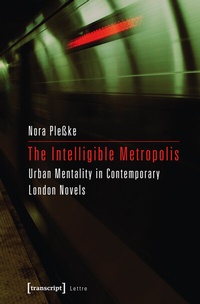
The Intelligible Metropolis
Urban Mentality in Contemporary London Novels
1st Edition
Published on 15. August 2014
576 pages
978-3-8394-2672-2 (ISBN)
Description

Writings on the metropolis generally foreground illimitability, stressing thereby that the urban ultimately remains both illegible and unintelligible. Instead, the purpose of this interdisciplinary study is to demonstrate that mentality as a tool offers orientation in the urban realm. Nora Pleßke develops a model of urban mentality to be employed for cities worldwide. Against the background of the Spatial Turn, she identifies dominant urban-specific structures of London mentality in contemporary London novels, such as Monica Ali's »Brick Lane«, J.G. Ballard's »Millennium People«, Nick Hornby's »A Long Way Down«, and Ian McEwan's »Saturday«.
Reviews / Votes
»Nora Pleßke's study is impressive with regard to both its theoretical framework and the scope of primary texts considered.«More details
Series
Language
English
Place of publication
Bielefeld
Germany
Target group
Professional and scholarly
Edition type
Digital original
Illustrations
5
4 farbige Abbildungen, 1 s/w Abbildung
File size
2,60 MB
ISBN-13
978-3-8394-2672-2 (9783839426722)
DOI
10.14361/transcript.9783839426722
Schweitzer Classification
Other editions
Additional editions
Book
09/2017
1st Edition
transcript
€54.99
Article exhausted; check different version
Person
Nora Pleßke (Dr. phil.) teaches English studies at the University of Passau. Her research interests include London literature, material culture, mentality, spatial and postcolonial theory.
Content
- Cover The Intelligible Metropolis
- Contents
- 1 Introduction
- 1.1 Setting the Theme: Intelligibility and Legibility
- 1.2 'New' London (1997-2007)
- 1.3 Selecting the Literary Corpus
- 1.4 The Present State of Research
- 1.5 Structure and Approach
- Theory and Methodology
- 2 Theories and Categories of Mentality
- 2.1 The Definition of Mentality
- 2.1.1 The History of Mentalities
- 2.1.2 Historical and Contemporary Social Constructions of Reality
- 2.1.3 Mentality as Organon and Rhizome
- 2.2 Determinants of Mentality
- 2.2.1 Collectivity and Collective Mentality
- 2.2.2 Time and Temporal Mentality
- 2.2.3 Space and Spatial Mentality
- 2.2.4 Collective Space-Time Compressions
- 2.3 The Concept of Mentality
- 3 Theories of Urbanity
- 3.1 City and Urbanity
- 3.1.1 Definition of the City
- 3.1.2 Urbanity as the Metropolitan Way of Life
- 3.1.3 Metamorphosis of the City and Transformation of Urbanity
- 3.2 Urban Theoretical Approaches to Mentalities
- 3.2.1 Georg Simmel's Sociology of Modern Urbanity
- 3.2.2 The Chicago School of Urban Sociology
- 3.2.3 New Urban Political Economy and City Culture
- 3.2.4 The Contemporary City and Postmodern Urbanity
- 4 The Concept of Urban Mentality
- 4.1 Ambivalences of Urban-Generic Mentality
- 4.1.1 City and Country
- 4.1.2 Public and Private
- 4.1.3 Sociability and Anomie
- 4.1.4 Heterogeneity and Homogeneity
- 4.1.5 Familiarity and Strangeness
- 4.1.6 Community and Individualism
- 4.1.7 Indifference and Involvement
- 4.1.8 Apathy and Vigilance
- 4.2 Factors of Influence on Urban-Specific Mentality
- 4.2.1 Culture
- 4.2.2 Imaginary
- 4.2.3 Image
- 4.2.4 Text
- 4.2.5 Narrative
- 4.2.6 Atmosphere
- 4.2.7 Emotion
- 4.2.8 Identity
- 4.3 The Model of Urban Mentality
- 5 Methodological Implications
- 5.1 Methodological Approaches to Mentality
- 5.1.1 Quantitative and Qualitative Methods
- 5.1.2 Literary and Cultural Studies and the Concept of Mentalities
- 5.1.3 Narratological Approaches
- 5.2 A Spatio-Narratological Analysis of Mentality
- 5.2.1 Literary Topographies
- 5.2.2 Boundaries
- 5.2.3 Chronotopes
- 5.2.4 Metaphors
- Analysis of London Mentality
- 6 Cityscape
- 6.1 Public and Private
- 6.1.1 Interpenetrations of Public and Private Drama
- 6.1.2 Private Dereliction and Public Regeneration
- 6.1.3 Enclosed Privacies in the Global City
- 6.1.4 Public 'Aparthide' and Search for Intimacy
- 6.1.5 Isolationist Structures of Mentality
- 6.2 Underground London
- 6.2.1 Isotopic, Utopic, and Heterotopic Space
- 6.2.2 Subterranean Sociability
- 6.2.3 The Metropolitan (Un)Conscious
- 6.2.4 Deep Collective Space-Time Compressions
- 6.2.5 Subterranean Structures of Mentality
- 6.3 Navigating the Flux
- 6.3.1 Mapping the Metropolis
- 6.3.2 Touring the Streets of London
- 6.3.3 Sensing the City
- 6.3.4 Apprehending Urbanity
- 6.3.5 (Sub)Textual Structures of Mentality
- 6.4 The Palimpsestuous City
- 6.4.1 Historical Layering
- 6.4.2 Psychogeographical Tracing
- 6.4.3 Socio-Cultural Re-Con-Textualisation
- 6.4.4 Intertextual Writing
- 6.4.5 Hypertextual Simulation
- 6.4.6 Palimpsestuous Structures of Mentality
- 7 Socioscape
- 7.1 Urban Sociability
- 7.1.1 Networks of Human Interrelation
- 7.1.2 Urban Islands of Loneliness
- 7.1.3 Metropolitan Voids and Millennial Anomie
- 7.1.4 Transcultural Contact Zones
- 7.1.5 Mental Structures of Relational Fluidity
- 7.2 London Metropolarities
- 7.2.1 The Urban Middle-Class Crisis
- 7.2.2 (Un)Homely Cosmopolis
- 7.2.3 Gendered (Dis)Orientations
- 7.2.4 The Urban Pariah
- 7.2.5 Mental Structures of Deviation
- 8 Idioscape
- 8.1 The City and the Citizen
- 8.1.1 Identityscape and Performativity
- 8.1.2 Bodyscape and Psychasthenia
- 8.1.3 Mindscape and Screening
- 8.1.4 Hypertrophic Structures of Mentality
- 8.2 The Urban State of Mind
- 8.2.1 Simulated Anxiousness
- 8.2.2 The Spectres of Terror
- 8.2.3 Millennial Apocalyptic Visions
- 8.2.4 Terror Structures of Mentality
- 9 Conclusion
- Works Cited
- Primary Literature
- Further Primary Sources
- Secondary Sources
- Appendix: London Novels (1997-2007)
- Index
- Acknowledgements
