

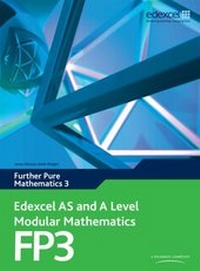
Edexcel AS and A Level Modular Mathematics Further Pure Mathematics 3 FP3
1st Edition
Published on 30. September 2016
232 pages
978-1-292-18510-1 (ISBN)
Description

Edexcel's own course for the GCE specification. Providing the best possible match to the specification, Edexcel AS and A Level Modular Mathematics FP3 motivates students by making maths easier to learn. Completely re-written by chief examiners for the specification, it provides student-friendly worked examples and solutions, leading up to a wealth of practice questions. Sample past exam papers for thorough exam preparation, and regular review sections that help consolidate learning are included. Opportunities for stretch and challenge are presented throughout the course. Also included is an interactive FREE LiveText CD-ROM, containing Solutionbank and Exam Cafe to support and inspire students to reach their potential for exam success. Solutionbank contains fully worked solutions with hints and tips for every question in the Student Book. Exam Cafe includes a revision planner and checklist as well as a fully worked examination-style paper with chief examiner's commentary
More details
Other editions
Additional editions
Keith Pledger | Dave Wilkins
Edexcel AS and A Level Modular Mathematics Further Pure Mathematics 3 FP3
Book
08/2009
Heinemann
€20.00
Shipment within 5-8 weeks
Content
- Cover
- Contents
- About this book
- Chapter 1: Hyperbolic functions
- 1.1: The definitions of the hyperbolic functions
- 1.2: Graphs of hyperbolic functions
- 1.3: For hyperbolic functions, finding and using identities that are very similar to trigonometric identities
- 1.4: Defining and using the inverses of the hyperbolic functions, similar to those of the trigonometric functions
- 1.5: Solving equations involving hyperbolic functions
- Summary of key points
- Chapter 2: Further coordinate systems
- 2.1: Equations for an ellipse
- 2.2: Using parametric equations to find tangents and normals
- 2.3: Cartesian and parametric equations for a hyperbola
- 2.4: Finding equations of tangents and normals to a hyperbola
- 2.5: Defining the focus and direction of the ellipse and hyperbola
- 2.6: Finding equations of simple loci
- Summary of key points
- Chapter 3: Differentiation
- 3.1: Differentiating hyperbolic functions
- 3.2: Differentiating inverse hyperbolic functions
- 3.3: Differentiating inverse trigonometric functions
- Summary of key points
- Chapter 4: Integration
- 4.1: Recognising standard integrals
- 4.2: Integrating expressions involving hyperbolic functions
- 4.3: Using trigonometric and hyperbolic substitutions in integration
- 4.4: Integrating expressions of the form ?1/px2+qx+r dx and ?1/Vpx2+qx+r dx
- 4.5: Integrating inverse trigonometric and hyperbolic functions using integration by parts
- 4.6: Deriving and using reduction formulae
- 4.7: Using integration to find the length of an arc of a curve
- 4.8 Using integration to find the area of a surface of revolution
- Summary of key points
- Review Exercise 1
- Chapter 5: Vectors
- 5.1: The definition of the vector product of two vectors
- 5.2: Interpreting |a*b| as an area
- 5.3: Finding the triple scalar product a.(b*c) of three vectors a, b and c, and using it to find the volume of a parallelepiped and of a tetrahedron
- 5.4: Writing the vector equation of a line in the form (r-a)*b=0
- 5.5: Writing the equation of a plane in the scalar, vector, or Cartesian form
- 5.6: Using vectors in a variety of contexts
- Summary of key points
- Chapter 6: Further matrix algebra
- 6.1: Finding the transpose of a matrix
- 6.2: Finding the determinant of a 3*3 matrix
- 6.3: Finding the inverse of a 3*3 matrix where it exists
- 6.4: Using matrices to represent linear transformations in 3 dimensions
- 6.5: Using inverse matrices to reverse the effects of a linear transformation
- 6.6: Finding the eigenvalues and eigenvectors of 2*2 and 3*3 matrices
- 6.7: Reducing a symmetrical matrix to diagonal form
- Summary of key points
- Review Exercise 2
- Examination style paper
- Answers
- Index
