

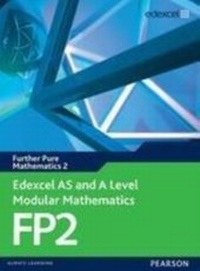
Edexcel AS and A Level Modular Mathematics Further Pure Mathematics 2 FP2
1st Edition
Published on 28. March 2017
192 pages
978-1-292-18511-8 (ISBN)
Description

Edexcel and A Level Modular Mathematics FP2 features: Student-friendly worked examples and solutions, leading up to a wealth of practice questions. Sample exam papers for thorough exam preparation. Regular review sections consolidate learning. Opportunities for stretch and challenge presented throughout the course. Escalator section to step up from GCSE. PLUS Free LiveText CD-ROM, containing Solutionbank and Exam Caf to support, motivate and inspire students to reach their potential for exam success. Solutionbank contains fully worked solutions with hints and tips for every question in the Student Books. Exam Caf includes a revision planner and checklist as well as a fully worked examination-style paper with examiner commentary.
More details
Other editions
Additional editions
Book
05/2009
Edexcel Limited
€38.50
Shipment within 5-8 weeks
Content
- Cover
- Contents
- About this book
- Chapter 1: Inequalities
- 1.1: Solving inequalities by manipulation
- 1.2: Solving inequalities graphically
- Chapter 2: Series
- 2.1: Using the method of differences to sum simple finite series
- Chapter 3: Further complex numbers
- 3.1: The modulus - argument form
- 3.2: Euler's relation
- 3.3: Multiplying and dividing two complex numbers
- 3.4: De Moivre's theorem
- 3.5: De Moivre's theorem applied to trigonometric identities
- 3.6: Using de Moivre's theorem to find the nth roots of a complex number
- 3.7: Using complex numbers to represent a locus of points on an Argand diagram
- 3.8: Using complex numbers to represent regions on an Argand diagram
- 3.9: Applying transformations that map points on the z-plane to points on the w-plane by applying a formula relating z = x + iy to w = u + iv
- Review Exercise 1
- Chapter 4: First order differential equations
- 4.1: Solving first order differential equations with separable variables and the formation of differential equations and sketching members of the family of solution curves
- 4.2: Solving exact equations where one side is the exact derivative of a product and the other side can be integrated with respect to x
- 4.3: Solving first order linear differential equations of the type dy/dx + Py = Q, where P and Q are functions of x, by multiplying through the equation by an integrating factor to produce an exact equation
- 4.4: Using a given substitution to reduce a differential equation into one of the above types of equation, which you can then solve
- Chapter 5: Second order differential equations
- 5.1: Finding the general solution of the linear second order differential equation ad2y/dx2 + bdy/dx + cy = 0, where a, b and c are constants and where b2& 4ac
- 5.2: Finding the general solution of the linear second order differential equation ad2y/dx2 + bdy/dx + cy = 0, where a, b and c are constants and where b2 = 4ac
- 5.3: Finding the general solution of the linear second order differential equation ad2y/dx2 + bdy/dx + cy = 0, where a, b and c are constants and where b2&4ac
- 5.4: Finding the general solution of the linear second order differential equation ad2y/dx2 + bdy/dx + cy = f(x), where a, b and c are constants, by using y = complementary function + particular integral
- 5.5: Using boundary conditions, to find a specific solution of the linear second order differential equation ad2y/dx2 + bdy/dx + cy = f(x), where a, b and c are constants, or initial conditions to find a specific solution of the linear second order differential equation ad2x/dt2 + bdx/dt + cx = f(t), where a, b and c are constants
- 5.6: Using a given substitution to transform a second order differential equation into one of the above types of equation, and solving it
- Chapter 6: Maclaurin and Taylor series
- 6.1: Finding and using higher derivatives of functions
- 6.2: Expressing functions of x as an infinite series in ascending powers of x using Maclaurin's expansion
- 6.3: Finding the series expansions of composite functions using known Maclaurin's expansions.
- 6.4: Finding an approximation to a function of x close to x = a, where a ? 0, using Taylor's expansion of the function
- 6.5: Finding the solution, in the form of a series, to a differential equation using the Taylor series method
- Chapter 7: Polar coordinates
- 7.1: Polar and Cartesian coordinates
- 7.2: Polar and Cartesian equations of curves
- 7.3: Sketching polar equations
- 7.4: Areas using polar coordinates
- 7.5: Finding tangents parallel and perpendicular to the initial line
- Review Exercise 2
- Examination style paper
- Answers
- Index
