

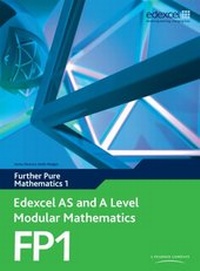
Edexcel AS and A Level Modular Mathematics Further Pure Mathematics 1 FP1
1st Edition
Published on 30. September 2016
168 pages
978-1-292-18509-5 (ISBN)
Description

Edexcel and A Level Modular Mathematics FP1 features: Student-friendly worked examples and solutions, leading up to a wealth of practice questions. Sample exam papers for thorough exam preparation. Regular review sections consolidate learning. Opportunities for stretch and challenge presented throughout the course. Escalator section to step up from GCSE. PLUS Free LiveText CD-ROM, containing Solutionbank and Exam Caf to support, motivate and inspire students to reach their potential for exam success. Solutionbank contains fully worked solutions with hints and tips for every question in the Student Books. Exam Caf includes a revision planner and checklist as well as a fully worked examination-style paper with examiner commentary.
More details
Other editions
Additional editions
Keith Pledger | Dave Wilkins
Edexcel AS and A Level Modular Mathematics Further Pure Mathematics 1 FP1
Book
08/2008
Heinemann
€38.50
Shipment within 5-8 weeks
Content
- Cover
- Contents
- About this book
- Chapter 1: Complex numbers
- 1.1: Real and imaginary numbers
- 1.2: Multiplying complex numbers and simplifying powers of i
- 1.3: The complex conjugate of a complex number
- 1.4: Representing complex numbers on an Argand diagram
- 1.5: Finding the value of r, the modulus of a complex number z, and the value of ?, the argument of z
- 1.6: The modulus-argument form of the complex number z
- 1.7: Solving problems involving complex numbers
- 1.8: Solving polynomial equations with real coefficients
- Summary of key points
- Chapter 2: Numerical solutions of equations
- 2.1: Solving equations of the form f(x)=0 using interval bisection
- 2.2: Solving equations of the form f(x)=0 using linear interpolation
- 2.3: Solving equations of the form f(x)=0 using the Newton-Raphson process
- Summary of key points
- Chapter 3: Coordinate systems
- 3.1: Introduction to parametric equations
- 3.2: The general equation of a parabola
- 3.3: The equation for a rectangular hyperbola and finding tangents and normals
- Summary of key points
- Review Exercise 1
- Chapter 4: Matrix algebra
- 4.1: Finding the dimension of a matrix
- 4.2: Adding and subtracting matrices of the same dimension
- 4.3: Multiplying a matrix by a scalar (number)
- 4.4: Multiplying matrices together
- 4.5: Using matrices to describe linear transformations
- 4.6: Using matrices to represent rotations, reflections and enlargements
- 4.7: Using matrix products to represent combinations of transformations
- 4.8: Finding the inverse of a 2*2 matrix where it exists
- 4.9: Using inverse matrices to reverse the effect of a linear transformation
- 4.10: Using the determinant of a matrix to determine the area scale factor of the transformation
- 4.11: Using matrices and their inverses to solve linear simultaneous equations
- Summary of key points
- Chapter 5: Series
- 5.1: The S notation
- 5.2: The formula for the sum of the first n natural numbers, Sr
- 5.3: Formulae for the sum of the squares of the first n natural numbers, Sr2, and for the sum of the cubes of the first n natural numbers, Sr 3
- 5.4: Using known formulae to sum more complex series
- Summary of key points
- Chapter 6: Proof by mathematical induction
- 6.1: Obtaining a proof for the summation of a series, using induction
- 6.2: Using proof by induction to prove that an expression is divisible by a certain integer
- 6.3: Using mathematical induction to produce a proof for the general terms of a recurrence relation
- 6.4: Using proof by induction to prove general statements involving matrix multiplication
- Summary of key points
- Review Exercise 2
- Examination style paper
- Answers
- Index
