

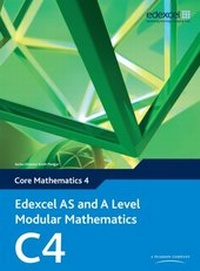
Edexcel AS and A Level Modular Mathematics Core Mathematics 4 C4
1st Edition
Published on 30. September 2016
168 pages
978-1-292-18506-4 (ISBN)
Description

Edexcel and A Level Modular Mathematics C4 features: Student-friendly worked examples and solutions, leading up to a wealth of practice questions. Sample exam papers for thorough exam preparation. Regular review sections consolidate learning. Opportunities for stretch and challenge presented throughout the course. Escalator section to step up from GCSE. PLUS Free LiveText CD-ROM, containing Solutionbank and Exam Caf to support, motivate and inspire students to reach their potential for exam success. Solutionbank contains fully worked solutions with hints and tips for every question in the Student Books. Exam Caf includes a revision planner and checklist as well as a fully worked examination-style paper with examiner commentary.
More details
Other editions
Additional editions
Book
01/2009
Edexcel Limited
€38.50
Shipment within 5-8 weeks
Content
- Cover
- Contents
- About this book
- Chapter 1: Partial fractions
- 1.1: Adding and subtracting algebraic fractions
- 1.2: Partial fractions with two linear factors in the denominator
- 1.3: Partial fractions with three or more linear factors in the denominator
- 1.4: Partial fractions with repeated linear factors in the denominator
- 1.5: Improper fractions into partial fractions
- Summary of key points
- Chapter 2: Coordinate geometry in the (x, y) plane
- 2.1: Parametric equations used to define the coordinates of a point
- 2.2: Using parametric equations in coordinate geometry
- 2.3: Converting parametric equations into Cartesian equations
- 2.4: Finding the area under a curve given by parametric equations
- Summary of key points
- Chapter 3: The binomial expansion
- 3.1: The binomial expansion for a positive integral index
- 3.2: Using the binomial expansion to expand (a+bx)n
- 3.3: Using partial fractions with the binomial expansion
- Summary of key points
- Chapter 4: Differentiation
- 4.1: Differentiating functions given parametrically
- 4.2: Differentiating relations which are implicit
- 4.3: Differentiating the function ax
- 4.4: Differentiation and rates of change
- 4.5: Simple differential equations
- Summary of key points
- Chapter 5: Vectors
- 5.1: Vector definitions and vector diagrams
- 5.2: Vector arithmetic and the unit vector
- 5.3: Using vectors to describe points in 2 or 3 dimensions
- 5.4: Cartesian components of a vector in 2 dimensions
- 5.5: Cartesian components of a vector in 3 dimensions
- 5.6: Extending 2 dimensional vector results to 3 dimensions
- 5.7: The scalar product of two vectors
- 5.8: The vector equation of a straight line
- 5.9: Intersecting straight line vector equations
- 5.10: The angle between two straight lines
- Summary of key points
- Chapter 6: Integration
- 6.1: Integrating standard functions
- 6.2: Integrating using the reverse chain rule
- 6.3: Using trigonometric identities in integration
- 6.4: Using partial fractions to integrate expressions
- 6.5: Using standard patterns to integrate expressions
- 6.6: Integration by substitution
- 6.7: Integration by parts
- 6.8: Numerical integration
- 6.9: Integration to find areas and volumes
- 6.10: Using integration to solve differential equations
- 6.11: Differential equations in context
- Summary of key points
- Review Exercise
- Practice paper
- Examination style paper
- Formulae you need to remember
- List of symbols and notation
- Answers
- Index
