

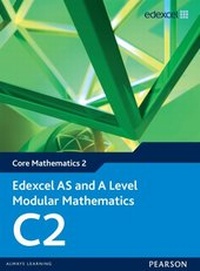
Edexcel AS and A Level Modular Mathematics Core Mathematics 2 C2
1st Edition
Published on 30. September 2016
240 pages
978-1-292-18504-0 (ISBN)
Description

Edexcel and A Level Modular Mathematics C2 features: Student-friendly worked examples and solutions, leading up to a wealth of practice questions. Sample exam papers for thorough exam preparation. Regular review sections consolidate learning. Opportunities for stretch and challenge presented throughout the course. Escalator section to step up from GCSE. PLUS Free LiveText CD-ROM, containing Solutionbank and Exam Caf to support, motivate and inspire students to reach their potential for exam success. Solutionbank contains fully worked solutions with hints and tips for every question in the Student Books. Exam Caf includes a revision planner and checklist as well as a fully worked examination-style paper with examiner commentary.
More details
Other editions
Additional editions
Keith Pledger | Dave Wilkins
Edexcel AS and A Level Modular Mathematics Core Mathematics 2 C2
Book
05/2008
Heinemann
€35.29
Shipment within 5-8 weeks
Content
- Cover
- Contents
- About this book
- Chapter 1: Algebra and functions
- 1.1: You can simplify algebraic fractions by division
- 1.2: Dividing a polynomial by (x ± p)
- 1.3: Factorising a polynomial using the factor theorem
- 1.4: Using the remainder theorem
- Summary of key points
- Chapter 2: The sine and cosine rule
- 2.1: Using the sine rule to find missing sides
- 2.2: Using the sine rule to find unknown angles
- 2.3: The rule and finding two solutions for a missing angle
- 2.4: Using the cosine rule to find an unknown side
- 2.5: Using the cosine rule to find a missing angle
- 2.6: Using the sine rule, the cosine rule and Pythagoras' Theorem
- 2.7: Calculating the area of a triangle using sine
- Summary of key points
- Chapter 3: Exponentials and logarithms
- 3.1: The function y=ax
- 3.2: Writing expressions as a logarithm
- 3.3: Calculating using logarithms to base 10
- 3.4: Laws of logarithms
- 3.5: Solving equations of the form ax=b
- 3.6: Changing the base of logarithms
- Summary of key points
- Chapter 4: Coordinate geometry in the (x , y) plane
- 4.1: The mid-point of a line
- 4.2: The distance between two points on a line
- 4.3: The equation of a circle
- Summary of key points
- Review Exercise 1
- Chapter 5: The binomial expansion
- 5.1: Pascal's triangle
- 5.2: Combinations and factorial notation
- 5.3: Using (n/r) in the binomial expansion
- 5.4: Expanding (a+bx)n using the binomial expansion
- Summary of key points
- Chapter 6: Radian measure and its applications
- 6.1: Using radians to measure angles
- 6.2: The length of the arc of a circle
- 6.3: The area of a sector of a circle
- 6.4: The area of a segment of a circle
- Summary of key points
- Chapter 7: Geometric sequences and series
- 7.1: Geometric sequences
- 7.2: Geometric progressions and the nth term
- 7.3: Using geometric sequences to solve problems
- 7.4: The sum of a geometric series
- 7.5: The sum to infinity of a geometric series
- Summary of key points
- Chapter 8: Graphs of trigonometric functions
- 8.1: Sine, cosine and tangent functions
- 8.2: The values of trigonometric functions in the four quadrants
- 8.3: Exact values and surds for trigonometrical functions
- 8.4: Graphs of sine ?, cos ? and tan ?
- 8.5: Simple transformations of sine ?, cos ? and tan ?
- Summary of key points
- Review Exercise 2
- Chapter 9: Differentiation
- 9.1: Increasing and decreasing functions
- 9.2: Stationary points, maximum, minimum and points of inflexion
- 9.3: Using turning points to solve problems
- Summary of key points
- Chapter 10: Trigonometrical identities and simple equations
- 10.1: Simple trigonometrical identities
- 10.2: Solving simple trigonometrical equations
- 10.3: Solving equations of the form sin(n?+a ), cos(n?+a ) and tan(n?+a ) = k
- 10.4: Solving quadratic trigonometrical equations
- Summary of key points
- Chapter 11: Integration
- 11.1: Simple definite integration
- 11.2: Area under a curve
- 11.3: Area under a curve that gives negative values
- 11.4: Area between a straight line and a curve
- 11.5: The trapezium rule
- Summary of key points
- Review Exercise 3
- Practice paper
- Examination style paper
- Formulae you need to remember
- List of symbols and notation
- Answers
- Index
