

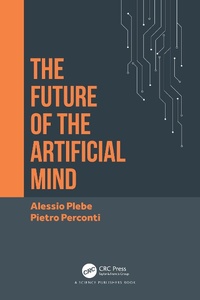
The Future of the Artificial Mind
1st Edition
Published on 8. June 2022
254 pages
978-1-000-61470-1 (ISBN)
Description

The Future of the Artificial Mind is about the social and technological challenges posed by the new wave of artificial intelligence, both from a technical and a cognitive perspective. Deep neural networks have brought about tremendous technological improvements. This renaissance in artificial intelligence, after decades of stagnation, has enabled new technologies capable of surpassing human performance, as in the case of visual recognition.
The book reviews the key ideas that have enabled these goals to be achieved and their historical origins. The book also considers some of the ethical and social challenges that the future development of artificial intelligence will face. Will humans fall in love with future android dolls? What will artificial sex be like? And what will it be like to travel in cars that will treat us as passengers instead of drivers? But predicting the future appears more magic than science. But when it comes to artificial intelligence, it is a constant temptation. Since it is well known that "the only way to get rid of a temptation is to enjoy it!", the hypothesis considered in the last chapter is that emerging trends point to a near future in which intelligence will be ubiquitous, but it will be difficult to identify its bearer. We may be heading towards an era of widespread intelligence, but an intelligence without accountability.
The book reviews the key ideas that have enabled these goals to be achieved and their historical origins. The book also considers some of the ethical and social challenges that the future development of artificial intelligence will face. Will humans fall in love with future android dolls? What will artificial sex be like? And what will it be like to travel in cars that will treat us as passengers instead of drivers? But predicting the future appears more magic than science. But when it comes to artificial intelligence, it is a constant temptation. Since it is well known that "the only way to get rid of a temptation is to enjoy it!", the hypothesis considered in the last chapter is that emerging trends point to a near future in which intelligence will be ubiquitous, but it will be difficult to identify its bearer. We may be heading towards an era of widespread intelligence, but an intelligence without accountability.
More details
Edition
1. Auflage
Language
English
Place of publication
London
United Kingdom
Publishing group
Taylor & Francis Ltd
Target group
College/higher education
Product notice
Reflowable
Illustrations
7 Tables, black and white; 35 Line drawings, black and white; 7 Halftones, black and white; 42 Illustrations, black and white
ISBN-13
978-1-000-61470-1 (9781000614701)
Copyright in bibliographic data and cover images is held by Nielsen Book Services Limited or by the publishers or by their respective licensors: all rights reserved.
Schweitzer Classification
Other editions
Additional editions
Alessio Plebe | Pietro Perconti
The Future of the Artificial Mind
Book
06/2022
1st Edition
CRC Press
€407.40
Shipment within 15-20 days
Alessio Plebe | Pietro Perconti
The Future of the Artificial Mind
Book
06/2022
1st Edition
CRC Press
€171.70
Shipment within 15-20 days
Persons
Alessio Plebe received a degree in Electronic Engineering in 1981 from the University of Rome and a PhD degree in Philosophy of Language from the University of Palermo in 2004. He is Full Professor in Philosophy of Science at the Department of Cognitive Science of the University of Messina. His main research areas are neural computation, its epistemology, and its explanatory power for several cognitive functions. He has developed realistic neural models of visual object recognition, early language acquisition, and moral behaviour. Currently, he is researching the rise of deep learning, its causes and its impact on philosophy and cognitive science.
Pietro Perconti is Full Professor of Philosophy of Mind at the University of Messina, Italy, where he is also head of the Department of Cognitive Science. Perconti studied philosophy at the Universities of Palermo and Berlin (Freie Universitaet) and received a PhD in Philosophy of Language from the University of Palermo in 1996. His first book is devoted to history of ideas (Kantian Linguistics, 1999). Now his main research fields are social cognition, consciousness, and the social role of cognitive science.
Pietro Perconti is Full Professor of Philosophy of Mind at the University of Messina, Italy, where he is also head of the Department of Cognitive Science. Perconti studied philosophy at the Universities of Palermo and Berlin (Freie Universitaet) and received a PhD in Philosophy of Language from the University of Palermo in 1996. His first book is devoted to history of ideas (Kantian Linguistics, 1999). Now his main research fields are social cognition, consciousness, and the social role of cognitive science.
Content
Introduction 1. The Landscape 2. When the Computer First Meets the Mind 3. The Early Shaping of Cognitive Science by Artificial Intelligence 4. Contending Philosophical Frameworks Within Artificial Intelligence 5. An Unexpected Renaissance Age 6. Humans, Machines, and Social Cognition 7. Towards the Hardest Things
