

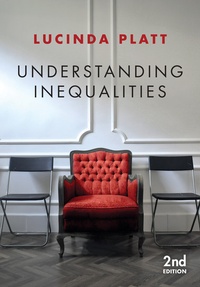
Understanding Inequalities
Stratification and Difference
2nd Edition
Published on 29. May 2019
248 pages
978-1-5095-2129-6 (ISBN)
Description

Bringing together the most recent empirical evidence and the latest theoretical debates, this fully revised new edition gets to grips with a broad range of inequalities in people's lives. Examining social class, gender, ethnicity, disability and migration status, it demonstrates how these play out in relation to education, health, poverty, neighbourhood and housing and how they cumulate across the life course. Richly illustrated with figures and concrete examples showing the distribution of life chances across social groups, the book demonstrates how people's lives are structured by inequalities across multiple dimensions.
Comprehensive topical chapters are framed by an exploration of the meaning and interpretation of inequalities and a discussion highlighting the important intersections between them. With new chapters on disability and international migration, this updated edition continues to provide a wide-ranging but detailed and theoretically sophisticated account of contemporary inequalities that will be invaluable to undergraduate and masters students alike.
More details
Other editions
Additional editions
Book
04/2019
2nd Edition
Polity Press
€82.50
Shipment within 15-20 days
Book
04/2019
2nd Edition
Polity Press
€22.50
Shipment within 15-20 days
Content
Figures, Tables and Boxes
Figures
- 2.1 The class distribution according to the NS-SeC categories, UK, 2011, all persons aged sixteen to seventy-four
- 2.2 Class distribution of men by current age, England and Wales, 2011
- 2.3 Class distribution of women by current age, England and Wales, 2011
- 2.4 Class distribution across ethnic groups, England and Wales 2011, men
- 2.5 Class distribution across ethnic groups, England and Wales 2011, women
- 3.1 Labour force participation among men and women aged fifteen to sixty-four, UK and OECD
- 3.2 Employment ratios among those of working age, selected OECD countries, 2015
- 3.3 Employment rates of men and women aged sixteen to sixty-four, UK, 1971-2013
- 3.4 Share of women in the occupations held by both men and women, UK, 2003-2012
- 3.5 Part-time work as a percentage of employment of men and women in selected OECD countries, 2016
- 3.6 The UK gender pay gap, 1970-2016
- 3.7 Average unpaid and paid work among working-age men and women in selected OECD countries, 2005
- 3.8 Proportion of women in aspired jobs of teenage boys and girls, 2015
- 3.9 Proportion of women in jobs carried out by men and women, 2003-2012
- 4.1 Size and share of white and minority group populations, 1991-2011
- 4.2 Distribution of ethnic minority groups in England and Wales, 2011
- 4.3 Timing of arrival by selected countries of origin, England and Wales, 2011
- 4.4 Economic status: men aged sixteen to sixty-four, England and Wales, 2011
- 4.5 Economic status: women aged sixteen to sixty-four, England and Wales, 2011
- 5.1 Share of top ten countries of origin as a percentage of all those foreign born, England and Wales, 2011
- 5.2 Share of top ten nationalities of all foreign nationals, England and Wales, 2011
- 5.3 Unemployment gap between migrants and non-migrants among those aged sixteen to sixty-four in selected OECD countries, 2017
- 5.4 Unemployment rates for the population aged twenty to sixty-four across the EU, by whether native born, foreign born (EU) or foreign born (outside the EU), 2008-2017
- 5.5 Distribution of qualifications among those native and foreign born of working age (fifteen to sixty-four), selected OECD countries, 2017
- 5.6 Difference in rates of overqualification among migrants compared to non-migrants of working age (fifteen to sixty-four), selected OECD countries, 2017
- 5.7 Health status of those aged thirty-five to forty-nine by time of arrival in the UK, England and Wales, 2011
- 6.1 Employment, unemployment and economic inactivity rates among disabled men and women, UK, April-June 2017 (%)
- 7.1 Rowntree's perspective on the life-cycle alternation of poverty and prosperity
- 7.2 Life expectancy at age sixty-five, selected OECD countries, 2015
- 7.3 Poverty rates among older adults and the whole population, selected OECD countries
- 8.1 Trends in those attaining at least upper secondary and tertiary qualifications, by birth cohort and age, OECD average, 2011
- 8.2 Tertiary qualifications across two age bands, selected OECD countries, 2016
- 8.3 Highest qualification of resident population of England and Wales by age group, 2011, men
- 8.4 Highest qualification of resident population of England and Wales by age group, 2011, women
- 8.5 Attainment of tertiary qualifications among those aged thirty to forty-four with and without a tertiary-educated parent, selected OECD countries, 2015
- 8.6 Attainment of GCSE grades A* to C in English and maths, by free school meals status, England, 2010/11-2015/16
- 8.7 Share of graduates from tertiary education who are women, selected OECD countries, 2015
- 8.8 Attainment of more than five GCSEs at grades A* to C by sex, ethnic group and free school meals status, England, 2013-2014
- 9.1 Poverty rates across selected countries and by individual characteristics, 2014
- 9.2 Persistent and total poverty across the EU and other selected countries, 2015
- 10.1 Infant mortality (rates per 1,000 live births) by neighbourhood deprivation, England, 2016
- 10.2 Obesity (BMI > 30) among adults (aged over eighteen), selected countries, 2016
- 10.3 Different causes of amenable mortality for men and women in the EU, 2015 (% of total deaths)
- 10.4 Different contributors of preventable mortality for men and women in the EU, 2015 (% of total deaths)
- 11.1 Employment rate (% employed of all those aged sixteen to sixty-four) in the UK, by region, 2018
- 11.2 Housing tenure across Europe, 2014
- 11.3 Housing type by tenure, England, 2008
Tables
- 1.1 Key indicators of selected OECD countries used for cross-country comparisons
- 2.1 Illustration of relative and absolute mobility chances
- 3.1 Shares in various occupations of men and women (percentages)
- 4.1 Ethnic group categories in England and Wales, 1991-2011
- 4.2 Proportion of ethnic groups born outside the UK, England and Wales, 2011
- 4.3 Hourly rates of pay by ethnic group and migration status, men and women, UK, 2014
- 5.1 Those wishing to migrate permanently to another country, by region of residence, 2013-2016
- 5.2 Unemployment, employment and participation rates among migrants age sixteen to sixty-four in selected OECD countries, by sex, 2017
- 6.1 The medical (individual) and social models of disability
- 6.2 Attainment at the end of compulsory schooling in England, 2014
- 9.1 Gini coefficients and income distribution, selected OECD countries, 2007 and 2015
- 9.2 Top ten countries for global shares of income, 2012
- 9.3 Income distribution across ethnic groups, UK, 2016
- 9.4 Poverty rates by individual and family characteristics and region, 2015-2016
- 10.1 Top ten global causes of death, 2016
- 10.2 Life expectancy and healthy life expectancy for the ten countries with lowest and highest life expectancy, 2016
- 10.3 Life expectancy and healthy life expectancy, selected OECD countries, 2016
- 10.4 Suicide rates for the ten countries with the lowest and highest rates (numbers per 100,000), 2015
- 10.5 Suicide rates per 100,000 population, selected OECD countries, 2015
- 10.6 Life expectancy and healthy life expectancy for men and women in countries with lowest and highest life expectancy overall, 2016
- 11.1 Local authorities by deprivation according to the indices of multiple deprivation, 2015
Boxes
- 1.1 Defences of inequality
- 2.1 The NS-SeC
- 3.1 Key concepts in measuring labour market differences between men and women
- 4.1 Sources of variation across the UK's minority groups
- 4.2 Potential reasons for differences in work and pay
- 4.3 Ascertaining discrimination
- 5.1 Types of migration
- 6.1 Measuring disability in the...
