

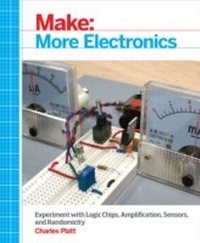
Make: More Electronics
Journey Deep Into the World of Logic Chips, Amplifiers, Sensors, and Randomicity
1st Edition
Published on 29. April 2014
392 pages
978-1-4493-4402-3 (ISBN)
Description

Want to learn even more about electronics in a fun, hands-on way? If you finished the projects in Make: Electronics, or if you're already familiar with the material in that book, you're ready for Make: More Electronics. Right away, you'll start working on real projects, and you'll explore all the key components and essential principles through the book's collection of experiments. You'll build the circuits first, then learn the theory behind them!This book picks up where Make: Electronics left off: you'll work with components like comparators, light sensors, higher-level logic chips, multiplexers, shift registers, encoders, decoders, and magnetic sensors. You'll also learn about topics like audio amplification, randomicity, as well as positive and negative feedback. With step-by-step instructions, and hundreds of color photographs and illustrations, this book will help you use -- and understand -- intermediate to advanced electronics concepts and techniques.
More details
Other editions
Additional editions
Charles Platt
Make: More Electronics
Journey Deep Into the World of Logic Chips, Amplifiers, Sensors, and Randomicity
Book
06/2014
1st Edition
Make Community, LLC
€35.00
Shipment within 10-20 days
Content
- Intro
- Copyright
- Table of Contents
- Acknowledgments
- Preface
- What You Need
- How to Use This Book
- Schematics
- Dimensions
- Math
- Organization
- If Something Doesn't Work
- Writer-Reader Communication
- Me Informing You
- You Informing Me
- You Asking Me
- Before You Write
- Going Further
- A Note from the Publisher: O'Reilly Safari
- Setup
- Power Source
- Regulation
- Boarding School
- Wiring
- Grabbing
- Component Storage
- Verifying
- Chapter 1. Experiment 1: Sticky Resistance
- A Glue-Based Amplifier
- What's Happening
- Symbology
- Warning: Nonstandard Leads
- Background: Conductors and Insulators
- Make Even More
- Chapter 2. Experiment 2: Getting Some Numbers
- Requirements
- Transistor Behavior
- Warning: Meter at Risk!
- Abbreviations and Datasheets
- What About the Voltage?
- Quick Facts About Voltage
- Make Even More: Old-School Metering
- Quick Facts About Transistors
- Answers to Voltage Divider Examples
- Chapter 3. Experiment 3: From Light to Sound
- Photosensitive Audio Pitch
- Chapter 4. Experiment 4: Measuring Light
- Using Phototransistors
- Quick Facts About Phototransistors
- Background: Photons and Electrons
- Quick Facts About the 555
- Quick Facts About CMOS Versus Bipolar
- Chapter 5. Experiment 5: That Whooping Sound
- Make Even More
- Chapter 6. Experiment 6: Easy On, Easy Off
- Making Comparisons
- Quick Facts About Comparators
- Feedback
- Hysteresis
- The Symbol
- Quick Facts About Plus and Minus
- The Output
- More Quick Facts About Comparators
- Inside the Chip
- The Circuit Redrawn
- Warning: Inverted Comparators
- Comparisons with a Microcontroller
- Make Even More: A Laser-Based Security System
- Chapter 7. Experiment 7: It's Chronophotonic!
- Warning: Avoid Dangerous Voltage
- The Circuit Basics
- Step Two
- Circuit Testing
- Relay Details
- The Coupling Capacitor
- Cracking a Clock
- Warning: No AC-Powered Clocks!
- Looking Inside
- Clock Voltage
- How It Beeps
- Using the Beeps
- Hooking Up the Clock
- How It Ought to Work
- Testing
- Connecting Relay to Lamp
- Warning: AC Precautions
- Make Even More
- What's Next?
- Chapter 8. Experiment 8: Adventures in Audio
- Amping Up
- Introducing the Electret
- Can You Hear Me?
- Background: Microphone Miscellany
- Ups and Downs of Sound
- Chapter 9. Experiment 9: From Millivolts to Volts
- Putting a Cap on It
- Introducing the Op-Amp
- What's the Difference?
- A Perfect Pair
- Measuring the Output
- Chapter 10. Experiment 10: From Sound to Light
- An LED-Transistor Combination
- Chapter 11. Experiment 11: The Need for Negativity
- Messing with Measurement
- DC Amplification
- The Ins and Outs of Amplification
- Electronic Ritalin
- Gain
- Background: Negative Origins
- Pushing the Limits
- No Pain, No Gain!
- Phase 1: Output Voltages
- Phase 2: Input Voltages
- Phase 3: Graphing It
- Phase 4: The Gain
- Is It Right?
- Splitting the Difference
- The Basics
- Basic with No Split
- Quick Facts About Op-Amps
- Chapter 12. Experiment 12: A Functional Amplifier
- Introducing the 386 Chip
- The Amplification Circuit
- Troubleshooting the Amplifier
- Chapter 13. Experiment 13: No Loud Speaking!
- Background: The Widlar Story
- Step by Step
- Sensing
- Will It Really Work?
- Background: Voltage Translation
- Noise Protest, Continued
- Power Problems
- Fail?
- Just One More Little Thing
- Chapter 14. Experiment 14: A Successful Protest
- Timing Is Everything
- Revision Summary
- The Noise Test
- Make Even More
- Can You Do It with a Microcontroller?
- What's Next?
- Chapter 15. Experiment 15: It's All So Logical!
- Experiment 15: Telepathy Test
- Background: ESP
- The Setup
- Quick Facts About Logic Chips
- ESP Logic
- Building It
- Making It Better
- Chapter 16. Experiment 16: Enhanced ESP
- Are You Ready?
- Cheating Revealed
- Failure Indicated
- Conflicts
- The Untangling
- Translating the Chart
- Optimizing
- Building It
- Details
- The Digital Difference
- Making It Even Better
- Not So Simple?
- Could We Use a Microcontroller?
- Chapter 17. Experiment 17: Let's Rock!
- Background: Probability
- Background: Game Theory
- The Logic
- Who's On?
- Who's Cheating?
- Background: Gate Arrays
- Chapter 18. Experiment 18: Time to Switch
- Background: An XNOR Made from Light Switches
- Back to the Rock
- Showing Which Button
- Cheat Proofing
- Fit to Be Tied
- Wiring It
- Cheat-Proofed Wiring
- Conclusion
- Chapter 19. Experiment 19: Decoding Telepathy
- Decoder Testing
- Remembering Binary
- Boarding It
- Decoder Pinouts
- Chapter 20. Experiment 20: Decoding Rock, Paper, Scissors
- The Logic
- The Specification
- An Unobtainable Or
- Saved by NOR
- Boarding the Simplified Scheme
- Make Even More
- Undecoding
- Chapter 21. Experiment 21: The Hot Slot
- Muxing It
- Jumping and Roaming
- Quick Facts About Muxes
- Mux Pinouts
- Mux Applications
- Analog Versus Digital Mux
- Quick Facts About Mux Variants
- Game Design
- Slot Counting
- Circuit Design
- Slot Design
- Hot Slot Testing
- Who Wins?
- The Payoff
- Understanding the Odds
- Background: Alternative Game Arrays
- And a Microcontroller?
- Chapter 22. Experiment 22: Logically Audible
- Background: Neither Here nor Theremin
- Logical Audio
- Audible XOR
- All Mixed Up
- Chapter 23. Experiment 23: A Puzzling Project
- Background: The British King of Puzzles
- Moving Counters
- The Logical Grid
- Using Logic
- Switching Ovid
- Making Even More
- Answer to the Puzzle
- Chapter 24. Experiment 24: Adding It Up
- The Five Rules of Binary
- From Bits to States
- Background: The NAND Alternative
- Your Own Little Adder
- Breadboard Addition
- Chapter 25. Experiment 25: Enhancing Your Adder
- Return of the Decoder
- DIPping In
- Introducing an Encoder
- Other Encoder Features
- Background: The Power of Binary
- Background: Encode Your Own
- Make Even More: Other Input Options
- Can We Switch It?
- Make Even More: Switched Binary Adder
- Making a Table
- Switch Specification
- Make Even More: Other Possibilities
- Chapter 26. Experiment 26: Running Rings
- Ring Demo
- Warning: Timer Incompatibilities
- Annoying Pin Sequence
- Quick Facts About Headers
- Quick Facts About Ring Counters
- Making a Game of It
- Additional Features
- Playability
- Make Even More
- And a Microcontroller?
- Chapter 27. Experiment 27: Shifting Bits
- No Bouncing!
- Specifics
- A Bit-Shifting Demo
- Quick Facts About Shift Registers
- Pinouts
- Background: Bit Streams
- Modern Applications
- Chapter 28. Experiment 28: The Ching Thing
- Hexagrams
- The Display
- The Straight and Yarrow Path
- The Numbers
- Random Sampling
- The Look and Feel
- The Details
- Bars or LEDs
- Boarding the Ching Thing
- Assembly and Testing
- Ching Usage
- Packaging
- Chapter 29. Experiment 29: Common Sensors
- The Little Magnetic Switch
- Reed Test
- How It Works
- Level Sensor
- Fuel Gauge
- Quick Facts About Reed Switches
- Easy Substitution
- Installing a Reed Switch
- Background: Magnetic Polarity
- Magnetic Types and Sources
- Magnetic Shapes
- Make Even More: Eddy Currents
- Warning: Magnetic Hazards
- Chapter 30. Experiment 30: Hidden Detectors
- Hall Test
- Applications
- Quick Facts About Hall Sensors
- Hall Types
- Sensor Ideas
- Make Even More: Miniature Roll-the-Ball Game
- Plastic Bending
- Rolling-Ball Electronics
- Chapter 31. Experiment 31: Electronic Optics
- Active Light Sensors
- Warning: Slow Sensor Death!
- The Numbers
- Infrared Sensor Test
- Infrared LED Test
- Phototransistor Test
- Logic Test
- Options
- Quick Facts About Transmissive Optical Sensors
- Better Slots
- Proof of Concept
- The Schematic
- The Breadboard
- The Slot Box
- Chapter 32. Experiment 32: Enhancing Ovid
- The Logic Option
- Switching It Around
- Magnetic Issues
- Make Even More: Microcontrolling It
- Chapter 33. Experiment 33: Reading Rotation
- Defining a Rotational Encoder
- Specification
- The Pulse Train
- Warning: Mediocre Encoders
- Inside the Encoder
- Encoder Usage
- It Can Be Random
- Rotational Decider
- Rotational Equivocator
- Seriously Random
- Chapter 34. Experiment 34: Ambient Sensing
- One Timer Controlling Another
- Temperature Control
- Random Factors
- Automating the Randomizing Circuit
- Background: Lower Counting
- Speed Adjustment
- Quick Facts About Thermistors
- Making a Thermistor More Random
- Humidity Sensor
- Humidity Control
- Accelerometer
- Touch Sensor
- Empirical Issues
- How Random Is Random?
- Chapter 35. Experiment 35: The LFSR
- Getting to Know Your LFSR
- Quick Facts About a LFSR
- Bit-Shifting in Closeup
- The Problem with Zeroes
- The Need to Be Nonrepeating
- Warning: XNOR Idiosyncracies
- Running the Test
- Ones and Zeroes
- The Problem of Weighting
- Skipping 254
- Sharing the Clock Input
- Any Other Options?
- Seeding
- Make Even More: Other Games and Other Numbers
- Make Even More: Microcontroller Randomicity
- Chapter 36. Experiment 36: The One-Person Paranormal Paradigm
- The Last Logic Diagrams
- Looking at Part 2
- Input Logic
- The Ready Signal
- Random Seeding
- Two More XORs
- Timing is Everything
- Making Every Guess Count
- Schematic Part 2
- Testing the Tester
- How Unlikely Is ESP?
- Powers of the Triangle
- John Walker's Probabilities
- Chapter 37. Is That All?
- Appendix A. Bibliography
- Appendix B. Shopping for Parts
- The Kit Option
- Sources
- Generic Components
- Resistors
- Capacitors
- LEDs
- LEDs with internal resistor
- Warning: Series Resistors
- Chip Family Basics
- Transistors
- Switches
- Power Supply, Breadboards, and Wiring
- Minimum Shopping: Experiments 1 Through 14
- Minimum Shopping: Experiments 15 Through 25
- Minimum Shopping: Experiments 26 Through 36
- Moderate Shopping: Experiments 1 Through 14
- Moderate Shopping: Experiments 15 Through 25
- Moderate Shopping: Experiments 26 Through 36
- Maximum Shopping, Experiments 1 Through 14
- Maximum Shopping: Experiments 15 Through 25
- Maximum Shopping: Experiments 26 Through 36
- Incremental Shopping
- Experiment 1
- Experiment 2
- Experiment 3
- Experiment 4
- Experiment 5
- Experiment 6
- Experiment 7
- Experiment 8
- Experiment 9
- Experiment 10
- Experiment 11
- Experiment 12
- Experiment 13
- Experiment 14
- Experiment 15
- Experiment 16
- Experiment 17
- Experiment 18
- Experiment 19
- Experiment 20
- Experiment 21
- Experiment 22
- Experiment 23
- Experiment 24
- Experiment 25
- Experiment 26
- Experiment 27
- Experiment 28
- Experiment 29
- Experiment 30
- Experiment 31
- Experiment 32
- Experiment 33
- Experiment 34
- Experiment 35
- Experiment 36
- Index
- About the Author
