

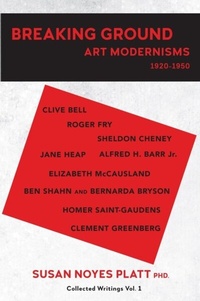
Breaking Ground
Description

Breaking Ground: Art Modernisms 1920-1950 reveals exciting new perspectives on the history of modernist art criticism in the United States. The first essays examine critics who embraced formalism in the 1920s under the impact of the English theorists Roger Fry and Clive Bell. Next is the brilliant Jane Heap's eccentric wedding of mysticism and modernism. At the same time Elizabeth McCausland articulated the principles of the widely accepted concept of socially engaged art during the Depression years. Ben and Bernarda Shahn demonstrate the flexibility of the principle of social engagement, as do the expansive perspectives of Homer Saint-Gaudens during thirty years as the curator of the Carnegie International exhibition.
In these same years, under the pressure of the rise of Fascism, Alfred Barr at the Museum of Modern Art stripped away this inclusive and radical vision. His invention of a myth of modern art evolving toward abstraction became the dominant critical concept of the mid twentieth century through the opportunistic rise of Clement Greenberg during World War II. Breaking Ground: Art Modernisms 1920-1950 overturns the long-codified history of modernist criticism by demonstrating its roots, expansion, and transformations as well as its final ossification.
More details
Content
Roger fry and Clive Bell Transform American Art Criticism in the 1920s
Art Criticism, vol 2, no. 2, 1986, 69-84. (originally titled "Formalism in the 1920s")
Sheldon Cheney: Crusader for Modernism
Archives of American Art Journal, vol. 25, no. 3, 1985, 11-17.
Mysticism in the Machine Age: Jane Heap and The Little Review
Twenty / One, University of Illinois, Chicago, vol. 1, no.1, 1990, 18-44.
Modernism, Formalism, and Politics: the "Cubism and Abstract Art" Exhibition of 1936 at the Museum of Modern Art
Art Journal, vol 47, no.4, 1988, 284-295.
Elizabeth McCausland: 1930s essays on Georgia O'keeffe, Kathe Kollwitz, Gertrude Stein, Martha Graham, and Berenice Abbott
Katy Deepwell, ed.,Women and Modernism, Manchester University Press, 1998, 83-96 (originally titled "Elizabeth McCausland: Art, Politics and Sexuality").
From Immigration to Community: the Jersey Homesteads Mural by Ben Shahn and Bernarda Bryson
Patricia M. Burnham and Lucretia Hoover Geise, eds., Redefining American History Painting, Cambridge University Press, 1995, 294-309 (originally titled "The Jersey Homesteads Mural: Ben Shahn, Bernarda Bryson, and History Painting in the 1930s").
Gambling, Fencing and Camouflage, Homer Saint-Gaudens and the Carnegie International, 1922- 1950
International Encounters: The Carnegie International and Contemporary Art 1896 - 1996, Carnegie Museum, 1996, 66-91.
Franz Kafka, Hans Hofmann and T.S. Eliot: the Formation of Clement Greenberg in the 1930s
Art Criticism, vol. 5, no. 3, 1989, 47-64 (originally titled "Clement Greenberg in the 1930s: A New Perspective on his Criticism").
Original publication formatting retained. All articles published by permission.
