

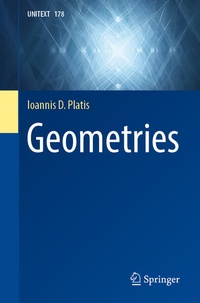
Geometries
Description

The work is an exploration to geometry that transcends traditional approaches, placing Felix Klein's transformative Erlangen Program firmly at its heart. It aims to reveal the essence of geometry through the unifying power of transformation groups and their actions on space. Klein's genius was to define each geometry by the group of transformations that preserve its fundamental properties. This book makes this powerful conceptual framework accessible and compelling. The reader is guided through this perspective, demonstrating how the structure and symmetries of each geometric realm - Euclidean, Similarity, Affine, Spherical, Projective, Inversive, Hyperbolic - are fundamentally defined and understood by the transformations that leave them invariant.
It develops a sophisticated understanding of geometry through the intrinsic symmetries defined by transformation groups. Geometries is an invitation to experience the elegance, power, and breathtaking unity of geometry through the transformative lens pioneered by Klein. The reader is invited to master the language of symmetry and transformation groups, conquer challenging exercises with confidence, and unlock the interconnected universe of geometric spaces, where the abstract becomes tangible, and the transformation is the key. This book is a precise and clear mathematical presentation suitable for advanced undergraduates and graduate students, but also for mathematical educators as well as self-learners.
Reviews / Votes
"Following this textual material, there are three appendices, two providing background material on the Euclidean space Rn and group theory, respectively, and the other providing solutions to a selection of the problems appearing in the text. ... After the appendices, there is a three-page bibliography. ... this is an interesting and quite unusual presentation of undergraduate geometry." (Mark Hunacek, MAA Reviews, maa.org, May 1, 2026)
More details
Other editions
Additional editions
Person
Ioannis D. Platis is a professor in the Department of Mathematics at the University of Patras, Greece, specialising in differential geometry, complex geometry, and geometric structures on manifolds. With a strong academic background, he earned his Ph.D. from the University of Crete and has since conducted extensive research on hyperbolic, complex hyperbolic, CR and sub-Riemannian geometries. Ioannis has held visiting positions at international institutions and collaborates with researchers worldwide. His work has been published in prominent journals, contributing to advancements in geometric analysis and its applications. At the University of Patras, he teaches advanced geometry courses among others, and supervises graduate students. Additionally, he has participated in numerous conferences and organised workshops, promoting geometric research in Greece. His expertise also includes interdisciplinary applications of geometry in physics and engineering. Ioannis is an active member of the Greek mathematical community, fostering academic exchange and research development.
Content
Chapter 1. Historical background.- Chapter 2. Kleinian Geometry.- Chapter 3. Euclidean geometry.- Chapter 4. Similarity geometry.- Chapter 5. Affine geometry.- Chapter 6. Spherical geometry.- Chapter 7. Projective geometry.- Chapter 8. Inversive geometry.- Chapter 9. Hyperbolic geometry.
