

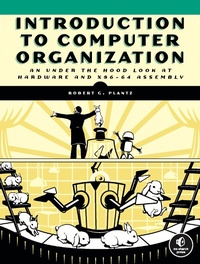
Introduction to Computer Organization
An Under the Hood Look at Hardware and x86-64 Assembly
Published on 25. January 2022
512 pages
978-1-7185-0010-5 (ISBN)
Description

This tutorial-style book provides an introductory "look under the hood" of a modern computer. It covers fundamental topics like data storage formats, computer arithmetic, basic data types, logic gates and circuits, and the CPU.
Unlike other books about assembly language and computer organization, Introduction to Computer Organization is written with the understanding that most programmers will never have to write x86-64 assembly language or design hardware. This book is written to give those programmers a practical and concrete understanding of what's happening in a computer in the hopes that this knowledge will help them become a better programmer in their chosen field.
You'll learn how transistors are used to construct the binary switches that are used to implement the logic circuits that make up a computer; how these circuits are programmed to implement basic programming constructs; and how data items are organized and manipulated. By the end of the book you should have a strong understanding of how binary is used to store data; how Boolean logic works, and how it's implemented in a computer; the basics of computer hardware; and how to use assembly language to implement things like program flow and Input/Output.
Unlike other books about assembly language and computer organization, Introduction to Computer Organization is written with the understanding that most programmers will never have to write x86-64 assembly language or design hardware. This book is written to give those programmers a practical and concrete understanding of what's happening in a computer in the hopes that this knowledge will help them become a better programmer in their chosen field.
You'll learn how transistors are used to construct the binary switches that are used to implement the logic circuits that make up a computer; how these circuits are programmed to implement basic programming constructs; and how data items are organized and manipulated. By the end of the book you should have a strong understanding of how binary is used to store data; how Boolean logic works, and how it's implemented in a computer; the basics of computer hardware; and how to use assembly language to implement things like program flow and Input/Output.
More details
Other editions
Additional editions
Bob Plantz
Introduction to Computer Organization
An Under the Hood Look at Hardware and x86-64 Assembly
Book
01/2022
No Starch Press
€56.00
Shipment within 3-4 weeks
Person
Bob Plantz started his career designing electronics for the horizon scanners on the Gemini spacecraft and Apollo Lunar Module. He earned his PhD in electrical engineering at the University of California Berkeley and worked as a software engineer for eight years before becoming an educator. He was a professor at Sonoma State University for 21 years.
