

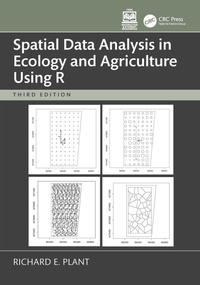
Spatial Data Analysis in Ecology and Agriculture Using R
3rd Edition
Published on 28. January 2026
670 pages
978-1-040-66117-8 (ISBN)
Description

Since the publication of the second edition of Richard Plant's bestselling textbook Spatial Data Analysis in Ecology and Agriculture Using R, the methodology of spatial data analysis and the suite of R tools for carrying out this analysis have evolved dramatically. This third edition thus explores both the leading software tools for the analysis of vector and raster data; the first based on sf and associated libraries, the second based on the terra package as it has evolved out of the earlier raster package.
Further, within the methodology of spatial data analysis, the set of methods available has significantly expanded. This book adds several of the most popular and useful, including machine learning methods in spatial data analysis, the use of simulation methods in spatial data analysis, and a new chapter on the analysis of remotely sensed data. These methods are critically compared in the context of addressing the particular goals of the research project.
The book's practical coverage of spatial statistics, real-world examples, and user-friendly approach make this an essential textbook for ecology and agriculture graduate students. Using data sets from cultivated and uncultivated ecosystems, the book guides the reader through the analysis, including setting research objectives, designing the sampling plan, data quality control, exploratory and confirmatory data analysis, and drawing scientific conclusions.
Additional material to accompany the book, including a review of mathematical concepts, the full data sets, and a brief introduction to geographic coordinate systems, can be accessed via the Instructor Resources link on www.routledge.com.
Further, within the methodology of spatial data analysis, the set of methods available has significantly expanded. This book adds several of the most popular and useful, including machine learning methods in spatial data analysis, the use of simulation methods in spatial data analysis, and a new chapter on the analysis of remotely sensed data. These methods are critically compared in the context of addressing the particular goals of the research project.
The book's practical coverage of spatial statistics, real-world examples, and user-friendly approach make this an essential textbook for ecology and agriculture graduate students. Using data sets from cultivated and uncultivated ecosystems, the book guides the reader through the analysis, including setting research objectives, designing the sampling plan, data quality control, exploratory and confirmatory data analysis, and drawing scientific conclusions.
Additional material to accompany the book, including a review of mathematical concepts, the full data sets, and a brief introduction to geographic coordinate systems, can be accessed via the Instructor Resources link on www.routledge.com.
Reviews / Votes
"Given the widespread availability of large, georeferenced datasets, now is the time for analysts to consider specialized statistical techniques to accommodate spatial autocorrelation and reach valid conclusions about relationships between various attributes. Richard Plant's third edition of "Spatial Analysis in Ecology and Agriculture using R" revisits the research progress in the field of spatial statistics, covering a variety of modeling approaches that will prove to be highly useful to the intelligent non-specialist. Methods are explained in great detail and illustrated with updated R computer code and results from several different application areas. Scientists, researchers, and related professionals who work with georeferenced data will benefit greatly from this highly instructive, readable book."Dan S. Long, Research Agronomist (Emeritus), USDA-ARS Soil and Water Conservation Research, USA
More details
Edition
3rd edition
Language
English
Place of publication
London
United Kingdom
Publishing group
Taylor & Francis Ltd
Target group
College/higher education
Illustrations
25 Tables, black and white; 55 Line drawings, black and white; 149 Halftones, black and white; 204 Illustrations, black and white
File size
67,13 MB
ISBN-13
978-1-040-66117-8 (9781040661178)
Copyright in bibliographic data and cover images is held by Nielsen Book Services Limited or by the publishers or by their respective licensors: all rights reserved.
Schweitzer Classification
Other editions
Additional editions
Richard E. Plant
Spatial Data Analysis in Ecology and Agriculture Using R
Book
approx. 01/2026
3rd Edition
CRC Press
€340.10
Not yet published
Richard E. Plant
Spatial Data Analysis in Ecology and Agriculture Using R
Book
approx. 01/2026
3rd Edition
CRC Press
€127.50
Not yet published
Person
Richard E. Plant is a Professor Emeritus of Plant Sciences and Biological and Agricultural Engineering at the University of California, Davis. He is the co-author of Knowledge-Based Systems in Agriculture and is a former Editor-in-Chief of Computers and Electronics in Agriculture and Associate Editor of Precision Agriculture. He has published extensively on applications of crop modeling, expert systems, spatial statistics, remote sensing, and geographic information systems to problems in crop production and natural resource management.
Content
1. Working with Spatial Data 2. The R Programming Environment 3. Statistical Properties of Spatially Autocorrelated Data 4. Measures of Spatial Autocorrelation 5. Sampling and Data Collection 6. Acquisition and Analysis of Remotely Sensed Data 7. Preparing Spatial Data for Analysis 8. Preliminary Exploration of Spatial Data 9. Non-Spatial Methods: Linear and Additive Models 10. Variance Estimation, the Effective Sample Size, and the Bootstrap 11. Measures of Bivariate Association between Two Spatial Variables 12. Machine Learning Methods 1: Recursive Partitioning 13. Machine Learning Methods 2: Supervised Classification Methods: 14. The Mixed Model 15. Regression Models for Spatially Autocorrelated Data 16. Assembling Conclusions. Appendix A. Review of Mathematical Concepts
