

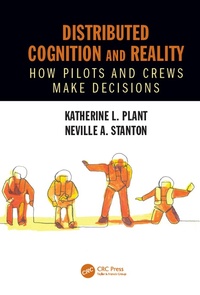
Distributed Cognition and Reality
How Pilots and Crews Make Decisions
Published on 30. November 2016
276 pages
978-1-317-14940-8 (ISBN)
Description

Distributed Cognition and Reality puts theory into practice, as the first book to show how to apply the Perceptual Cycle Model in aviation decision making. Based on case studies, critical incident interviews and live observations in cockpits, the authors develop a new way to understand how pilots and crews make decisions. This book will be useful for practitioners involved in accident and incident investigations and decision-making training, researchers and students within the disciplines of Aviation, Human Factors, Ergonomics, Engineering, Computer Science, and Psychology.
Dr Katherine L Plant is a New Frontiers Fellow in Human Factors Engineering at the University of Southampton in the UK. In 2014 she was awarded the Honourable Company of Air Pilots Prize for Aviation Safety Research.
Professor Neville A Stanton holds the Chair in Human Factors Engineering at the University of Southampton in the UK. In 2007 The Royal Aeronautical Society awarded him the Hodgson Medal for his work on flight-deck safety.
Dr Katherine L Plant is a New Frontiers Fellow in Human Factors Engineering at the University of Southampton in the UK. In 2014 she was awarded the Honourable Company of Air Pilots Prize for Aviation Safety Research.
Professor Neville A Stanton holds the Chair in Human Factors Engineering at the University of Southampton in the UK. In 2007 The Royal Aeronautical Society awarded him the Hodgson Medal for his work on flight-deck safety.
Reviews / Votes
The perceptual-cycle model (PCM) is one of the few approaches that truly integrates humans, systems, and environments. Plant and Stanton's thorough and detailed explanation of PCM, along with its application to understanding pilot decision making in critical situations, is a tremendously valuable resource for researchers and practitioners in this field. This book will be indispensable for all of us in the field of aviation human factors.Professor Steven Landry, Purdue University, USAPlant and Stanton have produced a remarkable piece of work in the field of aeronautical decision making. As an expert in the field, I find the Perceptual Cycle Model is extremely interesting. This book will be a valuable reference for accident analysis in practice as well as offering new research directions in the field. Prof Guy Andre Boy, Florida Institute of Technology, USA
This book challenges existing cognitive explanations of decision making to look beyond individual models and consider the dynamic collaborations between crew members.This book provides an analytic framework for improving our understanding of the precursors to critical events.A key contribution is to demonstrate the practical utility of tools that have a strong theoretical foundation. Professor Chris Johnson, University of Glasgow, UK
This book deserves a large audience and the theory is applicable to much wider domains for investigating incidents in other safety-critical systems. It moves significantly beyond the state-of-the-art accounts of learning from (human) error and contains many stimulating ideas for future research and practice in cognitive systems. I can highly recommend this book to engineers, practitioners, and academics who work on improving the safety of complex socio-technical systems, both through their design and in training the human operators. Professor Max Mulder, Technical University Delft, The Netherlands
More details
Language
English
Place of publication
London
United Kingdom
Publishing group
Taylor & Francis Ltd
Target group
Professional and scholarly
Product notice
Reflowable
Illustrations
34 Tables, black and white; 43 Illustrations, black and white
File size
5,00 MB
ISBN-13
978-1-317-14940-8 (9781317149408)
Copyright in bibliographic data and cover images is held by Nielsen Book Services Limited or by the publishers or by their respective licensors: all rights reserved.
Schweitzer Classification
Other editions
Additional editions
Katherine L. Plant | Neville A. Stanton
Distributed Cognition and Reality
How Pilots and Crews Make Decisions
Book
12/2019
1st Edition
CRC Press
€95.90
Shipment within 15-20 days
Katherine L. Plant | Neville A. Stanton
Distributed Cognition and Reality
How Pilots and Crews Make Decisions
Book
10/2016
1st Edition
CRC Press
€215.41
Shipment within 10-20 days
Persons
Dr Katherine Plant has been working as a human factors researcher at the University of Southampton since 2009. During this time she has worked on a variety of European Union funded projects in the field of aviation human factors. This work has primarily focused on applying human factors methods in the development and evaluation of future cockpit concepts. Katherine has published a number of papers in peer-reviewed journals. In June 2015 Katherine was awarded a PhD in Human Factors from the University of Southampton, UK. The Honourable Company of Air Pilots awarded this work their Saul Prize for aviation safety research in May 2014. Professor Neville A Stanton, PhD, is both a Chartered Psychologist and a Chartered Engineer and holds the Chair in Human Factors in the Faculty of Engineering and the Environment at the University of Southampton. He has degrees in Psychology, Applied Psychology and Human Factors and has worked at the Universities of Aston, Brunel, Cornell and MIT. His research interests include modelling, predicting and analysing human performance in transport systems as well as designing the interfaces between humans and technology. Professor Stanton has worked on cockpit design in automobiles and aircraft over the past 25 years, working on a variety of automation projects. He has published 30 books and over 200 journal papers on Ergonomics and Human Factors, and is currently an editor of the peer-reviewed journal Ergonomics. The Institute of Ergonomics and Human Factors awarded him The Otto Edholm Medal in 2001, The President's Medal in 2008 and The Sir Frederic Bartlett Medal in 2012 for his contribution to basic and applied ergonomics research. The Royal Aeronautical Society awarded him and his colleagues the Hodgson Prize and Bronze Medal in 2006 for research on design-induced flight-deck error published in The Aeronautical Journal. The University of Southampton awarded him a DSc in 2014 for his sustained contribution to the development and valid
Content
Introduction. Schema Theory: Past, Present, and Future. A Case Study of the Kegworth Plane Crash: Understanding Local Rationality with the Perceptual Cycle Model. A Pilot Study: Using the Perceptual Cycle Model and Critical Decision Method to Understand Decision-Making Processes in the Cockpit. Examining the Validity of Neisser's Perceptual Cycle Model with Accounts from Critical Decision-Making in the Cockpit. The Development of a Perceptual Cycle Classification Scheme. The Schema World Action Research Method (SWARM) for Understanding Perceptual Cycle Processes. Team Perceptual Cycle Processes. Exploring Distributed Cognition in Search and Rescue Teams.
