

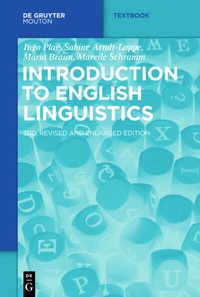
Introduction to English Linguistics
Description

The new and updated third edition of this highly successful textbook contains an additional chapter that presents modern empirical research methods in the form of exemplary small-scale studies. In these projects the authors invite the reader to develop and address research questions from phonetics/phonology, morphology and syntax. The pertinent experimental and corpus-linguistic techniques are introduced and students are familiarized with some basic statistical tools necessary for the analysis of the data.
The major difference between this book and its potential competitors lies in its hands-on didactic orientation, with a strong focus on linguistic analysis and argumentation. Language and linguistic theory are approached from a strictly empirical perspective: given a certain set of data to be accounted for, theoretical and methodological problems must be solved in order to analyze and understand the data properly. The book is not written from the perspective of a particular theoretical framework and draws on insights from various research traditions. Introduction to English Linguistics concentrates on gaining expertise and analytical skills in the traditional core areas of linguistics, i.e. phonology, morphology, syntax, semantics and pragmatics. The chapter on "Extensions and applications" widens the perspective to other areas of linguistic research, such as historical, socio- and psycholinguistics. Each chapter is accompanied by exercises and suggestions for further reading. A glossary and an index facilitate access to terms and topics.
Reviews / Votes
"[...] an excellent introduction [...]"
Claudia Claridge
in: Anglistik: International Journal of English Studies 28.1 (March 2017), pp. 155-156
"[...] the book is indeed enjoyable. University students all over the globe will, undoubtedly, find it stimulating and inspiring."
Dinha T. Gorgis in: Linguist List 21.664
More details
Other editions
Additional editions
Previous edition
Persons
Content
- Intro
- Table of contents
- Preface to the first edition
- Preface to the second edition
- Preface to the third edition
- Abbreviations and notational conventions
- Introduction: what this book is about and how it can be used
- 1. The sounds: phonetics
- 2. The sound system: phonology
- 3. The structure of words: morphology
- 4. The structure of sentences: syntax
- 5. The meaning of words and sentences: semantics
- 6. Studying language in use: pragmatics
- 7. Extensions and applications: historical linguistics, sociolinguistics and psycholinguistics
- 8. Linguistics as an empirical science
- Glossary
- References
- Subject index
