


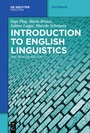
Introduction to English Linguistics
Description

The book introduces beginning university students of English to the study of English linguistics. The major difference between this book and its potential competitors lies in its hands-on didactic orientation, with a strong focus on linguistic analysis and argumentation. Language and linguistic theory are approached from a strictly empirical perspective: given a certain set of data to be accounted for, certain theoretical and methodological problems must be solved in order to analyze and understand the data properly. Thus, the theoretical apparatus is crucially developed in conversation with the data, and not presented as a set of given facts. After having worked with the book, the students should be able to use necessary methodological tools to obtain relevant data (such as corpora, dictionaries, experiments), and to systematically analyze their data and relate their findings to theoretical problems. The book is not written from the perspective of a particular theoretical framework and draws on insights from various research traditions.
Introduction to English Linguistics
concentrates on gaining expertise and analytical skills in the traditional core areas of linguistics, i.e. phonology, morphology, syntax, semantics and pragmatics. The final chapter on "Extensions and applications" widens the perspective to other areas of linguistic research, such as historical, socio- and psycholinguistics. Exercises and a glossary are also provided.
Reviews / Votes
"Overall, I find this to be an excellent textbook introducing the linguistic analysis of English. All the terminology and analytical techniques are presented thoroughly, and are applied to a wide range of data from English. I particularly like the fact that examples from the BNC are brought in as additional evidence. Specific issues in the analysis of English are covered, such as the wide range of allomorphs, and it is good to see that the conditioning of these morphs are dealt with as well. The exercises cover the material in each chapter, and extend it to give the student insights into further study. The glossary is comprehensive."Jonathan White in: http://linguistlist.org/issues/19/19-213.html "Overall this is a extremely well written and highly useful introductory textbook on linguistics. [...] In short, this is an excellent introduction that can be read with great profit by both instructors and students in linguistics."Parth Bhatt in: The Canadian Journal of Linguistics 3/2008More details
Other editions
New editions
Additional editions

Persons
Content
- Intro
- Preface
- Abbreviations and notational conventions
- Introduction
- 1. The sounds: phonetics
- 1.1 Introduction
- 1.2 Spelling vs. pronunciation: the representation of speech sounds
- 1.3 Producing sounds
- 1.4. How sounds differ from each other: the classification of speech sounds
- 1.5. Conclusion
- Further reading
- Exercises
- 2. The sound system: phonology
- 2.1 Introduction
- 2.2 Introducing order into the chaos: the phoneme
- 2.3 The key to finding the order
- 2.4 More about the sound system of English
- 2.5 The syllable
- 2.6 Conclusion
- Further reading
- Exercises
- 3. The structure of words: morphology
- 3.1 Introduction
- 3.2 Minimal building blocks: morphemes
- 3.3 Types of morphemes
- 3.4 Morphological analysis of words
- 3.5 Realisation of morphemes: allomorphs
- 3.6 Morphological processes: inflection and derivation
- 3.7 Word-formation
- 3.8 Conclusion
- Further reading
- Exercises
- 4. The structure of sentences: syntax
- 4.1 Introduction
- 4.2 The building blocks: words and phrases
- 4.3. The functional level: subjects, objects, adverbials, predicates
- 4.4 The mapping of form and function
- 4.5 Conclusion
- Further reading
- Exercises
- 5. The meaning of words and sentences: semantics
- 5.1. Introduction
- 5.2. What does 'meaning' mean? Words, concepts, and referents
- 5.3 Compositional and non-compositional meaning
- 5.4 The network: organising word meaning
- 5.5 Conclusion
- Further reading
- Exercises
- 6. Studying language in use: pragmatics
- 6.1 Introduction
- 6.2 Expressing intentions through language
- 6.3 Understanding utterance meaning
- 6.4 Exploring pragmatic principles
- 6.5 Conclusion
- Further reading
- Exercises
- 7. Extensions and applications: historical linguistics, sociolinguistics and psycholinguistics
- 7.1 Introduction
- 7.2 Historical linguistics: how languages develop
- 7.3 Sociolinguistics: the social significance of language
- 7.4 Psycholinguistics: how do we store and process language?
- 7.5 Conclusion
- Further reading
- Exercises
- Glossary
- References
- Subject index
