

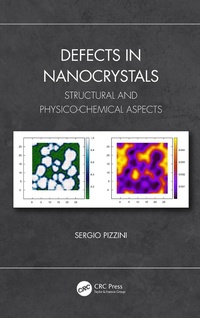
Defects in Nanocrystals
Structural and Physico-Chemical Aspects
1st Edition
Published on 11. May 2020
294 pages
978-1-000-06615-9 (ISBN)
Description

Defects in Nanocrystals: Structural and Physico-Chemical Aspects discusses the nature of semiconductor systems and the effect of the size and shape on their thermodynamic and optoelectronic properties at the mesoscopic and nanoscopic levels. The nanostructures considered in this book are individual nanometric crystallites, nanocrystalline films, and nanowires of which the thermodynamic, structural, and optical properties are discussed in detail. The work:
Outlines the influence of growth processes on their morphology and structure
Describes the benefits of optical spectroscopies in the understanding of the role and nature of defects in nanostructured semiconductors
Considers the limits of nanothermodynamics
Details the critical role of interfaces in nanostructural behavior
Covers the importance of embedding media in the physico-chemical properties of nanostructured semiconductors
Explains the negligible role of core point defects vs. surface and interface defects
Written for researchers, engineers, and those working in the physical and physicochemical sciences, this work comprehensively details the chemical, structural, and optical properties of semiconductor nanostructures for the development of more powerful and efficient devices.
Outlines the influence of growth processes on their morphology and structure
Describes the benefits of optical spectroscopies in the understanding of the role and nature of defects in nanostructured semiconductors
Considers the limits of nanothermodynamics
Details the critical role of interfaces in nanostructural behavior
Covers the importance of embedding media in the physico-chemical properties of nanostructured semiconductors
Explains the negligible role of core point defects vs. surface and interface defects
Written for researchers, engineers, and those working in the physical and physicochemical sciences, this work comprehensively details the chemical, structural, and optical properties of semiconductor nanostructures for the development of more powerful and efficient devices.
Reviews / Votes
Defects in Nanocrystals concentrates on the physicochemical properties of nanostructured semiconductors. Although properties of materials are enhanced in nanostructures and nanocrystals due to the higher proportion of surfaces compared to the situation characteristic of bulk materials, the differing properties are further influenced by defects in the nanocrystals. This situation is summarized in the conclusion of Chapter 1 as "small is beautiful and useful." The physics and thermodynamics of nanostructures are discussed in Chapter 2, the preparation and properties of nanocrystalline silicon materials in Chapter 3, and other materials in Chapter 4. Optical properties of defects in semiconductor nanomaterials are then covered in Chapter 5. The literature of nanomaterials is massive and the author has been selectively inclusive. The audience for this work would include scholars and professionals concerned with the analysis and technology of nanocrystalline semiconductor materials.--R. E. Buntrock, independent scholar, CHOICE, June 2021
More details
Edition
1. Auflage
Language
English
Place of publication
London
United Kingdom
Publishing group
Taylor & Francis Ltd
Target group
College/higher education
Product notice
Reflowable
Illustrations
18 Tables, black and white; 13 Illustrations, color; 161 Illustrations, black and white
ISBN-13
978-1-000-06615-9 (9781000066159)
Copyright in bibliographic data and cover images is held by Nielsen Book Services Limited or by the publishers or by their respective licensors: all rights reserved.
Schweitzer Classification
Other editions
Additional editions
Book
02/2022
1st Edition
CRC Press
€123.00
Shipment within 15-20 days
Book
05/2020
1st Edition
CRC Press
€263.20
Shipment within 15-20 days
Person
Sergio Pizzini started his carrier at the Joint Research Centre of the European Commission in Ispra (Italy) and later in Petten (Nederland), committed to studies of a fuel for a molten salt reactor, within a Joint Program with the Oak Ridge Centre in USA. After leaving the Commission he joined the University of Milano as Associated Professor, where he started basic studies on solid electrolytes, which also resulted in the realization of a prototype of a solid electrolyte gas sensor and of a solid state sensor for the determination of the stoichiometry of nuclear oxide fuels. Still maintaining his position at the University, he worked for five years as Director of the Materials Department of the Corporate Research Centre of Montedison in Novara, where he launched a number of new R&D activities on advanced materials for electronics. After having left Montedison he founded the Heliosil Company, where as its CEO he studied a process for the production of solar grade silicon and patented a furnace and a process for the directional solidification of silicon in multicrystalline ingots. In 1982 he left any outside duty for serving the University of Milano, and later, the University of Milano-Bicocca, as full Professor of Physical Chemistry. In this last period of activity, in addition to his teaching and management duties, he carried out systematic studies on semiconductor silicon, mostly addressed at the understanding of electronic and optical properties of point and extended defects of Czochralski, multicrystalline and nanocrystalline silicon in the frame of national and European Projects.
Sergio Pizzini is author of more than 250 technical papers published in international Journals. He authored or co-authored four books and was Chairman or Co-Chairman of a number of international symposia in the materials science field. After his retirement, he serves the University of Milano-Bicocca with an external cooperation.
Sergio Pizzini is author of more than 250 technical papers published in international Journals. He authored or co-authored four books and was Chairman or Co-Chairman of a number of international symposia in the materials science field. After his retirement, he serves the University of Milano-Bicocca with an external cooperation.
Content
Chapter 1 Basic Physico-Chemical Concepts and Potential Applications of Nanosized Semiconductors Chapter 2 Physics and Thermodynamics of Nanostructures Chapter 3 Preparation, Structural, and Physical Properties of Nanocrystalline Silicon, Germanium, and Diamond Nanocrystals, Films, and Nanowires Chapter 4 Preparation, Structural, and Physical Properties of Nanocrystalline Dots, Films, and Nanowires of Compound Semiconductors Chapter 5 Optical Signatures of Defects in Semiconductor Nanostructures
