

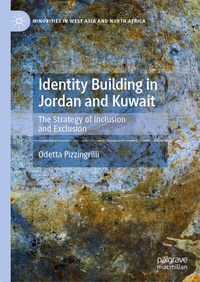
Identity Building in Jordan and Kuwait
Description

How do spatial dynamics and narrated identities shape each other? How do the ongoing processes of inclusion and exclusion construct individual and group self-perceptions within the Kuwaiti and Jordanian societies?
In this book, the author explores these questions through a spatial lens, examining the evolving narrated identities within Kuwait and Jordan. The monograph contributes to MENA studies, Middle Eastern history, nationalism, minority studies, late Ottoman studies, post-colonialism, national and transnationalism, and the history of epistemology.
More details
Other editions
Additional editions
Person
Odetta Pizzingrilli is a Senior Researcher and coordinator at the Renaissance Strategic Center (RSC) of the NGO Arab Renaissance for Democracy and Development (ARDD). Previously a researcher at the Center for Strategic Studies (CSS) of the University of Jordan, she was research fellow at the Faculty of Political Science of Luiss Guido Carli in where she obtained her PhD.
Content
Introduction.- Part I: The Hashemite Kingdom of Jordan.- Chapter 1: Methodology: Interviewing outside the interview society.- Chapter 2: The narrated identities of Jordan.- Chapter 3: The Jordanian awakening ten years later?.- Part II: The State of Kuwait.- Chapter 4: Overview.- Chapter 5: The narrated identities of Kuwait.- Chapter 6: The Kuwaiti awakening ten years later.- Conclusion.
