

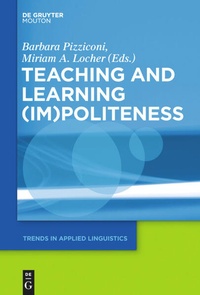
Teaching and Learning (Im)Politeness
Description

This collection combines research from the field of (im)politeness studies with research on language pedagogy and language learning. It aims to engender a useful dialogue between (im)politeness theorists, language teachers, and SLA researchers, and also to broaden the enquiry to naturalistic contexts other than L2 acquisition classrooms, by formulating 'teaching' and 'learning' as processes of socialization, cultural transmission, and adaptation.
Reviews / Votes
"In sum, this book breaks new ground in illuminating the largely unexamined interface between (im)politeness research and language learning/pedagogy. The eclectic nature of the collection affords it wide-ranging relevance, engaging policy makers, researchers in linguistic (im)politeness, language pedagogy specialists, and classroom practitioners alike. It will serve as an ideal springboard for further dialogue into this fascinating and important area of study."
lan Walkinshaw in: Journal of Politeness Research 2017; 13(1): 169-173
"I highly recommend this book for researchers and graduate students in the fields of first/second language pragmatics, (im)politeness research, and second language acquisition and pedagogy."
Wei Ren in: LINGUIST List 27.4143
More details
Other editions
Additional editions
Persons
Content
- Intro
- Acknowledgements
- Table of contents
- 1. Introducing the 'teaching' and 'learning' of (im)politeness
- I. (Im)politeness in L2 instructional contexts
- 2. Teaching politeness?
- 3. Voices from the Japanese language classroom: Honorifics do far more than politeness
- 4. (Im)politeness and L2 socialization: Using reactions from online fora to a world leader's 'impolite' behavior
- 5. Teaching and learning (im)politeness: A look at the CEFR and pedagogical research
- II. 'Teaching' and 'learning' (about) (im)politeness in L1 and L2
- 6. Paths to politeness: Exploring how professional interpreters develop an understanding of politeness norms in British Sign Language and English
- 7. "After all, the last thing I wanted to be was rude": Raising of pragmatic awareness through reflective writing
- 8. Children instructing kin and peers in politeness routines in Japanese
- 9. Epilogue: Impoliteness in learning and teaching
- Bionotes
- Author index
- Subject index
