

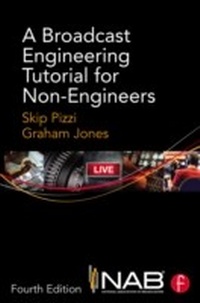
A Broadcast Engineering Tutorial for Non-Engineers
4th Edition
Published on 24. April 2014
360 pages
978-1-317-90683-4 (ISBN)
Description

A Broadcast Engineering Tutorial for Non-Engineers is the leading publication on the basics of broadcast technology. Whether you are new to the industry or do not have an engineering background, this book will give you a comprehensive primer of television, radio, and digital media relating to broadcast-it is your guide to understanding the technical world of radio and television broadcast engineering. It covers all the important topics such as DTV, IBOC, HD, standards, video servers, editing, electronic newsrooms, and more.
This long-awaited fourth edition includes new standards and identifies and explains the emerging digital technologies that are revolutionizing the industry, including:
HDTV-and "UltraHD"
IP-based production and distribution and Internet delivery (including "over-the-top" TV)
Connected/Smart TV, Mobile TV Second Screens and Social TV
"Hybrid" broadcasting (over-the-air and online convergence)
Podcasting and Mobile Apps
Connected Cars
This long-awaited fourth edition includes new standards and identifies and explains the emerging digital technologies that are revolutionizing the industry, including:
HDTV-and "UltraHD"
IP-based production and distribution and Internet delivery (including "over-the-top" TV)
Connected/Smart TV, Mobile TV Second Screens and Social TV
"Hybrid" broadcasting (over-the-air and online convergence)
Podcasting and Mobile Apps
Connected Cars
Reviews / Votes
'The 4th Edition, published post the digitalization of TV with ATSC transmissions, presents an unprecedented overview of the new world of broadcasting with contemporary technologies being brought to the fore with amazing clarity. Retaining broadcasting as its core theme, it brings you up to speed with the entire chain involved-acquisition, production, broadcasting and streaming. A must-read for all professionals.' - Amitabh Kumar, Zee Network, India'This book is a great source for quickly finding what a particular broadcast-related acronym stands for. Think of this text as a relief valve that lets an interested reader reasonably drink from a high-pressure technical information water main.' - Dane Ericksen, Hammett & Edison, Inc., USA
'This book is a must-have for all those in the broadcast industry and reads like a well-written operating manual for your broadcast operation. Skip Pizzi is one of those rare gems-a polymath who can translate complex concepts to the lay person. His deep knowledge allows him to analyze the past and provide a glimpse into what's possible in the future.' - Jennifer Ferro, President/General Manager, KCRW 89.9, USA
More details
Edition
4th edition
Language
English
Place of publication
London
United Kingdom
Publishing group
Taylor & Francis Ltd
Target group
Professional and scholarly
<P>Non-technical managers and executives in broadcast and multimedia companies.</P>
Edition type
Revised edition
Illustrations
75 s/w Abbildungen, 5 s/w Tabellen
5 Tables, black and white; 75 Illustrations, black and white
File size
3,34 MB
ISBN-13
978-1-317-90683-4 (9781317906834)
Copyright in bibliographic data and cover images is held by Nielsen Book Services Limited or by the publishers or by their respective licensors: all rights reserved.
Schweitzer Classification
Other editions
Additional editions
Skip Pizzi | Graham Jones
A Broadcast Engineering Tutorial for Non-Engineers
Book
04/2014
4th Edition
Routledge
€232.50
Shipment within 15-20 days
Skip Pizzi | Graham Jones
A Broadcast Engineering Tutorial for Non-Engineers
Book
03/2014
4th Edition
Routledge
€77.30
Shipment within 15-20 days
Persons
Skip Pizzi is Senior Director of New Media Technologies at NAB, where he focuses on new methods for creation and delivery of broadcast content. He is also Vice-Chair of ATSC Technology Group 3 (TG3), which is developing standards for the next generation of digital television. Previously he worked in multimedia for 11 years at Microsoft, served as an editor and contributor to several broadcast technology books and journals, and consulted to the professional, educational and government sectors of the media industry worldwide. He began his career as an engineer, manager and technical trainer at NPR. He is a recipient of the Audio Engineering Society's Board of Governors Award, and a graduate of Georgetown University, where he studied Electrical Engineering, Fine Arts, and International Economics.
Graham Jones retired in 2010 from NAB, where he was a Senior Director working on advanced television issues. He is still active in ATSC, SCTE, and SMPTE standards committees. Previously he was Engineering Director for the Harris/PBS DTV Express, which introduced DTV to many U.S. broadcasters. He started his career with the BBC in London, and has worked as a consultant to broadcasters in many parts of the world. He holds a degree in physics, is a chartered electrical engineer, a fellow of SMPTE, and a life member of the SBE and the Royal Television Society. He has been honored with the Bernard J. Lechner Outstanding Contributor Award from the ATSC and received a citation from SMPTE for outstanding service to the society.
Graham Jones retired in 2010 from NAB, where he was a Senior Director working on advanced television issues. He is still active in ATSC, SCTE, and SMPTE standards committees. Previously he was Engineering Director for the Harris/PBS DTV Express, which introduced DTV to many U.S. broadcasters. He started his career with the BBC in London, and has worked as a consultant to broadcasters in many parts of the world. He holds a degree in physics, is a chartered electrical engineer, a fellow of SMPTE, and a life member of the SBE and the Royal Television Society. He has been honored with the Bernard J. Lechner Outstanding Contributor Award from the ATSC and received a citation from SMPTE for outstanding service to the society.
Content
1. Introduction
BROADCASTING BASICS
2. Types of Broadcasting
3. Sound and Vision
4. Analog Color Television
5. Digital Audio and Video
6. Information Technology
7. Radio Frequency Waves
STUDIOS AND, PRODUCTION, AND PLAYOUT FACILITIES
8. Radio Studios
9. Television Studios and Playout Facilities
10. Remote Broadcasting
11. Links
TRANSMISSION STANDARDS AND SYSTEMS
12. Analog Radio
13. IBOC Digital Radio
14. Alternate Radio Delivery Systems
15. NTSC Analog Television
16. ATSC Digital Television
17. Alternate Television Delivery Systems
18. Next-Generation Television Systems
19. Transmitter Site Facilities
20. Radio Wave Propagation and Broadcast Regulation
21. Conclusion
BROADCASTING BASICS
2. Types of Broadcasting
3. Sound and Vision
4. Analog Color Television
5. Digital Audio and Video
6. Information Technology
7. Radio Frequency Waves
STUDIOS AND, PRODUCTION, AND PLAYOUT FACILITIES
8. Radio Studios
9. Television Studios and Playout Facilities
10. Remote Broadcasting
11. Links
TRANSMISSION STANDARDS AND SYSTEMS
12. Analog Radio
13. IBOC Digital Radio
14. Alternate Radio Delivery Systems
15. NTSC Analog Television
16. ATSC Digital Television
17. Alternate Television Delivery Systems
18. Next-Generation Television Systems
19. Transmitter Site Facilities
20. Radio Wave Propagation and Broadcast Regulation
21. Conclusion
