

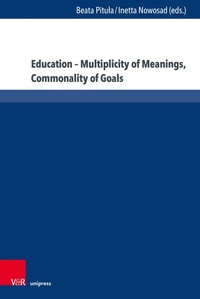
Education - Multiplicity of Meanings, Commonality of Goals
1st Edition
Published on 14. February 2022
239 pages
978-3-8470-1422-5 (ISBN)
Description

New technologies, innovative industry and digital revolution are changing today's world on an unprecedented scale. The changes touch all spheres of human existence creating the conditions for realising the vision of a better world and building a new society. This requires more and more openness, creativity and innovativeness in human thinking and activities, imply the need for changes in education. This is so as only education - the 'treasure' also of the 21st century - can live up to the challenge as long, however, as it is universal, fully accessible, flexible, open, innovative and creative. Along the lines of this thesis, this volume presents different views on selected problems of education of teachers in different specialities, with the aim of making the basis for in-depth analyses and optimal solutions.
Beata Pitu?a is Associate Professor at the Faculty of Mining, Safety Engineering and Industrial Automation of the Silesian University of Technology, Poland.
Beata Pitu?a is Associate Professor at the Faculty of Mining, Safety Engineering and Industrial Automation of the Silesian University of Technology, Poland.
More details
Other editions
Additional editions
Beata Pitula | Inetta Nowosad
Education - Multiplicity of Meanings, Commonality of Goals
Book
02/2022
1st Edition
Brill Deutschland
€45.00
Shipment within 7-9 days
Persons
Beata Pitula is Associate Professor at the Faculty of Mining, Safety Engineering and Industrial Automation of the Silesian University of Technology, Poland.
Content
- Intro
- Title Page
- Copyright
- Table of Contents
- Body
- Introduction
- Part I: Towards global challenges
- Jolanta Szempruch: The goals of modern education in changing society
- Principles of social life
- The functioning of an individual in a changing society
- Features of the modern society
- Goals of education in the face of social change
- References
- Beata Pitula: Correlation of communication relations between the teacher and the student in the teaching process and theories of individual personality traits
- The perspective of the theory of constant individual personality traits in the context of communication between the teacher and the student
- Introduction
- The concept of constant individual personality traits according to Jolanta Wilsz - general take
- Suggested values of the teacher's traits for optimisation of communication with the student
- The teacher's constant individual personality traits and communication
- Empirical verification of the theses of the constant individual personality traits
- Conclusion
- References
- Inetta Nowosad: Innovation and ICT in school education
- Understanding innovation
- Features of innovation in education/learning
- ICT in practicing innovation at school
- Summary
- Bibliography
- Danuta Uryga / Marta Wiatr: School Space as Teaching and Learning Technology - Social World Perspective
- Introduction
- What can/should be shown?
- Teaching places
- Theme rooms
- Study rooms
- Summary
- References
- Bibliografia
- Barbara Grzyb: Virtual University - Reality vs Evaluation by the Polish Pedagogy Students
- Introduction
- Distance Learning in the Pandemic
- Methodological Assumptions
- Studied Population
- Own Research
- Summary
- References
- Elzbieta Jaszczyszyn: Community of goals and differentiated ways of achieving them in preschool education
- Between the uniformity of education and the diversity of development
- New modernity - social change
- Kindergartens and the implementation of the goals of education
- Common goals and program diversity in kindergartens
- Common goals and a variety of pedagogical innovations
- Common goals and the variety of types of cooperation between kindergartens and the environment
- Stage I. Unconscious incompetence - "I have no idea that I don't know."
- Stage II. Conscious incompetence - "I know that I don't know, but ".
- Stage III. Conscious competence - "I know that I know."
- Stage IV. Unconscious competence - "I am not aware that I know."
- Personal context of achieving goals - interactions
- Conclusion
- References
- Part II: Ways to Overcome Native Barriers and Limitations
- Marzanna Farnicka: Education in XXI - how to overcome problems with dispersion?
- Introduction
- The common threats in XXI century and circumstances
- What are the circumstances?
- Looking for the proposals
- ICC as a solution
- How to teach and promote aims of IC
- Entrepreneurship as a solution?
- How to evaluate the development of E at school?
- Conclusions
- References
- Zenon Gajdzica: Reasons of insufficient cooperation between special schools and mainstream schools in Poland
- Introduction
- Inclusive education for learners with disability in Poland - some opening remarks
- Concepts of cooperation between special and mainstream school
- In search for the determinants of poor cooperation of special and mainstream schools in Poland
- Instead of the ending - in search for solutions which enhance cooperation
- Bibliography
- Zdzislawa Janiszewska-Niescioruk / Julia Niescioruk: The problematics of social and educational inclusion of people with disabilities in Poland
- Introduction
- First issue: Deficits in social capital and trust as a barrier to social and educational inclusion of people with disabilities
- Second issue: Disability as a high-risk factor for poverty, unemployment and precarity, hindering the social and educational inclusion of those affected.
- Final thoughts
- Bibliography
- Jerzy Wolny / Monika Adamczyk: The process of social inclusion of people with intellectual disabilities in the opinion of teachers from special schools. An empirical study on the example of international, interdisciplinary comparative research
- Introduction
- Main theses
- Methodology
- Sample description
- Results
- Normalisation of everyday life, ways to satisfy needs, lifestyle (independent living), establishment of partner relationships and preparation to having a sexual life
- Normalisation of living conditions in the light of housing conditions
- Normalisation of participation in the life of local communities to the fullest possible extent, civil rights and duties
- Normalisation of the field of professional activity.
- Summary and Conclusions
- References
- Ewa Pasterniak-Kobylecka: About the possibilities and barriers of shaping students' artistic culture at Polish school
- Introduction
- Terminology
- Synergy of humanistic and artistic education
- Preparation for participation in culture
- Final thoughts
- References
- Jolanta Konieczny: The concept of neuroeducation in the learning process of school failure affected students
- Introduction
- Aim of the research
- The transmission school model
- A student with school failures
- The power of school alternatives
- Research background and methods
- Action research (AR) activities
- Educational ethnography
- Efficiency is not everything
- Creative and critical thinking
- Movement, or why students love their desks
- Towards a new approach
- References
- Magdalena Zapotoczna: Theories of career choice in the process of projecting educational and professional future
- Introduction
- Career theories and their classification
- Implications for the career counseling practice
- Bibliography
- Authors list
