

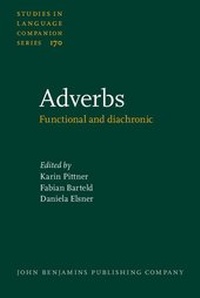
Adverbs
Functional and diachronic aspects
1st Edition
Published on 24. September 2015
V, 275 pages
978-90-272-6812-9 (ISBN)
Description

Adverbs as a word class are notoriously difficult to define. The volume deals with the delimitation of this category, its internal structure, the morphological make-up of adverbs and their positions in syntactic structures. A closer look at diachronic developments sheds light on the characteristics of adverbial word-formation. Taking into account adverbs in German, English, Dutch, French and Italian, the contributions to this volume provide new insights into the characteristics of this heterogeneous and multi-faceted category and will be of interest to linguists working in the fields of morphology, syntax and language change.
More details
Other editions
Additional editions
Book
09/2015
John Benjamins Publishing Co
€100.70
Shipment within 10-15 days
Persons
Content
- Intro
- Adverbs
- Editorial page
- Title page
- LCC data
- Table of contents
- Introduction
- 1. Delimiting the category 'adverb'
- 2. Adverbs and adjectives
- 3. Adverbs and adverbials: Word class and syntactic function
- 4. Adverbs as a prototypical category
- 5. The place of the category 'adverb' among other lexical categories
- 6. Historical perspectives
- 7. Overview of contributions
- 7.1 Categorisation
- 7.2 Morphological structure
- 7.3 Diachronic developments
- 7.4 Positions in syntax
- Acknowledgements
- References
- Adverbs as a linguistic category (?)
- 1. Introduction
- 2. What is an adverb? or: How are adverbs identified?
- 2.1 Identification based on definition
- 2.2 Identification not based on definition
- 2.3 Conclusion
- 3. On linguistic categories
- 3.1 Categorization in general
- 3.2 Categorization in linguistics
- 3.3 Results and conclusions
- 4. What kind of category do adverbs form?
- 4.1 Adverbs as a lexical part-of-speech category
- 4.2 Adverbs as syntactic distributional categories
- 5. Results
- References
- Defining Focusing Modifiers in a cross-linguistic perspective
- 1. Introduction
- 2. Focusing Modifiers: Labeling and inventorying the class
- 2.1 Focusing Modifiers: English
- 2.1.1 Labeling the class
- 2.1.2 Inventorying the class
- 2.2 Focusing Modifiers: German
- 2.2.1 Labeling the class
- 2.2.2 Inventorying the class
- 2.3 Focusing Modifiers: French
- 2.3.1 Labeling the class
- 2.3.2 Inventorying the class
- 2.4 Focusing Modifiers: Italian
- 2.4.1 Labeling the class
- 2.4.2 Inventorying the class
- 2.5 Labeling and inventorying the class of FMs: Overview and discussion
- 2.5.1 Cross-linguistic inventories
- 2.5.2 Focusing Modifiers: Class extension
- 3. Focusing Modifiers: Defining criteria
- 3.1 Semantic properties of Focusing Modifiers
- 3.1.1 Interaction with a focal expression
- 3.1.2 Focusing Modifiers: Quantification and scalarity
- 3.1.3 Focusing Modifiers: Other semantic subclasses
- 3.1.4 Focusing Modifiers: Towards an operational semantic classification
- 3.2 Syntactic properties of Focusing Modifiers
- 3.2.1 Positional variety of Focusing Modifiers
- 3.2.2 Cross-categoriality of Focusing Modifiers
- 3.2.3 Focusing Modifiers: Overview of main syntactic features
- 4. Concluding remarks
- References
- Dutch adverbial morphology
- 1. Introduction
- 2. The Dutch adverb-adjective distinction
- 2.1 Dutch adverbs and adjectives: many areas of overlap
- 2.2 Dutch adverbs and adjectives in a scalar approach
- 3. Dutch adverbial morphology: The traditional account
- 3.1 Introducing Dutch adverbial morphology
- 3.2 The inventory of Dutch adverbial suffixes
- 3.3 Adverbial morphology: A classificational problem
- 4. Dutch adverbial morphology: A different account
- 4.1 Investigating Dutch adverbial morphology
- 4.2 Attributive use of output derivatives
- 4.3 A scalar approach to adverbial morphology
- 5. Conclusion and outlook
- References
- Adverbial morphology in German
- 1. Introduction
- 2. On the status of -(er)weise as a word formation device
- 3. -weise/-erweise-formations in German
- 3.1 Data - quantitative analysis
- 3.2 -weise-Formations with nominal bases
- 3.2.1 Deverbal and non-deverbal bases
- 3.2.2 Quantifying determiners
- 3.2.3 Typology & summary
- 3.3 -erweise-Formations with adjectival bases
- 3.3.1 Restrictions for bases
- 3.3.2 Adjectival and participial bases
- 3.3.3 Typology & summary
- 4. Conclusion
- References
- Data
- Between inflection and derivation
- 1. Introduction
- 2. Adverbs and adjectives: One category?
- 2.1 Inflection vs. derivation
- 2.2 Arguments against the inflectional status of -ly
- 2.3 Arguments in favour of the inflectional status of -ly
- 3. Historical perspectives
- 3.1 English
- 3.2 German
- 4. Two kinds of adverbial suffixes
- 5. Developments in German: The suffix -(er)weise
- 6. Conclusions
- References
- On the distinction between adverbs and adjectives in Middle High German
- 1. Introduction
- 2. Functional and formal properties of adverbs and adjectives
- 3. Types of modifiers
- 4. Modifiers in the history of German
- 5. Modifiers in Middle High German
- 6. Corpus analysis
- 6.1 The suffix -e
- 6.2 -lich(e) and -ig
- 7. The MHG modifier system
- 8. Conclusion
- Sources of attested examples
- References
- Lexicalization of PPs to adverbs in historic varieties of German
- 1. Defining lexicalization
- 2. How to 'become a word'
- 3. Properties of prepositional relations, properties of adverbs and the lexicalization of PPs to adverbs
- 4. Lexicalization of PPs to adverbs in historic varieties of German. The examples of MHG under wegen and bi namen
- 4.1 under wegen
- 4.2 bi namen
- 5. Conclusion
- Appendix
- References
- Primary sources
- Secondary sources
- Comparative adverb syntax
- 1. Introduction
- 2. Theoretical background
- 3. The cartography of the clause
- 3.1 The SVO configuration
- 3.2 The VSO Configuration (in declarative contexts)
- 3.3 The SOV configuration (in scrambling head/V-final languages)
- 3.4 Conclusions (first part)
- 4. P- and K-related positions for objects and adjuncts
- 4.1 DP- and PP-related Kase projections within the SVO chunk
- 4.2 A more detailed look at the fine structure of the clausal Mittelfeld
- 5. Conclusions
- References
- Adverbs in unusual places
- 1. Introduction
- 2. The word class 'adverb'
- 2.1 The morphological criteria
- 2.2 Usage-based criteria
- 3. The English data
- 3.1 English data: 'yesterday', 'here', and the like
- 3.2 English: The Payne et al. data
- 3.2.1 Post-head position as the only possibility
- 3.2.2 Kinds of semantic usages
- 3.2.3 Dependency on deverbal heads
- 3.2.4 Minimal pairs
- 3.3 Conclusion: The English data
- 4. The German data
- 4.1 'Gestern' and thepronoun analysis
- 4.2 'Hier' and the preposition analysis
- 4.3 German de-adverbal adjectives
- 4.4 German translations for the English minimal pairs
- 4.5 Conclusion: The German data
- 5. Towards a semantic analysis
- 5.1 The post-head position and topic sensitivity
- 5.2 The semantic properties and the adverbial/adverb connection
- 6. Summary
- References
- Appendix
- Example sources
- 6.1 Comparison written/spoken German
- Index
