

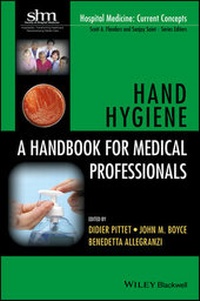
Hand Hygiene
Description

Reviews / Votes
"In their new textbook, Hand Hygiene: A Handbook for Medical Professionals, Didier Pittet, John Boyce, and Benedetta Allegranzi turn to leading experts on patient safety and infection control to produce an impressive book with 45 chapters focusing on every aspect of hand hygiene. But, as Pittet asks in the preface, "Does hand hygiene deserve a textbook?" It is refreshing for a textbook writer to ask this question about his own book, and the answer, as the foreword suggests, is a resounding "yes." While hand hygiene is essential, compliance is complicated. Additionally, actual rates of compliance are difficult to measure as are the number of HAIs that can be prevented with high hand hygiene compliance rates. With these issues in mind, Pittet and colleagues present this new work with a noble objective, "to save many more millions of lives every year worldwide." The edition includes many important, but often overlooked, areas in chapters covering topics such as hand hygiene promotion strategies, human factors, barriers to compliance, and skin reaction to hand hygiene. Of particular importance, the book includes chapters on the safety climate as well as personal accountability. Of note, a chapter on religion and cultural practices sheds light on interesting issues that are often marginalised. The book is organised logically, beginning with a review of the data on HAI......We have a real problem with hand hygiene among medical professionals, and now is the time to embrace change. This handbook takes an important step in that direction. Pittet believes that a renewed commitment by providers will "drive excellence in hand hygiene practices, research, and attitudes for many years to come." The editors and authors should be commended for this laudable goal and outstanding handbook" (The Lancet Vol 17 August 17) "This well-written book, coupled with its excellent editing, is easy to read. It succeeds in appealing to a diverse population of healthcare professionals. All healthcare facility leaders in patient safety and infection prevention would be well served by this guide and reference to improving hand hygiene" Doodys, Sept 2017More details
Other editions
Additional editions
Persons
Content
Contributors xi
Preface xv
Foreword xvii
1. The Burden of Healthcare-Associated Infection 1
Benedetta Allegranzi, Sepideh Bagheri Nejad, and Didier Pittet
2. Historical Perspectives 8
Andrew J. Stewardson and Didier Pittet
3. Flora and Physiology of Normal Skin 12
Gürkan Kaya and Didier Pittet
4. Dynamics of Hand Transmission 18
Andrew J. Stewardson, Benedetta Allegranzi, and Didier Pittet
5. Mathematical Models of Handborne Transmission of Nosocomial Pathogens 28
Ben S. Cooper and Nantasit Luangasanatip
6. Methodological Issues in Hand Hygiene Science 36
Matthew Samore and Stephan Harbarth
7. Statistical Issues: How to Overcome the Complexity of Data Analysis in Hand Hygiene Research? 42
Angèle Gayet-Ageron and Eli Perencevich
8. Hand Hygiene Agents 51
Pascal Bonnabry and Andreas Voss
9. Methods to Evaluate the Antimicrobial Efficacy of HandHygiene Agents 58
Manfred L. Rotter, Syed A. Sattar, and Miranda Suchomel
10. Hand Hygiene Technique 70
Marie-Noëlle Chraïti and Andreas F. Widmer
11. Compliance with Hand Hygiene Best Practices 76
Benedetta Allegranzi, Andrew J. Stewardson, and Didier Pittet
12. Barriers to Compliance 85
John M. Boyce, Benedetta Allegranzi, and Didier Pittet
13. Physicians and Hand Hygiene 89
Benedetta Allegranzi, Andrew J. Stewardson, and Didier Pittet
14. Surgical Hand Preparation 94
Andreas F. Widmer and Joseph Solomkin
15. Skin Reaction to Hand Hygiene 101
Elaine Larson
16. Alcohol-Based Handrub Safety 105
John M. Boyce and M. Lindsay Grayson
17. Rinse, Gel, Foam, Soap ... Selecting an Agent 109
Andreas Voss
18. Behavior and Hand Hygiene 115
Mary-Louise McLaws and Hugo Sax
19. Hand Hygiene Promotion Strategies 123
Benedetta Allegranzi and Didier Pittet
20. My Five Moments for Hand Hygiene 134
Hugo Sax, Benedetta Allegranzi, and Didier Pittet
21. System Change 144
Benedetta Allegranzi, Andreas Voss, and Didier Pittet
22. Education of Healthcare Professionals 152
Elaine Larson, Marie-Noëlle Chraïti, and Wing-Hong Seto
23. Glove Use and Hand Hygiene 156
Marie-Noëlle Chraïti, Benedetta Allegranzi, and Elaine Larson
24. Monitoring Hand Hygiene Performance 162
Hugo Sax and John M. Boyce
25. Performance Feedback 172
Andrew J. Stewardson and Hugo Sax
26. Marketing Hand Hygiene 180
Julie Storr and Hugo Sax
27. Human Factors Design 185
Lauren Clack and Hugo Sax
28. Institutional Safety Climate 193
Enrique Castro-Sánchez, Alison Holmes, and Didier Pittet
29. Personal Accountability for Hand Hygiene 201
Robert M. Wachter and Peter Pronovost
30. Patient Participation and Empowerment 206
Yves Longtin, Susan E. Sheridan, and Maryanne McGuckin
31. Religion and Hand Hygiene 216
Jaffar A. Al-Tawfiq and Ziad A. Memish
32. Hand Hygiene Promotion from the US Perspective: PuttingWHO and CDC Guidelines into Practice 221
Katherine Ellingson
33. WHO Multimodal Promotion Strategy 230
Benedetta Allegranzi and Didier Pittet
34. Monitoring Your Institution (Hand Hygiene Self-Assessment Framework) 244
Benedetta Allegranzi, Andrew J. Stewardson, and Didier Pittet
35. National Hand Hygiene Campaigns 249
Claire Kilpatrick and Julie Storr
36. Hand Hygiene Campaigning: From One Hospital to the Entire Country 256
Philip L. Russo and M. Lindsay Grayson
37. Improving Hand Hygiene through Joint Commission Accreditation and the Joint Commission Center for Transforming Healthcare 263
Mark R. Chassin, Barbara I. Braun, and Anne Marie Benedicto
38. A Worldwide WHO Hand Hygiene in Healthcare Campaign 275
Claire Kilpatrick, Julie Storr, and Benedetta Allegranzi
39. The Economic Impact of Improved Hand Hygiene 285
Nicholas Graves
40. Hand Hygiene: Key Principles for the Manager 294
Eleanor Murray, Alison Holmes, and Didier Pittet
41. Effect of Hand Hygiene on Infection Rates 299
Benedetta Allegranzi, Stephan Harbarth, and Didier Pittet
42A.Hand Hygiene in Specific Patient Populations and Situations: Critically Ill Patients 317
Caroline Landelle, Jean-Christophe Lucet, and Didier Pittet
42B. Hand Hygiene in Specific Patient Populations and Situations: Neonates and Pediatrics 324
Walter Zingg and Hanan H. Balkhy
42C. Hand Hygiene in Long-Term Care Facilities and Home Care 329
Maria Luisa Moro, Marie-Noëlle Chraïti, and Benedetta Allegranzi
42D.Hand Hygiene in Ambulatory Care 337
Marie-Noëlle Chraïti, Sepideh Bagheri Nejad, and Benedetta Allegranzi
42E. Hand Hygiene in Hemodialysis 344
Marie-Noëlle Chraïti, Sepideh Bagheri Nejad, and Benedetta Allegranzi
42F. Hand Hygiene in Specific Patient Populations and Situations: Anesthesiology 350
François Stéphan
43. Hand Hygiene in Resource-Poor Settings 357
Nizam Damani, Shaheen Mehtar, and Benedetta Allegranzi
44A. Role of Hand Hygiene in MRSA Control 367
Stephan Harbarth
44B. Role of Hand Hygiene in Clostridium difficile Control 373
John M. Boyce and Walter Zingg
44C. Role of Hand Hygiene in Respiratory Diseases Including Influenza 378
Wing Hong Seto and Benjamin J. Cowling
44D. Handborne Spread of Noroviruses and its Interruption 385
Syed A. Sattar and Yves Longtin
45. Conducting a Literature Review on Hand Hygiene 391
Daniela Pires, Fernando Bellissimo-Rodrigues, and Didier Pittet
Appendix 400
Index 409
Foreword
Hand hygiene in healthcare settings seems like a pretty simple act. One places an antiseptic agent on the hands, rubs the hands together to reduce the transient microorganisms, dries the hands or lets them dry, and thereby reduces the risk of transmission of pathogens to patients and to the healthcare worker. In Hand Hygiene, Drs Pittet, Boyce, and Allegranzi, and their esteemed colleagues, show us how complicated - yet essential - hand hygiene really is.
The book encompasses all the important aspects of hand hygiene. Each chapter has a simple-to-read format: key messages; what we know - the scientific evidence; what we don't know; and the research that needs to be done to fill these gaps. The authors begin by providing a summary of the current status of data on healthcare-associated infections (HAIs) in both developed and resource-limited countries. These data show the enormous impact that HAIs have throughout the world, including morbidity, mortality, and cost. This chapter also illustrates how even now - over thirty-five years since the Centers for Disease Control and Prevention's (CDC) Study of the Efficacy of Nosocomial Infection Control (SENIC) programs documented the preventive impact of HAI surveillance and prevention intervention programs - many countries still do not have adequate surveillance systems in place to even answer what their HAI rates are, much less evaluate the impact of prevention interventions.
Next, the authors describe the history of hand hygiene from the time of Semmelweis, discuss the flora and physiology of skin, describe the dynamics of pathogen transmission from the skin, and culminate in three chapters on mathematical models of hand-borne pathogen transmission, methodological issues in hand hygiene science, and statistical issues in hand hygiene research. These last three chapters highlight the many gaps in our knowledge about hand hygiene, illustrate the weaknesses in many if not most of our current studies, and point out that conducting the studies that are necessary may be more difficult than Semmelweis's challenge of convincing clinicians that hand hygiene should be done at all. Essential issues include antiseptic agent volume, method of application, duration of application, agent formulation, and when these are all optimized, and what percentage of HAIs are prevented by best practices. These methodological chapters are particularly important, as they illustrate that if our Guidelines are supposed to depend solely upon well-designed randomized controlled trials (RCTs) of hand hygiene - rather than on the entire body of epidemiologic data - such RCTs do not and probably never will exist, and hand hygiene will be relegated to an unresolved issue. These methodological issues also should be kept in mind as one reads the rest of this book (or other published literature) in which many studies are referenced that suffer from these methodological design flaws.
The next three chapters discuss the various available hand hygiene agents, the methods for evaluating their efficacy and the hand hygiene technique. These chapters are incredibly important and discuss issues often not known or understood in the infection control/patient safety community. Data show that formulation of alcohol-based hand hygiene agents matters. The chapter on evaluating efficacy illustrates the differences between North American and European standards - that is American Society for Testing Methods (ASTM) vs. Comité Européen de Normalisation (CEN or EN) standard methods. Everyone in infection control should understand the different methods used, what these tests do and do not tell us about efficacy, how in vivo testing does or does not relate to clinical practice, and the importance of demanding that all manufacturers provide such data to us when we are comparing products. Formulation matters, and such testing can document this.
This leads to several chapters on compliance with hand hygiene best practices, barriers to compliance, and a discussion of physicians and the almost universal finding that they are the worst compliers with hand hygiene recommendations of all healthcare workers. We must ask ourselves exactly what compliance with hand hygiene best practices is. Is it as mentioned at the beginning of this foreward simply applying some agent (formulation and amount irrelevant) and rubbing our hands together (duration and method irrelevant)? Or does compliance with hand hygiene best practices mean using a formulation documented to be effective, using the correct volume of that specific product documented in the ASTM or EN standard testing (realizing that volume will differ by product and for gels, foams vs. rubs), applying the product in a specific manner (such as recommended by the World Health Organization [WHO]), for the correct duration, at each of the WHO five moments? With current visual observation of hand hygiene "compliance," how many healthcare workers pay any attention to the volume of agent used, the method of application, the duration of application, and so on. All of these are critical elements in hand hygiene best practices, yet they are often ignored. We need more precise definitions of what hand hygiene best practices are and when they should be done and measured. From the patient's perspective, moments 1 and 2 are most important. From the healthcare worker's perspective, moments 3, 4, and 5 are most important. These chapters also raise questions about who should monitor hand hygiene compliance (self-reporting appears to generally be inaccurate), when and how.
The next general area includes a discussion of behavior and hand hygiene, hand hygiene promotion strategies, the WHO five moments for hand hygiene, system change, and education of healthcare professionals. These chapters illustrate the continual struggle that those of us in infection control/quality improvement have trying to educate our healthcare workers about the importance of hand hygiene and methods to improve behavior, reduce barriers to compliance, and try to change our systems. Do we continue to invest enormous resources (time, personnel, and funding) to these activities to try to get our healthcare "professionals" to comply with hand hygiene best practices, or do we follow the dictates of the chapter on "Personal Accountability for Hand Hygiene"? As we have learned in the United States, if we do not regulate ourselves (e.g., through mandatory reporting of HAI rates, reduced funding for preventable HAIs), outside regulatory agencies will (i.e., the government). We all agree that proper performance of hand hygiene will reduce HAIs and improve patient safety. Then why do we accept noncompliance?
The chapter on monitoring hand hygiene compliance is critical. What should the gold standard be for measuring hand hygiene compliance? The majority of those measuring hand hygiene compliance (and/or publishing such studies) use "trained observer" visual observation. This chapter describes some flaws in such an approach: it is prone to bias, overestimates true performance, often captures <1% of hand hygiene opportunities at the time in the institution (yet is generalized to the entire facility), has large inter-rater variation, etc. As these authors state, "Today, a unique reliable and robust method to measure hand hygiene performance does not exist." We know that indirect and less costly (time, personnel, etc.) methods for estimating hand hygiene compliance, such as measuring the amount of agent used, are not accurate. We know that merely measuring hand hygiene compliance on patient room entry or exit does not predict in-room practices (which are most important for the prevention of pathogen transmission to the patient). We know that self-reporting is grossly inaccurate. However, at least in developing countries, emerging technologies may be the answer for the future. The question becomes what we want the system to measure. Currently, electronic systems can measure whether hand hygiene is performed. Such systems generally do not assess the volume of the specific product, the method and duration of application, or specific compliance with each of the five moments or with specific invasive procedures. Video systems are just emerging and have the capacity not only to measure all these elements, but also to be a record to play back for healthcare workers who deny their noncompliance. In the future, where our systems truly demand individual accountability, such video/electronic systems may become essential. It does appear that at least in the developing world - as personnel clinician accountability is enforced and systems insist that hand hygiene best practices be a patient safety issue and thus must be complied with, for cost and personnel reasons - electronic or video systems for hand hygiene measure will become integral components of our measuring systems.
The book ends with chapters on national and international campaigns and regulatory/accrediting body approaches. Undoubtedly, such campaigns - whether local, system-wide, state or nationwide or worldwide - have improved hand hygiene awareness, importance, and compliance. Given the large number of elements we have learned in this book are required for true "hand hygiene best practices compliance" - that is, the best agent, the correct volume, application in compliance with the five moments, application in the correct fashion and for the correct duration - it is hard to believe local or national hand hygiene compliance rates of 85%-95% or that such levels - even if they can be achieved - can be...
