

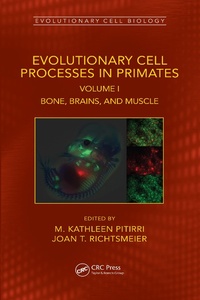
Evolutionary Cell Processes in Primates
Bone, Brains, and Muscle, Volume I
1st Edition
Published on 14. September 2021
270 pages
978-1-000-43938-0 (ISBN)
Description

Many complex traits define the human condition, including encephalization and bipedalism. The specific molecular signals and cellular processes producing these traits are the result of dramatic evolutionary change. At the same time, conservation of many of these developmental programs underlie both structure and function. Novel methodologies and techniques allow analysis of the collective behavior of cells, cell shapes, tissues, and organs. This volume demonstrates the essential role of cellular mechanisms in the evolutionary increase in the size and complexity of the primate brain. In addition, and concordant with encephalization, this book documents changes in the muscles and bones associated with the appearance of bipedalism. Genetic changes are the basis of these evolutionary changes, but transformation of genetic information into phenotypic outcomes occurs at the level of the cell, and this is the focus of the book. The goal is to encourage others to adopt evolutionary cell biology as a novel and necessary approach to the genotype-phenotype map of the diversification of primates, human variation, and human evolution. The contributors to this book utilize advances in genetic analysis, visualization of cells and tissues, and the merging of evolutionary developmental biology with evolutionary cell biology to address questions central to understanding the human and primate evolution.
Key Features
Explores mechanisms underlying trait distribution, dispersal, variation, and evolution through the direct testing of hypotheses especially with respect to patterns of encephalization, certain sensory modalities, and growth and life history specializations.
Documents the advantages for anthropologists to work at the level of cells focusing on how genes provide instructions for cells to make structure and how environmental influences affect the behavior of cells.
Illustrates the role cell biology plays with respect to encephalization, neocortical expansion, variation in facial morphology, locomotion, and dexterity.
Describes novel methodologies and techniques allowing analysis of how the collective behavior of cells shapes tissues and organs.
Related Titles
Ripamonti, U., ed. Induction of Bone Formation in Primates: The Transforming Growth Factor-beta 3 (ISBN 978-0-3673-7740-3).
Gordon, M. S., et al., eds. Animal Locomotion: Physical Principles and Adaptations (ISBN 978-0-3676-5795-6)
Bianchi, L. Developmental Neurobiology (ISBN 978-0-8153-4482-7)
Key Features
Explores mechanisms underlying trait distribution, dispersal, variation, and evolution through the direct testing of hypotheses especially with respect to patterns of encephalization, certain sensory modalities, and growth and life history specializations.
Documents the advantages for anthropologists to work at the level of cells focusing on how genes provide instructions for cells to make structure and how environmental influences affect the behavior of cells.
Illustrates the role cell biology plays with respect to encephalization, neocortical expansion, variation in facial morphology, locomotion, and dexterity.
Describes novel methodologies and techniques allowing analysis of how the collective behavior of cells shapes tissues and organs.
Related Titles
Ripamonti, U., ed. Induction of Bone Formation in Primates: The Transforming Growth Factor-beta 3 (ISBN 978-0-3673-7740-3).
Gordon, M. S., et al., eds. Animal Locomotion: Physical Principles and Adaptations (ISBN 978-0-3676-5795-6)
Bianchi, L. Developmental Neurobiology (ISBN 978-0-8153-4482-7)
Reviews / Votes
" ... these volumes will be of broad interest to biological anthropologists and demonstrates that cell biology can be incorporated into the study of any biological trait. In addition to the wide variety of complex traits covered by the authors, an equally impressive range of cellular and molecular concepts and techniques are included. The chapters within these volumes provide an excellent survey [and will be] a valuable resource for biological anthropologists for year to come." K. E. Willmore - American Journal of Biological Anthropology.More details
Series
Edition
1. Auflage
Language
English
Place of publication
London
United Kingdom
Publishing group
Taylor & Francis Ltd
Target group
College/higher education
Professional and scholarly
Illustrations
7 Tables, black and white; 13 Line drawings, color; 12 Line drawings, black and white; 11 Halftones, color; 3 Halftones, black and white; 24 Illustrations, color; 15 Illustrations, black and white
ISBN-13
978-1-000-43938-0 (9781000439380)
Copyright in bibliographic data and cover images is held by Nielsen Book Services Limited or by the publishers or by their respective licensors: all rights reserved.
Schweitzer Classification
Other editions
Additional editions
M. Kathleen Pitirri | Joan T. Richtsmeier
Evolutionary Cell Processes in Primates
Bone, Brains, and Muscle, Volume I
Book
11/2024
1st Edition
CRC Press
€91.50
Shipment within 10-20 days

M. Kathleen Pitirri | Joan T. Richtsmeier
Evolutionary Cell Processes in Primates
Bone, Brains, and Muscle, Volume I
Book
09/2021
1st Edition
CRC Press
€160.90
Shipment within 15-20 days
Persons
M. Kathleen Pitirri, PhD is a Postdoctoral Scholar in the Department of Anthropology at Pennsylvania State University. She received her PhD from the University of Toronto in 2019 where she studied primate evolution, focusing specifically on the taxonomic, ontogenetic, and functional basis of mandibular shape variation in living and fossil primates. During her PhD research, Dr. Pitirri developed a novel methodology for studying shape variation of mandibular fragments that are part of the primate fossil record. She found a strong relationship between the shape of the mandibular corpus and molar crypt formation in great apes, suggesting that mandibular shape is linked to an extended period of development in great apes, representing an important evolutionary shift in primates. Upon joining the Richtsmeier Lab, Dr. Pitirri began using mouse models to study the cellular mechanisms involved in transferring information from the genotype to the phenotype. The changes observed in mouse models can be used to interpret the cellular basis for changes observed in skull shape in primates because mechanisms that build the craniofacial skeleton during development also drive variation in disease and evolution. Dr. Pitirri is particularly interested in the evolutionary consequences of change in developmental processes driving the patterning of cellular activities involved in embryogenesis of skull bones, the role of the chondrocranium in skull development, and the genetic pathways regulating the relationship between tooth and bone formation during embryonic development.
Joan Richtsmeier is Distinguished Professor of Anthropology at the Pennsylvania State University. She received her PhD from Northwestern University in 1985 and joined the faculty of the Department of Cell Biology and Anatomy, Johns Hopkins University School of Medicine in 1986. There, she focused on establishing new quantitative methods for studying change in biological shape through time, especially in primates, with Professor Subhash Lele. In 1999 she became the 55th woman to achieve the rank of Professor at Johns Hopkins University School of Medicine since the school opened in 1893. In 2000, Dr. Richtsmeier moved her lab to the Pennsylvania State University. There, her focus turned to joining developmental biology with evolutionary biology, and with collaborators and students, she has worked to integrate the study of mouse models carrying known genetic variants with understanding the biological basis of patterns of evolutionary change. She is particularly interested in early formation of the chondrocranium and how and why cells decide to become osteoblasts and make bone. Dr. Richtsmeier was elected Fellow of the American Association of Anatomists (AAA) in 2018, received the Henry Gray Scientific Achievement Award of the AAA in 2019, and the David Bixler Excellence in Craniofacial Research Award of the Society for Craniofacial Genetics and Developmental Biology in 2019. She was elected Fellow of the AAAS (Section on Biological Sciences) in 2020. Her work is supported by grants from the National Science Foundation, the National Institutes of Health, and the Wellcome Trust.
Joan Richtsmeier is Distinguished Professor of Anthropology at the Pennsylvania State University. She received her PhD from Northwestern University in 1985 and joined the faculty of the Department of Cell Biology and Anatomy, Johns Hopkins University School of Medicine in 1986. There, she focused on establishing new quantitative methods for studying change in biological shape through time, especially in primates, with Professor Subhash Lele. In 1999 she became the 55th woman to achieve the rank of Professor at Johns Hopkins University School of Medicine since the school opened in 1893. In 2000, Dr. Richtsmeier moved her lab to the Pennsylvania State University. There, her focus turned to joining developmental biology with evolutionary biology, and with collaborators and students, she has worked to integrate the study of mouse models carrying known genetic variants with understanding the biological basis of patterns of evolutionary change. She is particularly interested in early formation of the chondrocranium and how and why cells decide to become osteoblasts and make bone. Dr. Richtsmeier was elected Fellow of the American Association of Anatomists (AAA) in 2018, received the Henry Gray Scientific Achievement Award of the AAA in 2019, and the David Bixler Excellence in Craniofacial Research Award of the Society for Craniofacial Genetics and Developmental Biology in 2019. She was elected Fellow of the AAAS (Section on Biological Sciences) in 2020. Her work is supported by grants from the National Science Foundation, the National Institutes of Health, and the Wellcome Trust.
Content
Volume 1 Evolutionary Cell Processes in Primates: bone, brains, and muscle
Chapter 1 Introduction: Evolutionary cell biology in anthropological research
Joan T. Richtsmeier and M. Kathleen Pitirri
Chapter 2 The role of bone and cartilage cells in the evolution of bipedalism
Cambell Rolian
Chapter 3 Cellular processes in limb development and primate evolution
Philip L. Reno, Kelsey M. Kjosness, and Allison L. Machnicki
Chapter 4 A muscular perspective on human evolution: Locomotor insights from analyses of primate muscle architecture and fiber type
Andrew S. Deane, Jason M. Organ, and Magdalena N. Muchlinski
Chapter 5 Evolution of the encephalized human brain: How did we become exceptional?
Kevin Alloway and Kevin Flaherty
Chapter 6 Primate Cognition: cellular processes and the developmental mechanisms in brain expansion
Maria Carolina Marchetto and Katerina Semendeferi
Chapter 7 The role of primate embryogenesis in encephalization and neocortical expansion
Andrew Halley
Chapter 8 How gene expression can induce correlated changes in brain and skull systems
Neus Martinez-Abadias, Ruben Gonzalez, Roger Mateu, Jaume Sastre, Alexandre Robert-Moreno, Jim Swoger, Susan M. Motch Perrine, Kazuhiko Kawasaki, Joan Richtsmeier, and James Sharpe
Chapter 9 Cellular dynamics and the developmental basis for craniofacial variation in evolution and disease
Nathan M. Young, Ralph S. Marcucio, Benedikt Hallgrimsson, Heather A. Richbourg, and Rebecca M. Green
Chapter 1 Introduction: Evolutionary cell biology in anthropological research
Joan T. Richtsmeier and M. Kathleen Pitirri
Chapter 2 The role of bone and cartilage cells in the evolution of bipedalism
Cambell Rolian
Chapter 3 Cellular processes in limb development and primate evolution
Philip L. Reno, Kelsey M. Kjosness, and Allison L. Machnicki
Chapter 4 A muscular perspective on human evolution: Locomotor insights from analyses of primate muscle architecture and fiber type
Andrew S. Deane, Jason M. Organ, and Magdalena N. Muchlinski
Chapter 5 Evolution of the encephalized human brain: How did we become exceptional?
Kevin Alloway and Kevin Flaherty
Chapter 6 Primate Cognition: cellular processes and the developmental mechanisms in brain expansion
Maria Carolina Marchetto and Katerina Semendeferi
Chapter 7 The role of primate embryogenesis in encephalization and neocortical expansion
Andrew Halley
Chapter 8 How gene expression can induce correlated changes in brain and skull systems
Neus Martinez-Abadias, Ruben Gonzalez, Roger Mateu, Jaume Sastre, Alexandre Robert-Moreno, Jim Swoger, Susan M. Motch Perrine, Kazuhiko Kawasaki, Joan Richtsmeier, and James Sharpe
Chapter 9 Cellular dynamics and the developmental basis for craniofacial variation in evolution and disease
Nathan M. Young, Ralph S. Marcucio, Benedikt Hallgrimsson, Heather A. Richbourg, and Rebecca M. Green
