

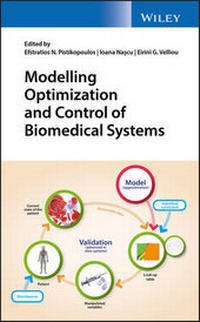
Modelling Optimization and Control of Biomedical Systems
Description

More details
Other editions
Additional editions
Persons
Content
List of Contributors xiii
Preface xv
Part I 1
1 Framework and Tools: A Framework for Modelling, Optimization and Control of Biomedical Systems 3
Eirini G. Velliou, Ioana Nascu, Stamatina Zavitsanou, Eleni Pefani, Alexandra Krieger, Michael C. Georgiadis, and Efstratios N. Pistikopoulos
1.1 Mathematical Modelling of Drug Delivery Systems 3
1.1.1 Pharmacokinetic Modelling 3
1.1.1.1 Compartmental Models 3
1.1.1.2 Physiologically Based Pharmacokinetic Models 5
1.1.2 Pharmacodynamic Modelling 5
1.2 Model analysis, Parameter Estimation and Approximation 7
1.2.1 Global Sensitivity Analysis 8
1.2.2 Variability Analysis 8
1.2.3 Parameter Estimation and Correlation 9
1.3 Optimization and Control 9
References 11
2 Draft Computational Tools and Methods 13
Ioana Nascu, Richard Oberdieck, Romain Lambert, Pedro Rivotti, and Efstratios N. Pistikopoulos
2.1 Introduction 13
2.2 Sensitivity Analysis and Model Reduction 14
2.2.1 Sensitivity Analysis 14
2.2.1.1 Sobol's Sensitivity Analysis 16
2.2.1.2 High-Dimensional Model Representation 17
2.2.1.3 Group Method of Data Handling 18
2.2.1.4 Gmdh-hdmr 19
2.2.2 Model Reduction 20
2.2.2.1 Linear Model Order Reduction 21
2.2.2.2 Nonlinear Model Reduction 22
2.3 Multiparametric Programming and Model Predictive Control 24
2.3.1 Dynamic Programming and Robust Control 28
2.4 Estimation Techniques 33
2.4.1 Kalman Filter 34
2.4.1.1 Time Update (Prediction Step) 34
2.4.1.2 Measurement Update (Correction Step) 34
2.4.2 Moving Horizon Estimation 34
2.5 Explicit Hybrid Control 39
2.5.1 Multiparametric Mixed-Integer Programming 40
2.5.1.1 Problem and Solution Characterization 40
2.5.1.2 Literature Review 42
2.5.1.3 A General Framework for the Solution of mp-MIQP Problems 48
2.5.1.4 Detailed Analysis of the General Framework 50
2.5.1.5 Description of an Exact Comparison Procedure 54
References 57
3 Volatile Anaesthesia 67
Alexandra Krieger, Ioana Nascu, Nicki Panoskaltsis, Athanasios Mantalaris, Michael C. Georgiadis, and Efstratios N. Pistikopoulos
3.1 Introduction 67
3.2 Physiologically Based Patient Model 69
3.2.1 Pharmacokinetics 69
3.2.1.1 Body Compartments 72
3.2.1.2 Blood Volume 73
3.2.1.3 Cardiac Output 73
3.2.1.4 Lung Volume 74
3.2.2 Pharmacodynamics 74
3.2.3 Individualized Patient Variables and Parameters 74
3.3 Model Analysis 75
3.3.1 Uncertainty Identification via Patient Variability Analysis 75
3.3.2 Global Sensitivity Analysis 77
3.3.3 Correlation Analysis and Parameter Estimation 81
3.3.4 Simulation Results 83
3.4 Control Design for Volatile Anaesthesia 86
3.4.1 State Estimation 87
3.4.1.1 Model Linearization 88
3.4.2 On-Line Parameter Estimation 90
3.4.2.1 Control and Algorithm Design 91
3.4.2.2 Testing of the On-Line Estimation Algorithm 93
3.4.3 Case Study: Controller Testing for Isourane-Based Anaesthesia 96
Conclusions 98
Appendix 99
References 100
4 Intravenous Anaesthesia 103
Ioana Nascu, Alexandra Krieger, Romain Lambert, and Efstratios N. Pistikopoulos
4.1 A Multiparametric Model-based Approach to Intravenous Anaesthesia 103
4.1.1 Introduction 103
4.1.2 Patient Model 104
4.1.3 Sensitivity Analysis 108
4.1.4 Advanced Model-based Control Strategies 110
4.1.4.1 Extended Predictive Self-adaptive Control (EPSAC) Strategy 111
4.1.4.2 Multiparametric Strategy 111
4.1.5 Control Design 112
4.1.5.1 Case 1: EPSAC 115
4.1.5.2 Case 2: mp-MPC Without Nonlinearity Compensation 116
4.1.5.3 Case 3: mp-MPC With Nonlinear Compensation 117
4.1.5.4 Case 4: mp-MPC With Nonlinearity Compensation and Estimation 118
4.1.6 Results 118
4.1.6.1 Induction Phase 119
4.1.6.2 Maintenance Phase 123
4.1.6.3 Discussion 125
4.2 Simultaneous Estimation and Advanced Control 130
4.2.1 Introduction 130
4.2.2 Multiparametric Moving Horizon Estimation (mp-MHE) 130
4.2.3 Simultaneous Estimation and mp-MPC Strategy 132
4.2.4 Results 134
4.2.4.1 Induction Phase 135
4.2.4.2 Maintenance Phase 138
4.3 Hybrid Model Predictive Control Strategies 142
4.3.1 Introduction 142
4.3.2 Hybrid Patient Model Formulation 143
4.3.3 Control Design 144
4.3.3.1 Hybrid Formulation of the Control Problem: Intravenous Anaesthesia 144
4.3.3.2 Robust Hybrid mp-MPC Control Strategy: Offset Free 146
4.3.3.3 Control Scheme 147
4.3.4 Results 147
4.3.4.1 No Offset Correction 147
4.3.4.2 Offset Free 150
4.3.5 Discussion 150
4.4 Conclusions 153
References 153
Part II 157
5 Part A: Type 1 Diabetes Mellitus: Modelling, Model Analysis and Optimization 159
Stamatina Zavitsanou, Athanasios Mantalaris, Michael C. Georgiadis, and Efstratios N. Pistikopoulos
5.a Type 1 Diabetes Mellitus: Modelling, Model Analysis and Optimization 159
5.a.1 Introduction: Type 1 Diabetes Mellitus 159
5.a.1.1 The Concept of the Artificial Pancreas 160
5.a.2 Modelling the Glucoregulatory System 162
5.a.3 Physiologically Based Compartmental Model 162
5.a.3.1 Endogenous Glucose Production (EGP) 167
5.a.3.2 Rate of Glucose Appearance (Ra) 168
5.a.3.3 Glucose Renal Excretion (Excretion) 168
5.a.3.4 Glucose Diffusion in the Periphery 168
5.a.3.5 Adaptation to the Individual Patient 169
5.a.3.5.1 Total Blood Volume 169
5.a.3.5.2 Cardiac Output 170
5.a.3.5.3 Compartmental Volume 170
5.a.3.5.4 Peripheral Interstitial Volume 171
5.a.3.6 Insulin Kinetics 171
5.a.4 Model Analysis 172
5.a.4.1 Insulin Kinetics Model Selection 172
5.a.4.2 Endogenous Glucose Production: Parameter Estimation 176
5.a.4.3 Global Sensitivity Analysis 177
5.a.4.3.1 Individual Model Parameters 178
5.a.4.4 Parameter Estimation 182
5.a.5 Simulation Results 183
5.a.6 Dynamic Optimization 185
5.a.6.1 Time Delays in the System 185
5.a.6.2 Dynamic Optimization of Insulin Delivery 188
5.a.6.3 Alternative Insulin Infusion 189
5.a.6.4 Concluding Remarks 192
Part B: Type 1 Diabetes Mellitus: Glucose Regulation 192
Stamatina Zavitsanou, Athanasios Mantalaris, Michael C. Georgiadis, and Efstratios N. Pistikopoulos
5.b Type 1 Diabetes Mellitus: Glucose Regulation 192
5.b.1 Glucose-Insulin System: Typical Control Problem 192
5.b.2 Model Predictive Control Framework 194
5.b.2.1 "High-Fidelity" Model 194
5.b.2.2 The Approximate Model 195
5.b.2.2.1 Linearization 195
5.b.2.2.2 Physiologically Based Model Reduction 196
5.b.3 Control Design 199
5.b.3.1 Model Predictive Control 199
5.b.3.2 Proposed Control Design 200
5.b.3.3 Prediction Horizon 200
5.b.3.4 Control Design 1: Predefined Meal Disturbance 202
5.b.3.5 Control Design 2: Announced Meal Disturbance 202
5.b.3.6 Control Design 3: Unknown Meal Disturbance 202
5.b.3.7 Control Design 4: Unknown Meal Disturbance 204
5.b.4 Simulation Results 204
5.b.4.1 Predefined and Announced Disturbances 204
5.b.4.2 Unknown Disturbance Rejection 204
5.b.4.3 Variable Meal Time 207
5.b.4.4 Concluding Remarks 207
5.b.5 Explicit MPC 208
5.b.5.1 Model Identification 209
5.b.5.2 Concluding Remarks 211
Appendix 5.1 212
Appendix 5.2 215
Appendix 5.3 215
References 217
Part III 225
6 An Integrated Platform for the Study of Leukaemia 227
Eirini G. Velliou, Maria Fuentes-Gari, Ruth Misener, Eleni Pefani, Nicki Panoskaltsis, Athanasios Mantalaris, Michael C. Georgiadis, and Efstratios N. Pistikopoulos
6.1 Towards a Personalised Treatment for Leukaemia: From in vivo to in vitro and in silico 227
6.2 In vitro Block of the Integrated Platform for the Study of Leukaemia 228
6.3 In silico Block of the Integrated Platform for the Study of Leukaemia 229
6.4 Bridging the Gap Between in vitro and in silico 231
References 231
7 In vitro Studies: Acute Myeloid Leukaemia 233
Eirini G. Velliou, Eleni Pefani, Susana Brito dos Santos, Maria Fuentes-Gari, Ruth Misener, Nicki Panoskaltsis, Athanasios Mantalaris, Michael C. Georgiadis, and Efstratios N. Pistikopoulos
7.1 Description of Biomedical System 233
7.1.1 The Human Haematopoietic System 233
7.1.2 General Structure of the Bone Marrow Microenvironment 235
7.1.3 The Cell Cycle 236
7.1.4 Leukaemia: The Disease 238
7.1.5 Current Medical Treatment 239
7.2 Experimental Part 240
7.2.1 Experimental Platforms 240
7.2.2 Crucial Environmental Factors in an in vitro System 241
7.2.2.1 Environmental Stress Factors and Haematopoiesis 241
7.2.3 Growth and Metabolism of an AML Model System as Influenced by Oxidative and Starvation Stress: A Comparison Between 2D and 3D Cultures 244
7.2.3.1 Materials and Methods 244
7.2.3.2 Results and Discussion 247
7.2.3.3 Conclusions 254
7.3 Cellular Biomarkers for Monitoring Leukaemia in vitro 255
7.3.1 (Macro-)autophagy: The Cellular Response to Metabolic Stress and Hypoxia 255
7.3.2 Biomarker Candidates 256
7.3.2.1 (Autophagic) Biomarker Candidates 256
7.3.2.2 (Non-autophagic) Stress Biomarker Candidates 257
7.4 From in vitro to in silico 257
References 258
8 In silico Acute Myeloid Leukaemia 265
Eleni Pefani, Eirini G. Velliou, Nicki Panoskaltsis, Athanasios Mantalaris, Michael C. Georgiadis, and Efstratios N. Pistikopoulos
8.1 Introduction 265
8.1.1 Mathematical Modelling of the Cell Cycle 266
8.1.2 Pharmacokinetic and Pharmacodynamic Mathematical Models in Cancer Chemotherapy 268
8.1.2.1 PK Mathematical Models 269
8.1.2.2 PD Mathematical Models 273
8.2 Chemotherapy Treatment as a Process Systems Application 273
8.2.1 Physiologically Based Patient Model for the Treatment of AML With DNR and Ara-C 275
8.2.2 Design of an Optimal Treatment Protocol for Chemotherapy Treatment 277
8.2.3 Mathematical Model Analysis Using Patient Data 278
8.2.3.1 Model Sensitivity Analysis 278
8.2.3.2 Patient Data 279
8.2.3.3 Estimation of Patient-specific Cell Cycle Parameters 280
8.3 Analysis of a Patient Case Study 282
8.3.1 First Chemotherapy Cycle 282
8.3.2 Second Chemotherapy Cycle 282
8.4 Conclusions 285
Appendix 8A Mathematical Model 286
Appendix 8B Patient Data 290
References 296
Index 301
Preface
A great challenge when dealing with severe diseases, such as cancer or diabetes, is the implementation of an appropriate treatment. Design of treatment protocols is not a trivial issue, especially since nowadays there is significant evidence that the type of treatment depends on specific characteristics of individual patients.
In silico design of high-fidelity mathematical models, which accurately describe a specific disease in terms of a well-defined biomedical network, will allow the optimisation of treatment through an accurate control of drug dosage and delivery. Within this context, the aim of the Modelling, Control and Optimisation of Biomedical Systems (MOBILE) project is to derive intelligent computer model-based systems for optimisation of biomedical drug delivery systems in the cases of diabetes, anaesthesia and blood cancer (i.e., leukaemia).
From a computational point of view, the newly developed algorithms will be able to be implemented on a single chip, which is ideal for biomedical applications that were previously off-limits for model-based control. Simpler hardware is adequate for the reduced on-line computational requirements, which will lead to lower costs and almost eliminate the software costs (e.g., licensed numerical solvers). Additionally, there is increased control power, since the new MPC approach can accommodate much larger - and more accurate - biomedical system models (the computational burden is shifted off-line).
From a practical point of view, the absence of complex software makes the implementation of the controller much easier, therefore allowing its usage as a diagnostic tool directly in the clinic by doctors, clinicians as well as patients without the requirement of specialised engineers, therefore progressively enhancing the confidence of medical teams and patients to use computer-aided practices. Additionally, the designed biomedical controllers increase treatment safety and efficiency, by carefully applying a "what-if" prior analysis that is tailored to the individual patient's needs and characteristics, therefore reducing treatment side effects and optimising the drug infusion rates. Flexibility of the device to adapt to changing patient characteristics and incorporation of the physician's performance criteria are additional great advantages.
There were several highly significant achievements of the project for all different diseases and biomedical cases under study (i.e., diabetes, leukaemia and anaesthesia). From a computational point of view, achievements include the construction of high-fidelity mathematical models as well as novel algorithm derivations. The methodology followed for the model design includes the following steps: (a) the derivation of a high-fidelity model, (b) the conduction of sensitivity analysis, (c) the application of parameter estimation techniques on the derived model in order to identify and estimate the sensitive model parameters and variables and (d) the conduction of extensive validation studies based on patient and clinical data. The validated model is then reduced to an approximate model suitable for optimisation and control via model reduction and/or system identification algorithms. The several theoretical (in silico) components are incorporated in a closed-loop (in silico-in vitro) framework that will be evaluated with in vitro trials (i.e., through experimental evaluation of the control-based optimised drug delivery). The outcome of the experiments will indicate the validity of the suggested closed-loop delivery of anaesthetics, chemotherapy dosages for leukaemia and insulin delivery doses in diabetes. It should be mentioned that this is the first closed-loop system including computational and experimental elements. The output of such a framework could be introduced, at a second step, in phase 1 clinical trials.
Chapter 1 is an overview of the framework for modelling, optimisation and control of biomedical systems. It describes the mathematical modelling of drug delivery systems that usually requires a pharmacokinetic part, a pharmacodynamic part and a link between the two. Model analysis, parameter estimation and approximation are used here in order to obtain an in-depth understanding of the model. Mathematical optimisation and control of the biomedical system could lead to a better prediction of the optimal drug and/or therapy treatment for a specific disease.
Chapter 2 presents in detail the theoretical background, computational tools and methods that are used in all the different biomedical systems analysed within the book. More specifically, Chapter 2 focuses on describing the computational tools, part of the developed multiparametric model predictive control framework presented in Chapter 1. It also presents the theory for multiparametric mixed-integer programming and explicit optimal control. This is part of the larger class of hybrid biomedical systems (i.e., biomedical systems featuring both discrete and continuous dynamics).
Chapters 3 and 4 aim at applying the presented framework to the process of anaesthesia: both volatile as well as intravenous. They present the procedure step by step from the model development to the design of a multiparametric model predictive controller for the control of depth of anaesthesia. Chapter 3 focuses on the process of volatile anaesthesia. A detailed physiologically based pharmacokinetic-pharmacodynamic patient model for volatile anaesthesia is presented where all relevant parameters and variables are analysed. A model predictive control (MPC) strategy is proposed to assure safe and robust control of anaesthesia by including an on-line parameter estimation step that accounts for patient variability. A Kalman filter is implemented to obtain an estimate of the states based on the measurement of the end-tidal concentration. An on-line estimator is added to the closed control loop for the estimation of the PD parameter C50 during the course of surgery. Closed-loop control simulations for the system for conventional MPC, explicit MPC and the on-line parameter estimation are presented for induction and disturbances during maintenance of anaesthesia.
In Chapter 4, we describe the process of intravenous anaesthesia. The mathematical model for intravenous anaesthesia is presented in detail, and sensitivity analysis is performed. The main objective is to develop explicit MPC strategies for the control of depth of anaesthesia in the induction and maintenance phases. State estimation techniques are designed and implemented simultaneously with mp-MPC strategies to estimate the state of each individual patient. Furthermore, a hybrid formulation of the patient model is performed, leading to a hybrid mp-MPC that is further implemented using several robust techniques.
Chapter 5 is focused on type 1 diabetes mellitus, more specifically on modelling, model analysis, optimisation and glucose regulation. The basic idea is to develop an automated insulin delivery system that would mimic the endocrine functionality of a healthy pancreas. The first level is the development of a high-fidelity mathematical model that represents in depth the complexity of the glucoregulatory system, presents adaptability to patient variability and demonstrates adequate capture of the dynamic response of the patient to various clinical conditions (normoglycaemia, hyperglycaemia and hypoglycaemia). This model is then used for detailed simulation and optimisation studies to gain a deep understanding of the system. The second level is the design of model-based predictive controllers by incorporating techniques appropriate for the specific demands of this problem.
The last three chapters are focused on the development of a systematic framework for the personalised study and optimisation of leukaemia (i.e., a severe cancer of the blood): from in vivo to in vitro and in silico. More specifically, Chapter 6 is a general description of the independent building blocks of the integrated framework, which are further analysed in the next chapters. Chapter 7 focuses on the detailed description of the in vitro building block of the framework. More specifically, it includes analysis of the disease, analysis of the experimental platform and environmental (stress) stimuli that are monitored within the platform, and a description of cellular biomarkers for monitoring the evolution of leukaemia in vitro. Chapter 8 focuses on the in silico building block of the framework. It describes the pharmacokinetic and pharmacodynamic models developed for the optimisation of chemotherapy treatment for leukaemia. Finally, the simulation results and analysis of a patient case study are presented.
The main outcome of this work is to develop models and model-based control and optimisation methods and tools for drug delivery systems, which would ensure: (a) reliable and fast calculation of the optimal drug dosage without the need for an on-line computer, while taking into account the specifics and constraints of the patient model (personalised health care); (b) flexibility to adapt to changing patient characteristics, and incorporation of the physician's performance criteria; and (c) safety of the patients, as optimisation of drug infusion rates would reduce the side effects of treatment. The major novelty introduced by mobile technology is that it is no longer necessary to trade off control performance against hardware...
