

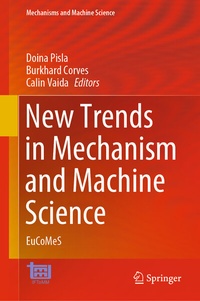
New Trends in Mechanism and Machine Science
Description

This volume presents the latest research and industrial applications in the areas of mechanism science, robotics and dynamics. The respective contributions cover such topics as computational kinematics, control issues in mechanical systems, mechanisms for medical rehabilitation, mechanisms for minimally invasive techniques, cable robots, design issues for mechanisms and robots, and the teaching and history of mechanisms. Written by leading researchers and engineers, and selected by means of a rigorous international peer-review process, the papers highlight numerous exciting ideas that will spur novel research directions and foster multidisciplinary collaborations. They reflect the outcomes of the 8th European Conference on Mechanism Science (EuCoMeS) in 2020.
More details
Other editions
Additional editions
Content
- Intro
- Preface
- Organization
- Conference Chair
- Conference Co-chair
- EuCoMeS Organising Committee
- International Scientific Committee
- Contents
- I Computational Kinematics
- A New 3T Parallel Mechanism: Topological Design, Analysis and Symbolic Position Solutions
- 1 Introduction
- 2 Topological Design and Analysis
- 2.1 Topology Analysis of the PM
- 3 Forward and Inverse Position Solutions
- 3.1 Solving Symbolic Forward Position
- 3.2 Solving Inverse Positions
- 3.3 Numerical Validation
- 4 Conclusions
- References
- Damping Mechanisms of a Vibration-Reduction System Using Granules
- 1 Introduction
- 2 Experimental Apparatus and Methods
- 3 Calculation Model of Granular-Material Damper
- 3.1 Calculation Model
- 3.2 Equations of Motion for Main System
- 4 Results of Experiment and Calculation
- 4.1 Damping Ratio and Relative-Motion Mass
- 4.2 Consideration of Rotational Motion and Damping Mechanism of Granular Material
- 5 Conclusions
- References
- Design Parameter Space of Spherical Four-Bar Linkages
- 1 Introduction
- 2 The Spherical 4R Algebraic IO Equation
- 2.1 Interpreting the Spherical 4R Algebraic IO Equation
- 3 Spherical 4R Design Parameter Space
- 4 Conclusions
- References
- Ball's Point Construction Revisited
- 1 Introduction
- 2 Bobillier's Construction of the Inflection Pole
- 3 Vectorization of Bobillier's Construction
- 4 Ball's Point Construction
- 5 Vectorization of Ball's Point Construction
- 6 Example
- 7 Conclusions
- References
- The Effect of Selection of Virtual Variable on the Direct Kinematics of Parallel Mechanisms
- 1 Introduction
- 2 Two Selection Methods for Virtual Variable
- 3 An Example-Position Analysis of 1T1R PM
- 3.1 Mechanism Design
- 3.2 Analysis of Topological Characteristics
- 3.3 Direct Kinematics
- 4 Conclusions
- References
- Function Generation Synthesis of Planar Slider-Crank Linkages for Given 3 Positions and a Dead-Center Position
- 1 Introduction
- 2 Design Equations
- 3 Computer Implementation
- 4 Conclusions and Discussions
- References
- Multidual Algebra and Higher-Order Kinematics
- 1 Introduction
- 1.1 Multidual Vectors
- 1.2 Multidual Tensors
- 1.3 Multidual Differential Transform
- 2 Higher-Order Kinematics with Multidual Transform
- 3 Higher-Order Kinematics of Lower-Pair Chains with Multidual Algebra
- 4 Conclusions
- References
- On Homotopy Continuation Based Singularity Distance Computations for 3-RPR Manipulators
- 1 Introduction
- 2 Non-homogeneous Representations
- 2.1 Results
- 3 Homogeneous Representations
- 3.1 Results
- 4 Conclusions
- References
- I Control Issues in Mechanical Systems
- Assistive Handwriting Haptic Mechanism Using Deep Learning Speech Recognition
- 1 Introduction
- 2 Kinematic Analysis
- 2.1 Position Analysis
- 2.2 Velocity Analysis
- 2.3 Acceleration Analysis
- 3 Dynamic Analysis
- 4 Dynamic Control
- 4.1 Speech Command Recognition Using Deep Learning
- 5 Simulation
- 5.1 Results
- 6 Conclusions
- References
- Design and Development of a Mobile Robot Equipped with Perception Systems for Autonomous Navigation
- 1 Introduction
- 2 Overall Design
- 2.1 Mechanical Design of the Main Parts of the Robot
- 2.2 Locomotive Mechanism
- 2.3 Sensors, Interfaces and Micro-controllers Used for Control and Navigation
- 3 Experimental Results
- 3.1 Prototype and Functional Simulation
- 3.2 Tests and Results
- 3.3 Discussion and Limitations
- 4 Conclusions
- References
- Validation of Flatness-Based Feedforward Control for a Four-Chain Crane Manipulator
- 1 Introduction
- 2 Nonlinear Dynamics of the Crane Manipulator
- 3 Flatness-Based Feedforward Control
- 4 Kinematic Measurement Model
- 5 Simulation and Experimental Results
- 6 Conclusions
- References
- The Model of a Controlled Mechanical System of an Air-Jet Loom Shedding Mechanism
- 1 Introduction
- 2 Controlled Mechanical System
- 3 Shedding Mechanism Model
- 4 Conclusions
- References
- Dynamics and Motion Control of a Three Degree of Freedom 3-PRRR Parallel Manipulator
- 1 Introduction
- 2 Conceptual Design
- 3 Kinematic Model
- 4 Dynamic Formulation
- 5 Motion Control Scheme
- 6 Results and Discussion
- 7 Conclusions
- References
- I Mechanisms for Medical Rehabiliation
- Numerical and Experimental Validation of ExoFing, a Finger Exoskeleton
- 1 Introduction
- 2 The ExoFing Finger Exoskeleton
- 3 Numerical Evaluation of Operation Performance
- 4 Experimental Setup and Tests
- 5 Experimental Results
- 6 Conclusions
- References
- Serious Gaming Approach to Rehabilitation Using a 1 DOF Upper Limb Exerciser
- 1 Introduction
- 2 State of the Art
- 3 Design and Testing of the System
- 4 Conclusions
- References
- Rehabilitation System with Integrated Visual Stimulation
- 1 Introduction
- 2 Kinematics of the Robotic Structure
- 3 The Control System and User Interface
- 4 Development of the Virtual Reality Application
- 5 Conclusions
- References
- A Numerical Method for Determining the Workspace of a Passive Orthosis Based on the RRRR Mechanism in the Lower Limb Rehabilitation System
- 1 Introduction
- 2 Formulation of the Problem
- 3 A Mathematical Model of a Passive RRRR Mechanism
- 4 Method for Determining the Workspace of the RRRR Mechanism
- 5 Algorithm Synthesis
- 6 Simulation Results
- 7 Conclusions
- References
- Static and Dynamic Analysis of a Prosthetic Human Knee
- 1 Introduction
- 2 Virtual Modeling of the Prosthetic Knee Joint
- 3 Results
- 4 Experimental Measurements
- 5 Dynamic Analysis
- 6 Conclusions
- References
- Dimensional and Workspace Analysis of RAISE Rehabilitation Robot
- 1 Introduction
- 2 RAISE Robotic Model for Lower Limb Rehabilitation
- 3 Anthropometric Data for the Lower Limb and Motion Amplitudes
- 4 Dimensioning of the Key Components of the RAISE System Using the Anthropomorphic Data
- 5 Workspace Modeling of RAISE Robot
- 6 Validation of the RAISE Structure
- 7 Conclusions
- References
- I Mechanisms for Minimally Invasive Techniques
- On the Collision Free-Trajectories of a Multiple-needle Robot Based on the Fibonacci Sequence
- 1 Introduction
- 2 Model
- 3 Results
- 4 Conclusions
- References
- Joint Space and Workspace Analysis of a 2-DOF Spherical Parallel Mechanism
- 1 Introduction
- 2 Mechanism Under Study
- 3 Singularity and Workspace Analysis
- 4 Conclusions
- References
- Kinematic Analysis of Two Innovative Medical Instruments for the Robotic Assisted Treatment of Non-resectable Liver Tumors
- 1 Introduction
- 2 The Multiple Needles Insertion Brachytherapy Robotic Instrument
- 3 The Ultrasound Probe Manipulation Robotic Instrument (USP)
- 4 Numerical Examples
- 5 Conclusions
- References
- Modeling a Cannula Insertion into a Phantom of Biological Tissue Using a Piezoelectric Actuator
- 1 Introduction
- 2 Description of the Model
- 3 Verification of Contact Model
- 4 Numerical Simulation
- 5 Conclusions
- References
- Robot-Assisted Ablation of Liver Hepatocellular Carcinoma and Colorectal Metastases: A Systematic Review
- 1 Introduction
- 2 Materials and Methods
- 3 Results
- 4 Discussion
- 5 Conclusions
- References
- Towards Building a Computerized System for Modelling Advanced HCC Tumors, in Order to Assist Their Minimum Invasive Surgical Treatment
- 1 Introduction
- 2 State of the Art
- 2.1 Computerized Systems for Surgical Treatment Assistance
- 2.2 Tumor Segmentation and 3D Reconstruction
- 3 Description of the Computerized System
- 3.1 Methods
- 4 Experimental Results
- 4.1 HCC Segmentation
- 4.2 3D Reconstruction of the Anatomical Context
- 5 Conclusions
- References
- I Gears
- Load Sharing and Quasi-Static Transmission Error of Non-Standard Tooth Height Spur Gears
- 1 Introduction
- 2 Meshing Stiffness and Load Sharing Ratio
- 3 Profile Modification
- 4 High Contact Ratio Spur Gears
- 5 Conclusions
- References
- A Transmission Error Analysis of a Herringbone Gear Set Considering Manufacturing Error
- 1 Introduction
- 2 Manufacturing Error Description
- 3 Transmission Error Analysis Model
- 3.1 Discrete Model of a Herringbone Gear Set
- 3.2 Equilibrium and Compatibility Equations
- 4 Case Study
- 5 Conclusions
- References
- Meshing Limit Line of Conical Worm Pair
- 1 Introduction
- 2 Theoretical Foundation for Determining Meshing Limit Line
- 3 Solving Control Equation and Analyzing Existence of Its Real Root
- 4 Numerical Investigations
- 5 Conclusions
- References
- Acoustic Emission Monitoring of Teeth Surface Damage Process in a Planetary Gearbox
- 1 Introduction
- 2 Experimental Procedure
- 3 Results and Discussion
- 3.1 Gear Damage and AE Signals Description
- 3.2 Burst Width as Condition Indicator
- 4 Conclusions
- References
- Impact of Position and Tooth Thickness Errors on Planetary Transmission Under Different Meshing Phase
- 1 Introduction
- 2 Method
- 2.1 Transmissions Considered
- 3 Results
- 3.1 Negative Torque
- 3.2 Positive Torque
- 4 Conclusions
- References
- Profile Shifting Coefficients of Spur Gears with Balanced Specific Sliding Coefficients at the Points Where the Meshing Stars and Ends
- 1 Introduction
- 2 Sliding Between Two Surfaces in the General Case
- 3 Sliding Between the Flanks in the Case of the Cylindrical Spur Gears
- 4 Specific Sliding Coefficients at the Points Where the Meshing Starts (a) and Ends (E)
- 5 Conclusions
- References
- I Dynamics of Multi-body Systems
- Simplified Method to Predict Clearance Evolution Effects Due to Wear Through MBD Simulation
- 1 Introduction
- 2 Wear Approximation
- 3 Implementation
- 4 Results and Comparison
- 5 Conclusions
- References
- A Modular Geometric Approach to Dynamics Modeling of Fully-Parallel PKM by Example of a Planar 3RPR Mechanism
- 1 Introduction
- 2 Kinematics of the Limb Prototype
- 2.1 Configurations of the Bodies in the Limb Prototype
- 2.2 Twists of the Bodies in the Limb Prototype
- 3 Kinematics of a General Limb
- 4 Inverse Kinematics of the Mechanism
- 5 Motion Equations
- 6 Conclusion and Further Aspects
- References
- Chaos Illustrations in Dynamics of Mechanisms
- 1 Introduction
- 2 The Equations of Motion
- 3 The Comparison Between the Software Simulation and Numerical Solutions
- 4 The Chaos Effect in Software Dynamical Modelling
- 5 The Estimation of the Effects of Inaccuracy of Initial Conditions in Numerical Integrating Modelling
- 6 Conclusions
- References
- Cartesian Elastodynamics Model of a Full-Mobility PKM with Flexible Links
- 1 Introduction
- 2 Virtual-Joint Model of the PKM
- 3 Elastostatics
- 3.1 Cartesian Stiffness Matrix
- 3.2 Cartesian Mass Matrix
- 3.3 Natural Frequencies and Natural Modes
- 4 Numerical Results
- 5 Conclusions
- References
- Synthesis of Function Generator Four-Bar Linkages: Minimization of the Joint-Forces Constraining Structural-Related Quantities
- 1 Introduction
- 2 Methods
- 3 Results and Discussion
- 3.1 Calibration
- 3.2 Results of the Method
- 4 Conclusions
- References
- Parametrization of a Real-Time Vehicle Model from Driving Tests for HiL Testing of Hydraulic Steering Systems
- 1 Introduction
- 2 Vehicle Model
- 3 Driving Tests
- 4 Parameter Identification
- 5 HiL Test Bench
- 6 Conclusion
- References
- Graphic Analysis of the Linear and Angular Momentum of a Dynamically Balanced 1-DoF Pantographic Linkage
- 1 Introduction
- 2 Graphic Analysis of the Linear and Angular Momentum
- 3 Conclusions
- References
- Inverse Dynamics and Simulation of a Parallel Robot Used in Shoulder Rehabilitation
- 1 Introduction
- 2 Innovative Parallel Robot for Shoulder Rehabilitation
- 3 The Inverse Dynamic Model of ASPIRE
- 4 Simulation Results and the Inverse Dynamic Model Validation Using Siemens NX
- 5 Conclusions
- References
- Periodic Walking Motion of a Humanoid Robot Based on Human Data
- 1 Introduction
- 2 Study of Human Walking
- 3 Human Trajectory and Humanoid Robot
- 4 Essential Model
- 5 Periodic Walking
- 6 Numerical Results
- 7 Effect of ZMP Evolution on Torques
- 8 Conclusions
- References
- I Industrial Applications
- Sailing/Coasting Enabled by Mechatronic Starting Devices
- 1 Introduction
- 2 Mechatronic Starters for Fast, Smooth Engine Starts
- 3 Application to Sailing/Coasting and Mild Hybridization
- 4 Conclusion and Future Work
- References
- Embedded Installation of Robot Operating System on Elbrus-Based Control Platform-High-Reliable Industrial Application
- 1 Introduction
- 2 Background and Related Work
- 2.1 Elbrus Embedded Platform
- 3 Embedding ROS into Elbrus Operating Environment
- 3.1 Target Setting
- 4 Testing
- 5 Performance Comparison
- 6 Conclusions
- References
- Calibration Study of a Continuously Variable Transmission System Designed for pHRI
- 1 Introduction
- 2 The Test Setup of the New CVT System
- 3 The Output Force Calibration of the CVT
- 4 Discussions and Conclusions
- References
- Maneuvers Possibility for the Spacecraft Equipped with Liquid-Fuelled Engines Operating with Different Kinds of Fuel
- 1 Introduction
- 2 Target Setting
- 3 Methodology
- 3.1 Velocity
- 3.2 Spatial Trajectory
- 4 Fuel Component Pairs: Brief Description
- 4.1 Ethanol-Liquid Oxygen
- 4.2 Kerosene-Liquid Oxygen
- 4.3 Asymmetric Dimethylhydrazine-Nitrogen Tetra-Oxide
- 4.4 Liquid Hydrogen-liquid Oxygen
- 4.5 Specific Thrust Comparison
- 5 Orbital Plane Movement Estimation
- 6 Conclusions
- References
- HiL Test Bench as a Development Environment for Hydraulic Steering Systems
- 1 Introduction
- 1.1 Innovative Steering Systems
- 1.2 HiL Development Environment
- 2 HiL Test Bench Concept
- 2.1 System Comparison
- 2.2 HiL Actuator
- 2.3 HiL Structure
- 3 Hydraulic Actuator Control
- 4 Experimental Results
- 4.1 Cylinder End Stop HiL Model
- 4.2 Compared Cylinder End Stop Results
- 5 Conclusion
- References
- Contact Detection Approach Between Wheel and Rail Surfaces
- 1 Introduction
- 2 Wheel and Rail Parametrization
- 3 Contact Forces Models
- 4 Example of Application
- 5 Conclusions
- References
- Counter-Rotating Savonius Wind Turbine
- 1 Introduction
- 2 Description of the Model
- 3 Equations of Motion and Averaging Method
- 4 Steady Operation Modes
- 5 Discussion
- 6 Conclusions
- References
- I Cable Robots
- An Inverse Kinematic Code for Cable-Driven Parallel Robots Considering Cable Sagging and Pulleys
- 1 Introduction
- 2 Definitions and Assumptions
- 3 The Catenary-Pulley Model
- 4 An Inverse Kinematic Code for the Catenary-Pulley Model
- 5 Comparison to a State-of-the-Art Inverse Kinematic Code
- 6 Conclusion and Outlook
- References
- Motion Generation for a Cable Based Rehabilitation Robot
- 1 Introduction
- 2 Requirements for Upper Limb Exercising
- 3 The LAWEX Cable Driven Robot
- 3.1 Mechanical Architecture
- 3.2 Control Hardware
- 4 Experimental Tests
- 5 Conclusions
- References
- Failure Analysis of a Collaborative 4-1 Cable-Driven Parallel Robot
- 1 Introduction
- 2 Kineto-Static Analysis of a 4-1 CDPR
- 3 Possible Failures
- 3.1 Cable Breaking
- 3.2 Adding Measurements
- 3.3 Zones Covered by the Cables
- 4 Ensuring Safety
- 5 Conclusion
- References
- I Design Issues for Mechanisms and Robots
- Software Optimization Problem Solver for Automated Linkage Design
- 1 Introduction
- 2 Advantages of Computer-Aided Design of Technological Systems
- 3 Synthesis of a Mechanism for a Given Function of the Output Joint: An Example of a Solution
- 3.1 Calculation of the Direct Kinematic Problem
- 3.2 Visualization
- 4 Development Prospects: Training
- 5 Conclusion
- References
- Static Analysis and Design Strategy of Two Antagonistically Actuated Joints
- 1 Introduction
- 2 Static Analysis of the Joints
- 2.1 Static Equilibrium and Stiffness of the R-Joint
- 2.2 Static Equilibrium and Stiffness of the X-Joint
- 3 Optimal Design of the Joints for a Specified WFW
- 3.1 Optimal Design of the R-Joint
- 3.2 Optimal Design of the X-Joint
- 4 Numerical Examples and Inferences
- 5 Conclusion
- References
- An Approach to Robotic End Effectors Based on Multistable Tensegrity Structures
- 1 Introduction
- 2 Mechanical Modeling
- 3 Changing the Equilibrium Configuration
- 4 Conclusion
- References
- Experimental Analysis of an MBS System with Two Degrees of Freedom Used in an Eolian Water Pump
- 1 Introduction
- 2 Finite Element Analysis of the Elastic Lever
- 3 Tests and Results
- 4 Conclusions
- References
- Design and Characterization of a 3D Printed Soft Pneumatic Actuator
- 1 Introduction
- 2 Design and Fabrication
- 3 Modelling
- 3.1 Material Characterization
- 3.2 Setup Simulation
- 4 Preliminary Test
- 5 Performance Evaluation
- 6 Conclusions and Future Work
- References
- Novel Planar Parallel Manipulator Using Geared Slider-Crank with Linear Actuation as Connection Kinematic Chain
- 1 Introduction
- 2 Geared Linkages with Linear Actuation
- 3 Novel Planar Parallel Manipulator
- 4 Singularities of the Novel Parallel with Linear Actuation Manipulator
- 5 Example Problem
- 6 Conclusions
- References
- I Teaching and History of Mechanisms
- Including the United Nations Sustainable Development Goals in Teaching in Engineering: A Practical Approach
- 1 Introduction
- 2 Formula Student
- 3 Formula Student Bizkaia: A Company Inside the University
- 3.1 Organisational Structure
- 3.2 Coordination
- 3.3 Educational Three Year Cycle
- 4 Formula Student Bizkaia and Sustainable Development Goals
- 5 Conclusions
- References
- Computer-Assisted Learning Used to Overconstrained Mechanism's Mobility
- 1 Introduction
- 2 Problem Description
- 3 Conclusions
- References
- Petrovaradin Fortress: Clock Tower Mechanism
- 1 Introduction
- 2 History of Time Measurement
- 3 Petrovaradin Fortress and Clock Tower
- 4 Clock Tower Mechanism
- 4.1 Timing Mechanism
- 4.2 Quarter Striking Mechanism
- 4.3 Full Hour Striking Mechanism
- 5 Conclusion
- References
- Author Index
