

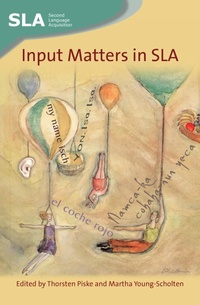
Input Matters in SLA
Published on 23. December 2008
312 pages
978-1-84769-931-2 (ISBN)
Description

This volume bridges the knowledge gap between second language acquisition researchers and second language pedagogy professionals in its focus on a topic of mutual interest: input. The reader-friendly contributions from seasoned researchers including Stephen Krashen, Bill VanPatten and new voices offer a wide range of existing and new perspectives on the matter of input. A rare feature of the book is that it includes extensive coverage by experts including James Flege and Alene Moyer of the acquisition of the sound system of a second language, where input seems to matter most. Those who are just making their acquaintance with second language acquisition research or updating their knowledge will find the editors' introductory chapter on past and current issues in the field particularly useful.
Reviews / Votes
Input matters in SLA is essential reading for those who are in the field of SLA research and will also be useful for teachers of SL/FL, since input continues to be one of the most discussed areas in SLA. -- Julia Baron, Universitat de Barcelona, Barcelona, Spain The volume constitutes a major contribution to the understanding of the role of input in L2 acquisition, and especially in L2 phonology, an area where input has not been investigated systematically. I think that L2 researchers and graduate students will find this volume quite appealing and would consider it a required reading for anyone planning to undertake research projects on L2 input. -- Monica Cabrera, Loyola Marymount University, USA * Linguist List 20.4070 * This book has the great merit of appealing to quite different kinds of reader. To delve into technically complex issues, second language researchers had to part company some time ago with the more practically oriented world of language pedagogy. Without understanding what happens in people's minds when they process what they are exposed to, we cannot make real progress in shaping efficient learning programmes but still we really need books like this one to bring issues of theory and issues of practice together. Input Matters covers a diversity of topics. Part 1 deals with more general issues and features some key players in the history of input studies, notably Stephen Krashen and Bill VanPatten. Kees de Bot and colleagues also provide a fresh new way of looking at how input is organised in the mind, providing diversity as well as depth to this first part of the book. Part 2, also featuring prominent researchers, focusses on phonology so speech input is the dominant theme. This book will have great appeal to theorists and practitioners alike. -- Mike Sharwood Smith, Heriot-Watt University, Edinburgh, UK This book has the great merit of appealing to quite different kinds of reader. This book will have great appeal to theorists and practitioners alike. -- Mike Sharwood Smith, Heriot-Watt University, Edinburgh, UKMore details
Series
Language
English
Place of publication
Bristol
United Kingdom
Publishing group
Channel View Publications Ltd
Target group
Professional and scholarly
ISBN-13
978-1-84769-931-2 (9781847699312)
Copyright in bibliographic data and cover images is held by Nielsen Book Services Limited or by the publishers or by their respective licensors: all rights reserved.
Schweitzer Classification
Other editions
Additional editions
Thorsten Piske | Martha Young-Scholten
Input Matters in SLA
Book
12/2008
Multilingual Matters
€48.80
Shipment within 10-20 days
Persons
Thorsten Piske is affiliated with the University of Education in Schwaebisch Gmuend, Germany. His research focuses on first and second language acquisition and on bilingual education. He is well known for joint work with James E. Flege on factors affecting degree of foreign accent in a second language. He has done research on the production and perception of first and second language speech sounds and on the effectiveness of bilingual programs in kindergartens and primary schools.
Currently at Newcastle University in England, Martha Young-Scholten works on morpho-syntax and phonology. She is well known for joint work with Anne Vainikka on uninstructed adultsa?? development of morpho-syntax in German. Prosodic structure, orthographic input and the phonological awareness of low-literate immigrant adults are some of the lines of research she pursues in the second language acquisition of phonology.
Currently at Newcastle University in England, Martha Young-Scholten works on morpho-syntax and phonology. She is well known for joint work with Anne Vainikka on uninstructed adultsa?? development of morpho-syntax in German. Prosodic structure, orthographic input and the phonological awareness of low-literate immigrant adults are some of the lines of research she pursues in the second language acquisition of phonology.
Content
Introduction - Martha Young-Scholten and Thorsten Piske
Part 1 : Matters of Input
1. Input Frequency and the Acquisition of the Progressive - Andreas Rohde
2. Processing Matters in Input Enhancement - Bill VanPatten
3. Input and Second Language Development from a Dynamic Perspective - Marjolijn Verspoor, Wander Lowie and Kees de Bot
4. The Comprehension Hypothesis Extended - Stephen Krashen
5. Output Matters Too - Nel de Jong
6. Learner Attitudes towards Comprehension-based Language Learning - John Stephenson
7. The Hidden Paradox of Foreign Language Instruction, or: Which are the Real Foreign Language Learning Processes? - Werner Bleyhl
Part 2: Input Matters in Phonology
8. Input as a Critical Means to an End: Quantity and Quality of Experience in L2 Phonological Attainment - Alene Moyer
9. Give Input a Chance! - James E. Flege
10. Orthographic Input and Second Language Phonology - Benedetta Bassetti
11. Second Language Speech Learning with Diverse Inputs - Ocke-Schwen Bohn and Rikke Bundgaard-Nielsen
12. Phonetic Input in Second Language Acquisition: Contrastive Analysis of Native and Non-native Sounds - Anja Steinlen
13. Developing Non-native Pronunciation in Immersion Settings - Henning Wode
Bibliography
Glossary
Part 1 : Matters of Input
1. Input Frequency and the Acquisition of the Progressive - Andreas Rohde
2. Processing Matters in Input Enhancement - Bill VanPatten
3. Input and Second Language Development from a Dynamic Perspective - Marjolijn Verspoor, Wander Lowie and Kees de Bot
4. The Comprehension Hypothesis Extended - Stephen Krashen
5. Output Matters Too - Nel de Jong
6. Learner Attitudes towards Comprehension-based Language Learning - John Stephenson
7. The Hidden Paradox of Foreign Language Instruction, or: Which are the Real Foreign Language Learning Processes? - Werner Bleyhl
Part 2: Input Matters in Phonology
8. Input as a Critical Means to an End: Quantity and Quality of Experience in L2 Phonological Attainment - Alene Moyer
9. Give Input a Chance! - James E. Flege
10. Orthographic Input and Second Language Phonology - Benedetta Bassetti
11. Second Language Speech Learning with Diverse Inputs - Ocke-Schwen Bohn and Rikke Bundgaard-Nielsen
12. Phonetic Input in Second Language Acquisition: Contrastive Analysis of Native and Non-native Sounds - Anja Steinlen
13. Developing Non-native Pronunciation in Immersion Settings - Henning Wode
Bibliography
Glossary
