

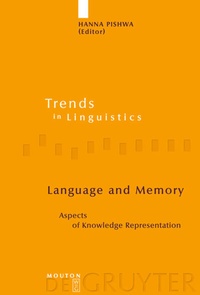
Language and Memory
Description

This volume presents an entirely new, expanded cognitive view of language by examining linguistic structure and its use in communication from the point of view of memory, thus providing a novel way of analysing language. The fourteen chapters, authored by linguists and psychologists, show the need for such an approach and illustrate that the properties of numerous linguistic structures reflect those of memory in various ways. Many different methodologies are presented because of the interdisciplinary nature of the volume, without reducing the comprehensibility and comparability of the contributions. Core linguistic areas are discussed in the contributions embracing syntax, semantics, pragmatics, and discourse analysis; psychological aspects are restricted to memory systems and their properties.
The introduction provides a concise overview of memory, and then three sections examine linguistic phenomena from various angles relating them to memory. In the first section, the contributions emphasize the issue of syntagmatic vs. paradigmatic organization in various linguistic phenomena with a focus on syntax and their locus in memory. The contributions in the second part investigate structures with non-fixed functions showing that they tend to be connected to a certain submemory sharing their features such as subjectivity and evaluation. The concern of the last section is discourse comprising coherence, evidentiality, politeness, and persuasion.
The book should be stimulating for researchers and students of linguistic core areas as well as those occupied with developmental aspects and theoretical aspects of language. It also provides new insights into methods of analysis both in linguistics and in cognitive psychology. The individual chapters are comprehensible to linguists who have no background in psychology and to psychologists who have to background in linguistics.
Reviews / Votes
"The book should be stimulating for researchers and students of linguistic core areas as well as those occupied with developmental aspects and theoretical aspects of language. It also provides new insights into methods of analysis both in linguistics and in cognitve pschology."www.kultur-insel.de 11/2006More details
Other editions
Additional editions
Person
Content
- Intro
- Contents
- Chapter 1: Memory and language: Introduction
- Part 1. Linguistic structure and memory
- Chapter 2: A constructivist epistemology for the language sciences
- Chapter 3: 'What's a nice NP like you doing in a place like this?' The grammar and use of English inversions
- Chapter 4: Cooccurrence and constructions
- Chapter 5: On the reduction of complexity: Some thoughts on the interaction between conceptual metaphor, conceptual metonymy, and human memory
- Chapter 6: Making ends meet
- Part 2. Select linguistic notions and memory
- Chapter 7: Evaluation and cognition: Inscribing, evoking and provoking opinion
- Chapter 8: Causality and subjectivity: The causal connectives of Modern Greek
- Chapter 9: Expression of uncertain goals in communication: The case of multifunctional 'try'
- Chapter 10: What psycholinguistic negation research tells us about the nature of the working-memory representations utilized in language comprehension
- Part 3. Discoursal units and memory
- Chapter 11: It utterly boggles the mind: Knowledge, common ground and coherence
- Chapter 12: Remembering another's experience: Epistemological stance and evaluation in narrative retelling
- Chapter 13 Conversation memory: Intentions, politeness, and the social context
- Chapter 14: Nonliteral language, persuasion, and memory
- Index
