

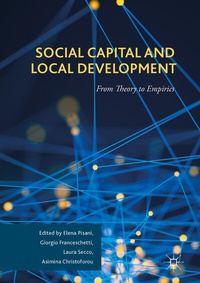
Social Capital and Local Development
Description

This book addresses the role of social capital in promoting rural and local development. The recent financial and economic crises have exposed the European Union (EU) to an increased risk of social exclusion and poverty, which are now at the heart of its economic, employment and social agenda with explicit reference to rural and marginal areas (Europe 2020). The authors' work from the notion that rural development is not imposed from the 'outside', but depends also on endogenous factors, namely local cultural and ecological amenities, eco-system services, and economic links with urban areas which expand rural opportunities for innovation, competitiveness, employment and sustainable development.
Social capital is of paramount importance because it helps build networks and trusting relations among local stakeholders in the public and private spheres, and supporting the enhancement of governance of natural resources in rural areasMore details
Other editions
Additional editions
Persons
Elena Pisani is Assistant Professor of Principles of Economics, Project Planning and Evaluation for Local and Sustainable Development at the University of Padova, Italy.
Laura Secco is Associate Professor in Forest Policy and Governance and in Environmental and Social Responsibility in Local Development Processes at the University of Padova, Italy.
Giorgio Franceschetti is Emeritus Professor of Economics, Rural Planning and Development Cooperation at the University of Padova, Italy.
Asimina Christoforou
is Adjunct Professor of International and European Economic Studies at the Athens University of Economics and Business, Greece.
Content
Introduction. -Part I: Social capital and rural development in European regions: a conceptual framework.- .Part II: A methodological approach to the evaluation of the LEADER initiative.- .Part III: LEADER and social capital: a comparative analysis and discussion.- Part IV: LEADER and social capital: regional case studies.- .Part V: Conclusions and policy recommendations.
