

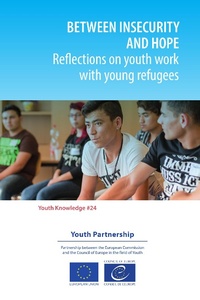
Between insecurity and hope
Reflections on youth work with young refugees
Published on 15. December 2018
218 pages
978-92-871-8933-2 (ISBN)
Description

Youth work can offer a space for young refugees to express themselves and participate in society.
This Youth Knowledge book presents theoretical references and reflections on the experiences of young refugees and the way they reconcile personal hope with the tensions within their host societies. It also explores learning from practices and their theoretical underpinnings concerning the role of youth work in a cross-sectoral approach. This book aims to be a reference for policy makers, practitioners and researchers in the youth field and stakeholders from other sectors working on inclusion, access to rights and the participation of young refugees.All the contributors propose a very critical engagement with the reality of young refugees in today's Europe, where tolerance levels for negative phenomena, such as human rights violations, hate speech and discrimination, are on the rise. However, there is also an underlying message of hope for those willing to engage in a human rights-based youth work practice that ensures safe spaces for being young, no matter who, no matter where. Practices and reflections deal with democracy, activism, participation, formal and non-formal education and learning, employment, trauma, "waitinghood" and negotiating identities.
We hope this book as a whole, and each individual contribution, will inspire youth policy makers and practitioners to take on board the complex realities of unfinished transitions and borderland experiences and create a positive environment for an enriched and transformed youth work for the inclusion of young refugees in their host communities.
This Youth Knowledge book presents theoretical references and reflections on the experiences of young refugees and the way they reconcile personal hope with the tensions within their host societies. It also explores learning from practices and their theoretical underpinnings concerning the role of youth work in a cross-sectoral approach. This book aims to be a reference for policy makers, practitioners and researchers in the youth field and stakeholders from other sectors working on inclusion, access to rights and the participation of young refugees.All the contributors propose a very critical engagement with the reality of young refugees in today's Europe, where tolerance levels for negative phenomena, such as human rights violations, hate speech and discrimination, are on the rise. However, there is also an underlying message of hope for those willing to engage in a human rights-based youth work practice that ensures safe spaces for being young, no matter who, no matter where. Practices and reflections deal with democracy, activism, participation, formal and non-formal education and learning, employment, trauma, "waitinghood" and negotiating identities.
We hope this book as a whole, and each individual contribution, will inspire youth policy makers and practitioners to take on board the complex realities of unfinished transitions and borderland experiences and create a positive environment for an enriched and transformed youth work for the inclusion of young refugees in their host communities.
More details
Other editions
Additional editions

Book
12/2018
Council of Europe
€73.32
Shipment within 10-20 days
Content
- Intro
- Title page
- Contents
- Preface. Youth work with young refugees - An enriching transformation and ongoing transition
- Introduction. Setting the context: some critical reflections and the contributions
- The "refugee crisis"?
- A note on terminology
- Youth work
- The contributions in this book
- References
- Chapter 1. Young refugees, youth work and a call for political energy: notes from an unfunded ethnographic study
- Introduction
- A refugee crisis or political crisis? Why here, why now
- Refugees: some statistics on the youth context
- A note on methods
- Welcome to Europe and its social and political landscape
- Managing the crisis: a European perspective
- Young refugee integration: the realities
- Discussion
- References
- Chapter 2. The role of youth work in working with trauma of young refugees
- Introduction
- The role of youth work in working with trauma of young refugees
- What is trauma?
- What can youth work do?
- What can youth work do to help young refugees facing trauma?
- References
- Chapter 3. Ankommen_Weiterkommen: impressions and reflections on working with young asylum seekers in Karlsruhe, Germany
- The context
- The Ankommen_Weiterkommen project
- Team, methods and activities
- Impressions and reflections from my work
- Being adolescent
- Asylum, uncertainties and contradictions
- Breaking points in the transition to adulthood
- Dealing with a multitude of transitory processes
- Trusting relationships and mutual learning
- Life is hard without women
- Self-inquiry
- Creativity as value and self-empowerment
- The way ahead
- Chapter 4. Working with unaccompanied minors: preparation for inclusion
- Chapter 5. "Living under the same roof" - A home for young apprentices and unaccompanied minor refugees right in the centre of Munich
- Introduction
- 1. A few explanations
- 2. The Salesianum in Munich - Description of the project
- 3. Educational approach -The preventive system
- Create networks
- A familiar place is not a family
- Help to create realistic work prospects
- Leisure time and learning time is no contradiction
- Talk and write about what you are doing - Advocacy
- Conceptual work is important
- Co-accommodation together with same-aged youth
- Chapter 6. Learning to hope and hoping to learn: a critical examination of young refugees and formal education in the UK
- Introduction
- Power of the media
- Social construction of young refugees in the media
- The UK and migration
- Young refugees' identity in the UK
- Theory of national identity
- Agency
- Education
- Identity and education
- Young refugees and formal education
- Hope
- Youth work responses
- Skills of youth workers
- Youth work as a relational practice
- Multi-agency working
- Youth work and social capital
- Anti-oppressive practice
- Conclusion
- References
- Chapter 7. Recognition of the cultural capital of young refugees: the CAP (Centre for Lifelong Learning) as an academic experience of inclusion in Italy
- Introduction
- The CAP: an institutional response grounded in rights
- From theory to international practices: the programmes Fondata sul Lavoro and Work for You
- Life stories of a group of refugees and migrant people involved in the CAP
- Conclusions and future directions of working for young refugees
- References
- Chapter 8. Transformation of youth work for young refugees in Turkey: a shift from emergency aid to integration initiatives
- Introduction
- What links youth work with refugee support mechanisms?
- Youth work in Turkey
- Young refugees in Turkey and challenges
- Youth as a key group
- What is going on in youth work for young refugees in Turkey?
- Conclusions
- References
- Chapter 9. Young refugees and the role of youth work - The Finnish perspective
- Introduction
- 1. The effects of migration policies and migration law in the contexts of youth work and youth policy
- 2. Transnational ties in the context of the leisure activities of young asylum seekers, including contact with family members and friends in the country of origin
- 3. The role of leisure time in the lives of young asylum seekers
- References
- Chapter 10. Refugee and asylum- seeking young people in the UK: human agency as a central principle of youth work
- Introduction
- Refugees in the UK
- Refugee and asylum-seeking young people in the UK
- Research study
- Theoretical lens
- Findings
- Conclusion
- Recommendations for European youth work with refugee young people
- References
- Chapter 11. Youth work in the borderlands: reflections from Malta
- Introduction
- Malta: the carceral archipelago
- Crossing borders: the borderlands...
- Dinja Wahda: building relationships
- New opportunities: developing trust, bonding and bridging social capital
- Responding to learning needs
- Spark 15 - A refugee youth-led organisation
- Conclusion
- References
- Chapter 12. Essaim d'Accueil: an example of youth work with young adult refugees in Geneva
- 1. Setting the scene: (young) refugees as embodying unease
- 2. Essaim d'Accueil: horizontal organisation for social inclusion
- 3. Concluding remarks
- References
- Chapter 13. Youth work and refugees: empowering young refugees through participation and involvement
- Germany says (said) welcome
- Participation of young refugees
- Involvement in local authority activities
- Digital participation
- Involvement in (sports) clubs
- What youth work needs
- Chapter 14. "Altochtonen van de Toekomst"
- Chapter 15. Spark 15 - a refugee youth-led organisation
- Paul Galea, mentor, Spark 15
- Bakary B. Kanteh, member, Spark 15
- How I came to know about Spark 15
- My thoughts on Spark 15
- Conclusions. Youth work and young refugees - Critical reflections on the evolving social order and bridges to inclusion
- Introduction
- Between violence and hope - Youth work navigating insecurity and uncertainty
- Youth work, cross-sectoral partnerships and relationships
- Confirmed and emerging themes - Considerations for youth policy
- Conclusion -Political contributions of youth work and policy: embracing and shaping a more dynamic and diffuse new world order
- References
- Contributors
- Copyright
- Table of contents
