

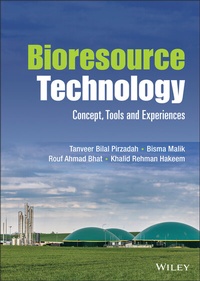
Bioresource Technology
Description

Discover the latest developments in the field of bioresource technology with this practical handbook
The management and cultivation of bioresources are critical components of the economic survival of nations. Significantly underexplored, recent advances in bioresource technologies have breathed new life into the research and development of new bioresource techniques and capabilities.
In Bioresource Technology: Concept, Tools, and Experiences, a team of distinguished researchers delivers a comprehensive work intended to bridge the gap between field-oriented taxonomists and ecologists and lab-oriented functional and molecular biologists.
The book is divided into three sections: food, environment, and energy. In the first part, the authors explore the functional food sector, from green and smart food packaging to nanosensors as diagnostic tools in the food industry. The second part is concerned with the achievement of future energy security through the use of bioresources as energy sources. Finally, the third section discusses sustainable environmental management policies via bioresource use.
Readers will also benefit from the inclusion of:
* A thorough introduction on the recent advances in the technology pertaining to functional food industry to overcome the future food challenges
* Comprehensive explorations of the art and science of growing microgreens, including their historical background, cultivation practices, quality, and shelf life
* In-depth examinations of the bioprospecting of bioresources, including bioprospecting in agriculture, chemical industries, and diagnostic applications
* Provides state-of-the art technologies in the green energy sector to cater for the energy demand of the people, reducing greenhouse gases (GHG) and the reliance on fossil fuels
* In-depth understanding on the recent advances in the bioresource management policies and sustainable environment
Perfect for postgraduate students, research scholars, faculty, and scientists involved in agriculture, plant sciences, environmental sciences, bioenergy, biofuels, molecular biology, and microbiology, Bioresource Technology: Concept, Tools, and Experiences is also an indispensable resource for those working in biochemistry, biotechnology, and food technology.
More details
Other editions
Additional editions
Persons
Bisma Malik, is Assistant Professor at the University Centre for Research and Development at Chandigarh University in Punjab, India.
Rouf Ahmad Bhat, works in the Department of School Education, Government of Jammu and Kashmir, India
Khalid Rehman Hakeem, is Professor at King Abdulaziz University in Jeddah, Saudi Arabia.
Content
1
Millets: Robust Entrants to Functional Food Sector
Sagar Maitra,1, Sandipan Pine,2, Pradipta Banerjee3, Biswajit Pramanick4 and Tanmoy Shankar5
1 Professor, Department of Agronomy and Agroforestry, Centurion University of Technology and Management, Paralakhemundi-761211, Odisha, India
2Associate Professor, Department of CSE, Centurion University of Technology and Management, Paralakhemundi-761211, Odisha, India
3 Assistant Professor, Department of Biochemistry and Plant Physiology, Centurion University of Technology and Management, Paralakhemundi-761211, Odisha, India
4 Assistant Professor, Department of Agronomy, Dr. Rajendra Prasad Central Agricultural University, Pusa-848125, Samastipur, Bihar, India
5Associate Professor, Department of Agronomy and Agroforestry, Centurion University of Technology and Management, Paralakhemundi-761211, Odisha, India
CHAPTER MENU
- 1.1 Introduction
- 1.2 Nomenclature and Use
- 1.3 Description of Important Millets
- 1.4 Millets: The Ancient Crops
- 1.5 Current Scenario of Millets Production
- 1.6 Nutritional Importance of Millets
- 1.7 Changes in Food Consumption Pattern and Future Demand
- 1.8 Food and Nutritional Security
- 1.9 Climate Change and Associated Threat to Agriculture
- 1.10 Millets: As Climate Smart Crops
- 1.11 Future Agriculture: Smart Technologies in Millet Farming
- 1.12 Conclusions
1.1 Introduction
The word "millet" derives from the "mil" or "thousand," which refers to the huge number of grains that can be produced from a single seed. Millets are coarse cereals with a heritage of consumption since early human civilizations from the Neolithic age. Presently, these crops are cultivated in arid and semi-arid regions of Asia and Africa as staple food and animal feed (Brahmachari et al. 2018; Maitra 2020). Millets are considered as miracle crops, because cultivation of millet has multiple benefits (Figure 1.1). The grains are used as food and the stover is used as fodder. Millets are diversified cereals; hence their cultivation enriches biodiversity in the agro-ecosystem. In erosion prone steep and arid regions, short statured millets provide grassy cover, thus restricting soil and nutrient loss. Soil organic carbon depletion is a major problem in drylands and cultivation of millet with less water assures carbon sequestration (Srinivasarao et al. 2014). Millets are less nutrient demanding, are cultivated with low chemical input and emit less greenhouse gas emissions; thus, millets reduce the carbon footprint in agriculture. Under extreme weather conditions, including higher temperatures, C4 millet plants assure CO2 abatement opportunities and, in the future, with elevated CO2 levels these crop will perform better than other major cereals. Food and nutritional security is a major concern, even in today's world, and nutrient-rich millets can fulfill this requirement. Moreover, millets are non-gluten foods richer in dietary fiber and essential macro- and micro-nutrients compared to other cereals. The world population will be 9.7 billion by 2050 and 11.2 billion by 2100 and agriculture will play a crucial role in feeding these huge populations with deteriorating and shrinking natural resources. Industrialization and urbanization have already changed the food consumption pattern and in future the transformation to value-added and energy-rich food will further intensify, leading to tremendous challenges to agriculture. The world cereal equivalent food demand is projected to be around 14,886 million tons in 2050 (Islam and Karim 2019). Food and nutritional security will add another dimension to the global food supply system. Considering all the above issues, including climate change, there is an urgent need to shift from ongoing crop production to ecologically sound and nutrient-rich crops. In this regard, millets can fulfill future requirements, because they have the desired qualities to cope with future climatic conditions. But, obviously, there is still the scope for adoption of smart technologies of precision agriculture (PA) to create a hunger-free world with sustainable agricultural production.
Figure 1.1 Multifaceted benefits of millet cultivation.
1.2 Nomenclature and Use
"Millet" is a generic term comprised of different coarse cereals and forage crops (Weber 1998). The millets can be placed as per prehistoric classification into mainly nine genera, namely, Brachiaria, Digitaria, Echinochloa, Eleusine, Panicum, Paspalum, Pennisetum, Setaria and Sorghum. Additionally, Coix and Amaranthus, and Eragrotis and Fagopyrum genera are also included as millets or coarse cereals. Among millets, the most prominent belong to the genera Sorghum and Pennisetum, which account for major world production, but the contribution of millets to the world's food basket is still negligible and these are essential food grains for mainly warm environments of the rainfed arid and semi-arid regions (Maitra 2020; Saxena et al. 2018). The classification of presently cultivated millets is essential to realize their uses and importance in agriculture in harsh agro-ecological regions (Table 1.1). Though the acreage of millets is less, these are a vital source of energy and staple food for sizeable populations dwelling in the dry regions of Asia and Africa. Out of total millet production in the world, about 50% of sorghum and 80% of millet are used as human food (Venkatesh Bhat et al. 2018). Grains of millets are common ingredients of animal feed and these are grown as green forage. The stover, or straw, of millets is used in animal feed, brewing, manufacturing of alcohol and for other industrial purposes. However, the use of millets varies in different countries; for example, in West African countries, a fermented thick porridge is made from pearl millet and sorghum. Finger millet and pearl millet are used for production of beer in Eastern Africa. However, these are also ingredients in Eastern European fermented drinks. Also breads are a very common food item prepared from millet in different countries like China, India, Mexico, Scotland, the United States and Ethiopia. In China, use of foxtail millet as an ingredient in soup is often observed. In cold regions of Japan, Japanese barnyard millet is used as a food. Flour from different millets is blended and used in the preparation of various value-added products such as pudding, breads, biscuits, sweets, cakes, chips, rolls and noodles. Moreover, due to their gluten-free nature and non-allergenic properties, these millet products have gained a rapid momentum, especially in the developing countries. Millets are mainly grown in the rainy season (June-July sown), but during recent times improved varieties and hybrids have been developed which can be cultivated in winter (October-November sown) and even in summer (February sown) under irrigated conditions. These hardy crops require less water and can more easily combat extreme weather conditions, including higher temperatures. As C4 plants, millets can utilize more CO2 and thus assure environmental benefits (Brahmachari et at. 2018). The agriculture in India faces many constraints, like the threat and variation of the monsoon season, but millets are ecologically sound crops which can withstand different weather aberrations with greater storability (Maitra 2020). However, millets have not received much attention from researchers and policy-makers compared to other major cereals like rice, wheat, maize and barley.
Table 1.1 Nomenclature of millets.
S. No. Common name Scientific name Major millets under cultivation 1 Sorghum/Giant millet Sorghum bicolor L. 2 Pearl millet Pennisetum glaucum L. Small millets under cultivation 3 Finger millet Eleusine coracana L. Gaertn. 4 Barnyard millet Echinochloa frumentacea L. 5 Proso millet Panicum miliaceum L. 6 Foxtail millet Setaria italic L. ... 7 Kodo millet Paspalum scrobiculatum L.