

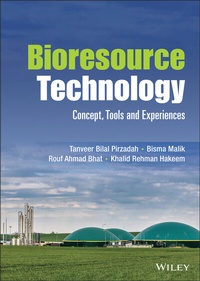
Bioresource Technology
Concept, Tools and Experiences
1st Edition
Published on 18. March 2022
544 pages
978-1-119-78942-0 (ISBN)
Description

Bioresource Technology
Discover the latest developments in the field of bioresource technology with this practical handbook
The management and cultivation of bioresources are critical components of the economic survival of nations. Significantly underexplored, recent advances in bioresource technologies have breathed new life into the research and development of new bioresource techniques and capabilities.
In Bioresource Technology: Concept, Tools, and Experiences, a team of distinguished researchers delivers a comprehensive work intended to bridge the gap between field-oriented taxonomists and ecologists and lab-oriented functional and molecular biologists.
The book is divided into three sections: food, environment, and energy. In the first part, the authors explore the functional food sector, from green and smart food packaging to nanosensors as diagnostic tools in the food industry. The second part is concerned with the achievement of future energy security through the use of bioresources as energy sources. Finally, the third section discusses sustainable environmental management policies via bioresource use.
Readers will also benefit from the inclusion of:
* A thorough introduction on the recent advances in the technology pertaining to functional food industry to overcome the future food challenges
* Comprehensive explorations of the art and science of growing microgreens, including their historical background, cultivation practices, quality, and shelf life
* In-depth examinations of the bioprospecting of bioresources, including bioprospecting in agriculture, chemical industries, and diagnostic applications
* Provides state-of-the art technologies in the green energy sector to cater for the energy demand of the people, reducing greenhouse gases (GHG) and the reliance on fossil fuels
* In-depth understanding on the recent advances in the bioresource management policies and sustainable environment
Perfect for postgraduate students, research scholars, faculty, and scientists involved in agriculture, plant sciences, environmental sciences, bioenergy, biofuels, molecular biology, and microbiology, Bioresource Technology: Concept, Tools, and Experiences is also an indispensable resource for those working in biochemistry, biotechnology, and food technology.
Discover the latest developments in the field of bioresource technology with this practical handbook
The management and cultivation of bioresources are critical components of the economic survival of nations. Significantly underexplored, recent advances in bioresource technologies have breathed new life into the research and development of new bioresource techniques and capabilities.
In Bioresource Technology: Concept, Tools, and Experiences, a team of distinguished researchers delivers a comprehensive work intended to bridge the gap between field-oriented taxonomists and ecologists and lab-oriented functional and molecular biologists.
The book is divided into three sections: food, environment, and energy. In the first part, the authors explore the functional food sector, from green and smart food packaging to nanosensors as diagnostic tools in the food industry. The second part is concerned with the achievement of future energy security through the use of bioresources as energy sources. Finally, the third section discusses sustainable environmental management policies via bioresource use.
Readers will also benefit from the inclusion of:
* A thorough introduction on the recent advances in the technology pertaining to functional food industry to overcome the future food challenges
* Comprehensive explorations of the art and science of growing microgreens, including their historical background, cultivation practices, quality, and shelf life
* In-depth examinations of the bioprospecting of bioresources, including bioprospecting in agriculture, chemical industries, and diagnostic applications
* Provides state-of-the art technologies in the green energy sector to cater for the energy demand of the people, reducing greenhouse gases (GHG) and the reliance on fossil fuels
* In-depth understanding on the recent advances in the bioresource management policies and sustainable environment
Perfect for postgraduate students, research scholars, faculty, and scientists involved in agriculture, plant sciences, environmental sciences, bioenergy, biofuels, molecular biology, and microbiology, Bioresource Technology: Concept, Tools, and Experiences is also an indispensable resource for those working in biochemistry, biotechnology, and food technology.
More details
Other editions
Additional editions
Tanveer Bilal Pirzadah | Bisma Malik | Rouf A Bhat
Bioresource Technology
Concept, Tools and Experiences
Book
05/2022
1st Edition
Wiley-Blackwell
€199.50
Shipment within 15-20 days
Tanveer Bilal Pirzadah | Bisma Malik | Rouf Ahmad Bhat
Bioresource Technology - Concept, Tools and Experiences
Software
04/2022
Wiley
€285.74
No shipping information available
Persons
Tanveer Bilal Pirzadah, is Assistant Professor at the University Centre for Research and Development at Chandigarh University in Punjab, India.
Bisma Malik, is Assistant Professor at the University Centre for Research and Development at Chandigarh University in Punjab, India.
Rouf Ahmad Bhat, works in the Department of School Education, Government of Jammu and Kashmir, India
Khalid Rehman Hakeem, is Professor at King Abdulaziz University in Jeddah, Saudi Arabia.
Bisma Malik, is Assistant Professor at the University Centre for Research and Development at Chandigarh University in Punjab, India.
Rouf Ahmad Bhat, works in the Department of School Education, Government of Jammu and Kashmir, India
Khalid Rehman Hakeem, is Professor at King Abdulaziz University in Jeddah, Saudi Arabia.
Content
- Intro
- Bioresource Technology: Concept, Tools and Experiences
- Contents
- About the Editors
- About the Book
- Foreword
- List of Contributors
- Preface
- Part I: The Application of Bioresource Technology in the Functional Food Sector
- 1. Millets: Robust Entrants to Functional Food Sector
- 1.1 Introduction
- 1.2 Nomenclature and Use
- 1.3 Description of Important Millets
- 1.3.1 Sorghum
- 1.3.2 Pearl Millet
- 1.3.3 Finger Millet
- 1.3.4 Foxtail Millet
- 1.3.5 Proso Millet
- 1.3.6 Barnyard Millet
- 1.3.7 Little Millet
- 1.3.8 Kodo Millet
- 1.3.9 Brown-Top Millet
- 1.4 Millets: The Ancient Crops
- 1.5 Current Scenario of Millets Production
- 1.6 Nutritional Importance of Millets
- 1.6.1 Millets as Functional Food 13
- 1.6.2 Anti-Oxidant and Anti-Aging Properties
- 1.6.3 Protection Against Cancer
- 1.6.4 Anti-Diabetic Properties
- 1.6.5 Protection Against Gastro-Intestinal Disorders
- 1.6.7 Protection Against Osteoporosis
- 1.7 Changes in Food Consumption Pattern and Future Demand
- 1.8 Food and Nutritional Security
- 1.9 Climate Change and Associated Threat to Agriculture
- 1.10 Millets: As Climate Smart Crops
- 1.11 Future Agriculture: Smart Technologies in Millet Farming
- 1.12 Conclusions
- References
- 2. The Art and Science of Growing Microgreens
- 2.1 Introduction
- 2.2 Historical Background
- 2.3 Health Benefits of Microgreens
- 2.3.1 Source of Functional Food Components
- 2.3.2 Component of Space Life Support Systems
- 2.3.3 Component of Nutritional Diet of Troops and Residents of High Altitude Regions
- 2.4 Cultivation Practices
- 2.4.1 Species Selection 30
- 2.4.2 Growing Media and Propagation Felts
- 2.4.3 Growing Process
- 2.5 Quality and Shelf Life
- 2.6 Market Trends
- 2.7 Future Outlook
- 2.8 Conclusions
- References
- 3. Novel Nutraceuticals From Marine Resources
- 3.1 Introduction
- 3.2 Marine Microorganisms as a Source of Nutraceuticals
- 3.2.1 Marine Algae
- 3.2.2 Marine Invertebrates
- 3.2.2.1 Sponges
- 3.2.2.2 Crustaceans, Echinoderms and Molluscs
- 3.2.2.3 Marine Fishes
- 3.2.2.4 Marine Actinomycetes
- 3.2.2.5 Marine Fungi
- 3.2.2.6 Marine Bacteria
- 3.3 Classification of Different Nutraceuticals Obtained from Marine Environment
- 3.3.1 Polysaccharides
- 3.3.2 Marine Lipids
- 3.3.3 Natural Pigments from Marine Sources
- 3.3.4 Chitosan and Its Derivatives
- 3.3.5 Proteins and Peptides
- 3.3.6 Minerals, Vitamins and Enzymes
- 3.3.7 Marine Probiotics and Phenolic Compounds
- 3.4 Important Bioactive Metabolites and Their Biological Properties
- 3.5 Current Status of Nutraceuticals in Market
- 3.6 Conclusion and Future Recommendations
- References
- 4. Bioprospecting of Bioresources: Creating Value From Bioresources
- 4.1 Introduction
- 4.2 Bioprospecting in Various Industrial Fields
- 4.2.1 Pharmaceutical Industries
- 4.2.1.1 Drugs From Plants
- 4.2.1.2 Drugs From Bugs
- 4.2.1.3 Drugs From Aquatics
- 4.3 Chemical Industries
- 4.3.1 Biocatalysis
- 4.4 Bioprospecting in Agriculture
- 4.4.1 Biofertilizers and Biopesticides
- 4.4.2 Bioremediation
- 4.5 Bioprospecting in Beautification/Cosmetics
- 4.6 Bioprospecting in Detergent Industry
- 4.7 Bioprospecting in Textile Industry
- 4.8 Bioprospecting in Paper Industry
- 4.9 Bioprospecting in Food Industry
- 4.9.1 Bioprospecting in Brewing Industry
- 4.10 Diagnostic
- 4.10.1 Application of Enzymes for the Detection of Pyrogens in Pharmaceutical Products
- 4.10.2 Bioprospecting in Biofuel Production
- 4.11 Conclusions and Future Perspectives
- References
- 5. Green and Smart Packaging of Food
- 5.1 Introduction
- 5.2 Green Packaging in Food
- 5.3 Properties of Green Packaging Materials
- 5.4 Mechanical Properties of Green Packaging Materials
- 5.5 Barrier Properties of Green Packaging
- 5.6 Green Packaging Materials with Active Properties
- 5.7 Biodegradation Mechanisms of Green Packaging
- 5.8 Main Green Food Packaging
- 5.8.1 Poly(lactic Acid) (PLA)
- 5.8.2 Polyhydroxyalkaonate (PHA)
- 5.8.3 Starch-based Materials
- 5.8.4 Cellulose-based Materials
- 5.9 Life Cycle of Green Packaging Materials
- 5.10 Smart Packaging in Food
- 5.11 Indicators for Smart Packaging
- 5.11.1 Time-Temperature Indicator (TTI)
- 5.11.2 Freshness Indicators
- 5.11.3 Packaging Integrity Indicators
- 5.12 Sensor Applications for Smart Packaging
- 5.13 Data Carriers for Smart Packaging
- 5.14 Regulatory Aspects
- 5.15 Conclusion and Future Perspectives
- References
- 6. Nanosensors: Diagnostic Tools in the Food Industry
- 6.1 Introduction
- 6.2 Identification of Foodborne Pathogens and Toxins
- 6.3 Pesticides and Carcinogenic Detection
- 6.3.1 Nitrites-Carcinogenic Detection
- 6.3.2 Mycotoxin Detection
- 6.3.3 Food Packaging
- 6.3.4 Food Freshness Detection
- 6.4 Chemicals and Food Additives Detection
- 6.4.1 Preservatives
- 6.4.2 Dyes
- 6.4.3 Sweeteners
- 6.4.4 Antioxidants
- 6.4.5 Food Allergens
- 6.5 Nano-based Sensors for Smart Packaging
- 6.5.1 Nanobarcodes
- 6.5.2 e-NOSE and e-TONGUE
- 6.5.3 Oxygen Sensors
- 6.5.4 Humidity Sensors
- 6.5.5 Carbon Dioxide (CO2) Sensor
- 6.6 Challenges
- 6.7 Conclusions and Future Perspectives
- References
- 7. Harnessing Genetic Diversity for Addressing Wheat-based Time Bound Food Security Projections: A Selective Comprehensive Practical Overview
- 7.1 The Global Wheat Scenario
- 7.2 Food Security: The Challenge of Feeding Over 9 Billion by 2050
- 7.3 Conventional Wheat Improvement Strategies
- 7.3.1 Breeding Methods
- 7.3.2 Recombination Breeding
- 7.3.3 Pedigree or Line Breeding
- 7.3.4 Bulk Method
- 7.3.5 Single Seed Descent (SSD) Method
- 7.3.6 Backcross Breeding
- 7.3.7 Modified Pedigree Bulk
- 7.3.8 Selected Bulk
- 7.3.9 Multiline Breeding
- 7.3.10 Shuttle Breeding
- 7.3.11 Doubled Haploid
- 7.3.12 Mutation Breeding
- 7.3.13 Hybrid Wheat
- 7.3.14 The XYZ System
- 7.4 Innovative Technologies for Accessing Novel Genetic Diversity
- 7.5 Major Global Locations of Wheat Genetic Diversity
- 7.6 Utilization of Genetic Diversity
- 7.6.1 Wide Crosses: The Historical Build-up
- 7.7 Distribution of Genetic Diversity: Gene Pools, Their Potential Impact and Research Integration for Practicality
- 7.7.1 The Gene Pool Structure
- 7.7.1.1 Primary Gene Pool Species
- 7.7.1.2 The A Genome (Triticum Boeoticum, T. Monococcum, T. Urartu
- 2n = 2x = 14, AA)
- 7.7.1.3 The D Genome (Aegilops Tauschii = Goat Grass
- 2n = 2x = 14, DD)
- 7.7.1.4 Secondary Gene Pool Species
- 7.7.1.5 Selected Secondary Gene Pool Species Utilization Example
- 7.7.1.6 Tertiary Gene Pool Species
- 7.7.1.7 The Gene Pool Potential Recap
- 7.7.1.8 Conclusion: Transfer Prerequisites Across Gene Pools
- 7.8 Underexplored Areas
- 7.8.1 Land Races: Definitions, General Characteristics and Practicality Potential
- 7.8.2 Wheat Landraces: An Additive Diversity Source
- 7.8.3 Important Collections of Wheat Landraces
- 7.9 Perennial Wheat
- 7.9.1 The Concept of a More Sustainable Perennial Wheat-Like Cereal. Is It Feasible?
- 7.9.1.1 What Benefit/s Would Come?
- 7.9.1.2 Potential Pitfalls
- 7.9.1.3 What Approaches Can Be Conceived?
- 7.9.1.4 What Progress?
- 7.9.1.5 What Lessons?
- 7.9.1.6 Suggested Way Forward?
- 7.9.2 Genetic Engineering for Wheat Improvement Focused on a Few Major Food Security Aspects
- 7.9.2.1 Tissue Culture and Transformation of Wheat
- 7.9.2.2 Production of Genetically-Modified Wheat
- 7.9.2.3 CRISPR/Cas9 Genome Editing in Wheat
- 7.9.2.4 Potential Traits for Genetic Improvement of Wheat Through Biotechnology
- 7.9.2.5 Yield Potential
- 7.9.2.6 Climate Change
- 7.9.2.7 Drought
- 7.9.2.8 Salinity
- 7.9.2.9 Heat
- 7.10 Historical Non-Conventional Trends for Exploiting Wheat's Genetic Resources
- 7.10.1 Pre-1900
- 7.10.2 1901-1920
- 7.10.3 1921-1930
- 7.10.4 1931-1950
- 7.10.5 The Post-1950 Era: Preamble
- 7.10.6 Homoeologous Pairing
- 7.10.7 Isolation of Homoeologous Recombinants
- 7.10.8 Intergeneric Hybridization Steps for Wheat/Alien Crossing
- 7.10.8.1 Embryo Extraction and Handling
- 7.10.8.2 Pre-Breeding Protocol
- 7.10.8.3 Development of Genetic Stocks
- 7.10.8.4 Establishing a Living Herbarium
- 7.10.9 Interspecific Hybridization
- 7.10.10 Additive Durum Wheat Improvement
- 7.10.10.1 The Parental Choice
- 7.10.10.2 Shortening the Breeding Cycle by Inducing Homozygosity in Desired Early Breeding Generations
- 7.10.10.3 The Integration of Molecular Development Options for Efficiency and Precision
- 7.11 Alleviating Wheat Productivity Constraints via New Genetic Variation
- 7.11.1 Biotic Constraints
- 7.11.2 Insect Resistance
- 7.11.3 Root Diseases
- 7.11.4 Abiotic Stresses
- 7.11.5 Grain Yield
- 7.11.6 Bio-Fortification
- 7.11.7 Future Directions and Strategies
- 7.12 Accruing Potental Practical Benefits
- 7.13 Summary of the Practical Potential Benefits
- 7.14 The Role of Genomics Information Including Molecular Markers in Wheat
- 7.15 The Way Forward and Wrap-Up
- 7.16 Concerns
- 7.17 Conclusions
- 7.18 Some Perceptions
- References
- Part II: Bioresource and Future Energy Security
- 8. Waste-to-Energy: Potential of Biofuels Production from Sawdust as a Pathway to Sustainable Energy Development
- 8.1 Introduction
- 8.2 Overview of Potential WTE Technologies for Biomass Wastes
- 8.2.1 Thermo-Chemical Conversion Technologies
- 8.2.1.1 Gasification
- 8.2.1.2 Pyrolysis
- 8.2.1.3 Liquefaction
- 8.3 Biochemical Conversion Technologies
- 8.4 Potential Feedstocks for Waste-to-Energy
- 8.4.1 Agricultural Residues
- 8.4.2 Animal Waste
- 8.4.3 Forestry Residues
- 8.4.4 Industrial Wastes
- 8.4.5 Municipal Solid Waste (MSW)
- 8.4.6 Black Liquor
- 8.5 Waste-to-Energy and Sustainable Energy Development
- 8.6 Challenges and Future Prospects of Waste-to-Energy Technologies
- 8.7 Case Study: Application of Fast Pyrolysis for Conversion of Sawdust to Bio-Oil
- 8.7.1 Samples Collection and Experimental Analysis
- 8.7.2 Instrumentation and Experimental Set-up
- 8.7.3 GCMS Analysis
- 8.7.4 Chemical and Physical Composition of Biofuel Yield
- 8.7.5 Characterization of Bio-Oil Yield from Sawdust Samples
- 8.8 Economic and Environmental Benefits of Biofuel
- 8.8.1 Economics Benefits
- 8.8.2 Environmental Benefits of Biofuel
- 8.9 Conclusion and Recommendations
- References
- 9. Biogas Production and Processing from Various Organic Wastes in Anaerobic Digesters and Landfills
- 9.1 Introduction
- 9.2 Urban Waste as a Raw Material for Biogas Production
- 9.2.1 Independent-Source Organic Waste
- 9.2.2 Sewage Sludge
- 9.3 Biogas Feedstock Properties
- 9.3.1 Suitability and Availability
- 9.3.2 Digestibility
- 9.3.3 Impurities with Digester-Disrupting Effects
- 9.3.4 Feedstocks Acting as AD Biogas Boosters
- 9.4 Biogas Production Technology Applied to Landfills
- 9.4.1 Anaerobic Digester Pre-Treatments
- 9.4.2 Digester Design and Process Optimization
- 9.4.3 Hydrolysis Enhancements
- 9.4.4 Bacterial Clean-up of AD Digester Effluent
- 9.4.5 Additives to Enhance Methane Yield
- 9.4.6 Biogas Upgrading Technologies
- 9.4.6.1 Carbon Dioxide Removal Technologies
- 9.4.7 Hydrogen Sulfide and Ammonia Removal
- 9.4.8 Siloxane Removal
- 9.5 Conclusions
- References
- 10. Extremophiles as Gold Mines for Bioprospecting
- 10.1 Introduction
- 10.2 Bioprospecting of Extremophiles
- 10.3 Bioprospecting of Thermophiles
- 10.4 Bioprospecting of Acidophiles
- 10.5 Bioprospecting of Psychrophiles
- 10.6 Bioprospecting of Halophiles
- 10.7 Bioprospecting of Metallophiles
- 10.8 Conclusion and Future Perspective
- References
- Part III: Bioresource Technology: Solution to Sustainable Environment and Management Policies
- 11. Algal-based Membrane Bioreactor for Wastewater Treatment
- 11.1 Introduction
- 11.2 Algal Treatment System: Requirements and Complications
- 11.3 Elements of Microalgae Cultivation
- 11.4 Membranes and Their Application in Water and Wastewater Treatments
- 11.5 Algal Membrane Photobioreactors
- 11.6 Factors Affecting the Performance of Membrane Photobioreactors
- 11.6.1 Operating Factors
- 11.6.1.1 Temperature
- 11.6.2.2 Acidity-Alkalinity (Ph)
- 11.6.3.3 Flux and Permeate Flux Through the Reactors
- 11.6.4.4 Hydraulic and Solids Retention Time
- 11.6.5.5 Lighting
- 11.6.6.6 Aeration
- 11.7 Biomass Properties Impacting MPBR Performance
- 11.7.1 Microorganisms
- 11.7.2 Wastewater Properties
- 11.8 Challenges and Limitations
- 11.9 Future Directions for Algal-based Membrane Bioreactors
- 11.10 Conclusions
- References
- 12. Engineering Plants for Metal Tolerance and Accumulation
- 12.1 Introduction
- 12.2 Metals' Bioremediation
- 12.2.1 Metal Phytoremediation
- 12.2.2 Non-Target Specific Engineered Plants to Metal Phytoremediation
- 12.2.3 Target Specific Genomic Engineering Technique to Enhance Plants Metal Tolerance and Accumulationc
- 12.2.4 Important Methodologies to Engineer Plants to Metals Phytoremediation
- 12.3 Omics as Tools to Elucidate Important Genes to Plants Engineering
- 12.4 Conclusion
- 12.5 Future Perspectives
- References
- 13. Recent Advances in Enzymatic Membranes and Their Sustainable Applications Across Industry
- 13.1 Introduction
- 13.2 Enzymes
- 13.3 Global Demand for Commercial Enzymes
- 13.4 Membrane Technology
- 13.5 Fouling-Type Immobilization Membranes
- 13.6 Physical Procedures that Immobilize Enzyme in/on Membranes
- 13.7 Covalent Bonds that Immobilize Enzymes in/on Membranes
- 13.7.1 Amino Groups that Modify Membranes
- 13.7.2 Carboxylic Groups that Modify Membranes
- 13.7.3 Epoxy Groups that Modify Membranes
- 13.7.4 Azido Groups that Modify Membranes
- 13.8 Cross-linkage Procedures
- 13.9 Applications of Enzymatic Membrane Reactors
- 13.9.1 Treatment of Milk or Cheese Whey
- 13.9.2 Treatments of Animal, Plant, and Waste Oils and Fats
- 13.9.3 Pharmaceutical Production Employing Biocatalytic Membrane Reactors
- 13.9.4 Biocatalytic-Membrane Reactors for Biomedical Applications
- 13.9.5 Biocatalytic-Membrane Reactors for Agricultural Applications
- 13.9.6 Biocatalytic-Membrane Reactors for Waste-Water Treatment
- 13.10 Limitations, Challenges and Solution for EMR Applications
- 13.11 Conclusions
- References
- 14. Use and Manufacture of Biopesticides and Biofertilizers in Latin America
- 14.1 Introduction
- 14.2 Current Problems of Pesticides and Fertilizers in Latin America
- 14.3 Manufacture and Use of Biopesticides and Biofertilizers in Latin America
- 14.4 Manufacture of A Natural Repellent: A Case Study
- 14.5 Biotechnological Interventions in Biopesticide Synthesis
- 14.6 Biofertilizers Relevance and Plant Tolerance to Abiotic/Biotic Stress
- 14.7 Conclusions
- References
- 15. Carbon Sequestration Alternatives for Mitigating the Accumulation of Greenhouse Gases in the Atmosphere
- 15.1 Introduction
- 15.2 Impact of Greenhouse Gases
- 15.2.1 The Natural Greenhouse Impacts
- 15.2.2 Anthropogenic Greenhouse Impacts
- 15.3 Soil's Role in the Sequestration of Carbon
- 15.3.1 Organic Carbon Sequestration
- 15.3.2 Inorganic Carbon Sequestration in Soils
- 15.4 Terrestrial Carbon Sequestration
- 15.4.1 Global Forest Management
- 15.4.1.1 Improving Agricultural Practices
- 15.4.1.2 Improving Biofuel Production Processes
- 15.5 Carbon Sequestration into Sub-Surface Geological Reservoirs
- 15.6 Oceanic Carbon Sequestration
- 15.7 Conclusions
- References
- 16. Nanotechnology for Future Sustainable Plant Production Under Changing Environmental Conditions
- 16.1 Introduction
- 16.2 Nanotechnology and Synthesis of Nanomaterials
- 16.2.1 Chemical Methods
- 16.2.2 Physical Methods
- 16.2.3 Biological Methods (Green Synthesis)
- 16.2.3.1 Plant Extract-based Synthesis of Nanomaterials
- 16.2.3.2 Microorganism-based Synthesis of Nanomaterials
- 16.3 Potential Applications of Nanotechnology in Agriculture for Climate Resilient Crops
- 16.3.1 Nanotechnology and Efficient Use of Input Resources
- 16.3.1.1 Water Use Efficiency Enhancement
- 16.3.1.2 Light Use Efficiency Enhancement
- 16.3.1.3 Nutrient Use Efficiency Enhancement
- 16.3.2 Nanomaterials and Plant Growth Enhancement
- 16.3.2.1 Germination and Vigor Enhancement
- 16.3.3 Nanoparticles to Mitigate Biotic Stresses
- 16.3.3.1 Nano-Pesticides
- 16.3.3.2 Nano-Fungicides
- 16.3.4 Nanomaterials to Mitigate Abiotic Stresses
- 16.3.4.1 Nanoparticles to Mitigate Drought Stress
- 16.3.4.2 Nanoparticles to Mitigate Metal Stress
- 16.3.4.3 Nanoparticles to Mitigate Salinity Stress
- 16.3.4.4 Nanoparticles to Mitigate Flooding Stress
- 16.3.4.5 Nanoparticles to Mitigate Heat Stress
- 16.3.4.6 Nanoparticles to Mitigate Cold Stress
- 16.4 Advances in Nanotechnology
- 16.4.1 Nanotechnology in Tissue Culture
- 16.4.2 NPs in Genome Editing
- 16.4.3 Nanosensors/Smart Plant Sensors
- 16.5 Conclusions and Future Prospects
- References
- 17. Nanoscience: A Boon for Reviving Agriculture
- 17.1 Introduction
- 17.2 Agriculture: A Growing Need
- 17.2.1 Advanced Agriculture System Through Nanoscience
- 17.2.2 Nanofertilizers for Agriculture
- 17.3 Nano Herbicides and Agriculture
- 17.4 Nanotechnology Leading to Sustainable Agriculture
- 17.5 Conclusion
- References
- 18. Profitability and Economics Analysis of Bioresource Management
- 18.1 Introduction
- 18.2 Bioeconomy
- 18.3 Profitability Analysis of Bioresource-based Business
- 18.3.1 Short Rotation Cultivation (SRC
- 18.3.2 Ecotourism
- 18.3.3 District Heating
- 18.3.4 Aquatic Biorefinery
- 18.4 Food Waste to Bioresource Businesses and Their Efficacies
- 18.4.1 Biofertilizer and Biogas Production
- 18.4.2 Biomethane
- 18.4.3 Bioethanol Fermentation
- 18.5 Bioresources for Risk Prevention and Poverty Alleviation
- 18.6 Conclusion
- References
- Index
- EULA
